
A dragonfly wing in stone can redraw a map. It cannot, by itself, tell us that an ecosystem had recovered.
That distinction gives John Acorn's Royal Tyrrell Museum lecture its unusual force. The fossils come from central Alberta's Paskapoo Formation, a Paleocene sequence of mudstone, siltstone, sandstone, and smaller amounts of limestone and coal. Around Red Deer, insect-bearing localities date to roughly 58–60 million years ago: several million years after the end-Cretaceous extinction, but still inside one of the thinnest intervals in the insect fossil record.[4][6] The lecture's title promises “life after the dinosaurs.” Its deeper subject is how cautiously a collection of flattened wings and bodies can support that story.[1]
Acorn, a University of Alberta entomologist and science communicator, presented the talk on March 26, 2026 for the Royal Tyrrell Museum's Speaker Series; the museum uploaded the hour-long recording on its official channel.[1][2] It is worth watching because it moves among three scales without pretending they are interchangeable: the anatomy of one compression fossil, the history of a collection, and the language people use for biological change after catastrophe.
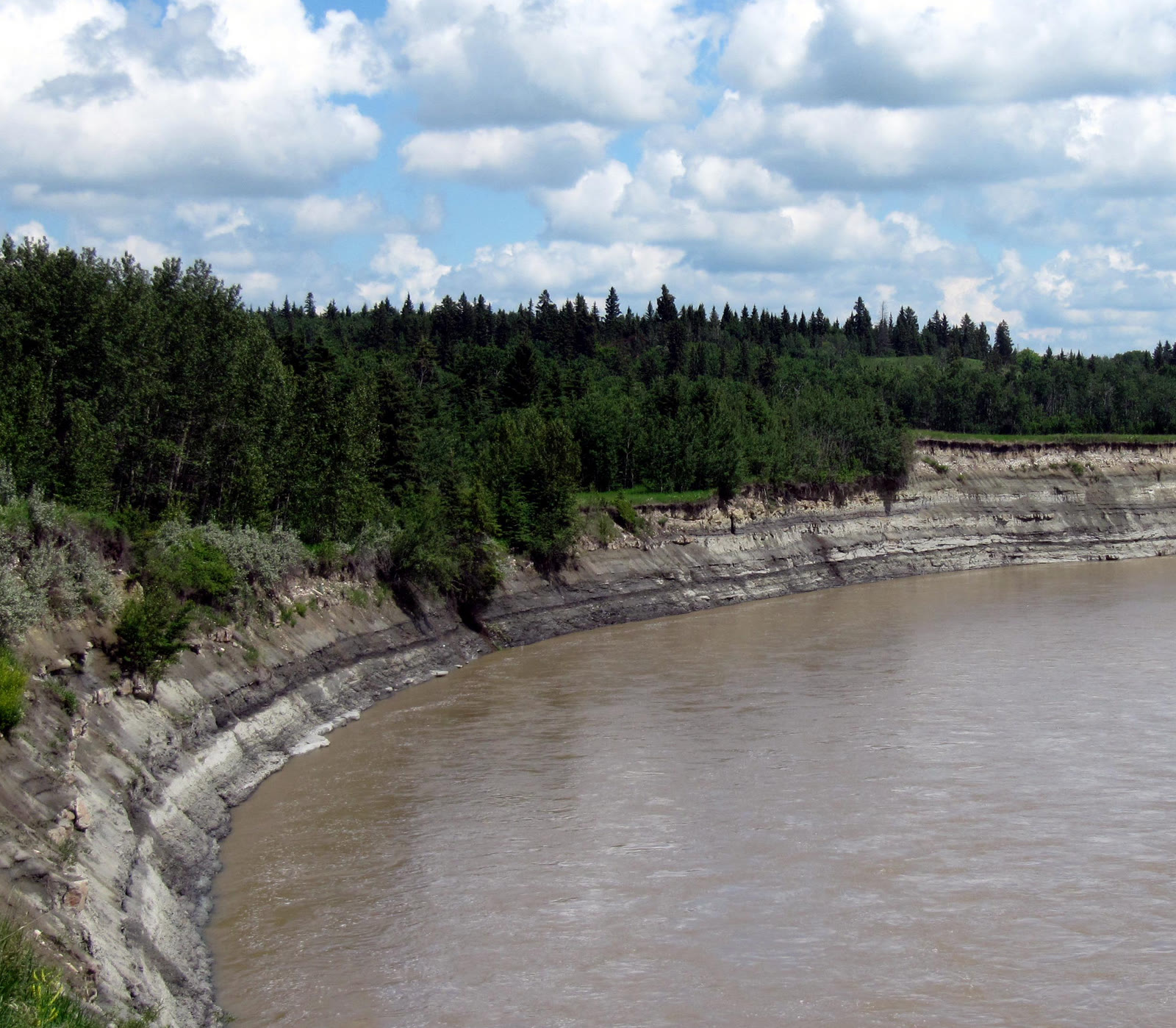
The mudstone photograph above is part of that argument. It shows the Paskapoo Formation along the Red Deer River just downstream from the Blindman River confluence, beside the documented Blackfalds Insect and Plant Site.[5][6][7] This is not a generic badlands backdrop. The quiet-looking layers are the physical filter that selected which pieces of Paleocene insect life could reach a museum drawer.
The viewing
A collection is an event in scientific history
The first thing to notice is that “the Paskapoo insects” are not a transparent census waiting in the rock. Collectors began assembling the central Alberta material intensively in the late twentieth century. The video describes more than 600 specimens accumulated during the 1980s; a March 2026 research abstract reports that approximately 700 compression fossils are now housed at the University of Alberta.[1][3] The change is a useful reminder that a fossil assemblage grows on two clocks. One belongs to deposition in deep time. The other belongs to collecting, preparation, identification, and curation now.
That second clock affects the questions the collection can answer. A collector may favor a slab with a legible wing over a fragment with no obvious outline. A locality may expose fresh surfaces one summer and slump beneath the riverbank the next. Older material may sit undescribed until a specialist, a new imaging method, or a comparison specimen makes it readable. The approximately 700 objects are therefore evidence of a rich deposit and sustained human attention—not 700 evenly sampled insects from a single Paleocene afternoon.[3]
The assemblage is especially rich in freshwater-associated insects. That makes ecological sense for low-energy river margins, ponds, oxbow lakes, and backswamps reconstructed for the formation.[4][5] It is also a preservation signal. An aquatic larva or an adult that falls onto quiet water has a route into fine sediment; an insect living far from the water may not. The rock records a habitat through a biased intake, not through an impartial camera.
One wing can expand a range—and shrink a species list
The lecture becomes most instructive when isolated wings stop looking like scraps. Dragonfly and damselfly venation is anatomically dense: forks, crossveins, cells, and the relation of one vein to another can preserve taxonomic information even when the head, thorax, legs, and abdomen are gone. That is why a wing can establish that a lineage reached a place where it was previously unknown.
It can also encourage overconfidence. A 2023 reanalysis of Paskapoo odonatans found that characters once used to separate three species of Alloaeschna fell within the kind of variation seen inside modern dragonfly species. The authors reduced A. marklae and A. quadrata to junior synonyms of A. paskapooensis.[4] More specimens did not simply add diversity. Comparison taught researchers that the earlier diversity count was too finely split.
The same study described Albertalestes paskapooensis from a well-preserved wing, the first fossil member of the damselfly family Synlestidae reported from North America.[4] That claim is geographically large but numerically narrow. The specimen demonstrates presence. It does not demonstrate that synlestids were common, that the whole animal matched every feature of its living relatives, or that its lineage originated in Alberta. A single wing closes one distributional gap while leaving abundance, ecology, and dispersal route open.
This is the right way to read a fossil “first.” It marks the earliest or first-known observation under current sampling. It is not automatically the biological beginning of the lineage.
The ant fills a gap in the record, not twenty-three million years of history
The Paskapoo ant makes the same boundary even sharper. Napakimyrma paskapooensis is known from one laterally compressed worker collected at Blackfalds. When described in 2018, it supplied definitive ant evidence inside a roughly 23-million-year interval between about 78-million-year-old Canadian amber and the approximately 55-million-year-old Fur Formation record in Denmark.[5]
“Filling a gap” is accurate if the gap means a blank interval in observed fossils. It becomes misleading if it suggests one specimen continuously documents what ants did throughout that interval. The fossil's long petiolar stalk supported placement near the relict ant subfamily Aneuretinae, yet the paper also stressed that fossil members assigned to that subfamily vary and that some placements remain uncertain.[5] The specimen is valuable partly because it resists a neat bridge from Cretaceous stem ants to later Cenozoic dominance.
It also exposes the difference between taxonomic presence and ecological importance. One worker shows that an ant lineage was there. It cannot establish colony density, community share, or whether ants had already assumed the ecosystem roles they would occupy later in the Cenozoic. The surrounding aquatic insects and plant evidence support a forested backswamp interpretation for Blackfalds, but the ant's route into that water-laid deposit is part of the taphonomic story, not proof that the sample proportion mirrors the living forest.[5]
“Recovery” needs a metric and a comparison
The phrase “life after the dinosaurs” is vivid because it supplies an instant before-and-after picture: catastrophe, emptiness, return. The Paskapoo fossils establish the “after” magnificently. They show dragonflies, damselflies, an ant, and many other insects inhabiting warm-temperate, freshwater-linked landscapes in the Paleocene.[3][4][5] What they do not supply on their own is a matched “before.”
To measure recovery, a researcher must first say what recovered. Is the metric species richness, phylogenetic diversity, abundance, body-size distribution, food-web function, or similarity to a pre-extinction community? The samples on either side must also be comparable in age resolution, depositional setting, collecting intensity, and preservation. A Cretaceous amber fauna and a Paleocene mudstone compression fauna preserve different organisms in different ways. Their raw species totals cannot be treated as two readings from the same instrument.
That does not make “recovery” forbidden. It makes it a hypothesis with dependencies. Paskapoo can test which lineages were present several million years after the K–Pg boundary, how far their known ranges extended, and what habitats the deposit favored. Broader claims about ecological rebound require other localities, other preservation windows, and explicitly chosen measures. The most honest version of the metaphor is not “nature returned to normal.” It is “a new, partially sampled community became visible.”
Lighting can change what the same fossil says
The collection's current work adds one final layer to the video. The 2026 Alberta Palaeontological Society abstract describes Reflectance Transformation Imaging, or RTI, being applied to the Paskapoo material. Instead of photographing a compression fossil under one uniform light, researchers record it under many light angles and build an interactive surface view. Subtle relief and wing venation that flatten under overhead lighting can become easier to assess.[3]
RTI does not add anatomy that the rock never preserved. It changes the visibility of surviving topography. That boundary matters because it explains how an old collection can yield new evidence without a new excavation. It also explains why taxonomic counts remain revisable: the specimen, illumination, comparison set, and species concept all participate in what researchers can defend.
The best way to finish the lecture is therefore to keep its scales separate but connected. A wing may revise a species or a continent-scale distribution. Hundreds of specimens may characterize a freshwater-biased assemblage. A formation may illuminate an undersampled epoch. None of those observations alone measures an entire biosphere's recovery. Paskapoo is powerful precisely because the chain is visible—from river mud, to compressed cuticle, to collector, to museum drawer, to changing light.
Sources
- Royal Tyrrell Museum of Palaeontology, “Insect Fossils from Central Alberta, and the Story of ‘Life After the Dinosaurs,’” John Acorn, YouTube lecture, presented March 26, 2026.
- Royal Tyrrell Museum of Palaeontology, “Speaker Series,” official 2026 schedule and institutional context for the recorded lecture.
- Kano Sasaguchi, John Acorn, and Felix Sperling, “Alberta's Paleocene Insects: New Insights from a Fossil Legacy,” in the Alberta Palaeontological Society's Paleo 2026 Abstracts, pp. 20–21.
- Corentin Jouault et al., “New odonatans (Odonata: Gomphaeschnidae; Synlestidae) from the Paleocene Paskapoo Formation: systematic and biogeographical implications,” Journal of Systematic Palaeontology 21 (2023), open author-hosted copy.
- John S. LaPolla and Phillip Barden, “A new aneuretine ant from the Paleocene Paskapoo Formation of Canada,” Acta Palaeontologica Polonica 63 (2018).
- Geological Survey of Canada, “Paskapoo Formation,” reviewed entry in the Lexicon of Canadian Geologic Units.
- Georgialh, “Paskapoo Mudstones Red Deer,” 2013 field photograph, Wikimedia Commons, CC BY-SA 3.0.