If Effigia okeeffeae were judged from silhouette alone, the obvious label would be “ostrich dinosaur.” It stood on long hind limbs, carried a long neck and tail, shortened its forelimbs, enlarged its eyes, and replaced teeth with a beak. Yet Effigia lived in the Late Triassic, long before the classic ornithomimid dinosaurs evolved, and it belongs on the crocodile side of the archosaur family tree.[1][2]
That surprise is only the beginning of a useful species profile. Calling Effigia a crocodile relative fixes its evolutionary address, but it does not explain the animal's body or habits. Calling it an ostrich mimic captures the shape, but it risks importing the wrong feeding behavior. The strongest portrait keeps three things separate: what the fossil preserves, where comparative anatomy places it, and what later mechanical tests permit us to infer.[1][2][3]
The animal waited in a jacket longer than it waited in public view
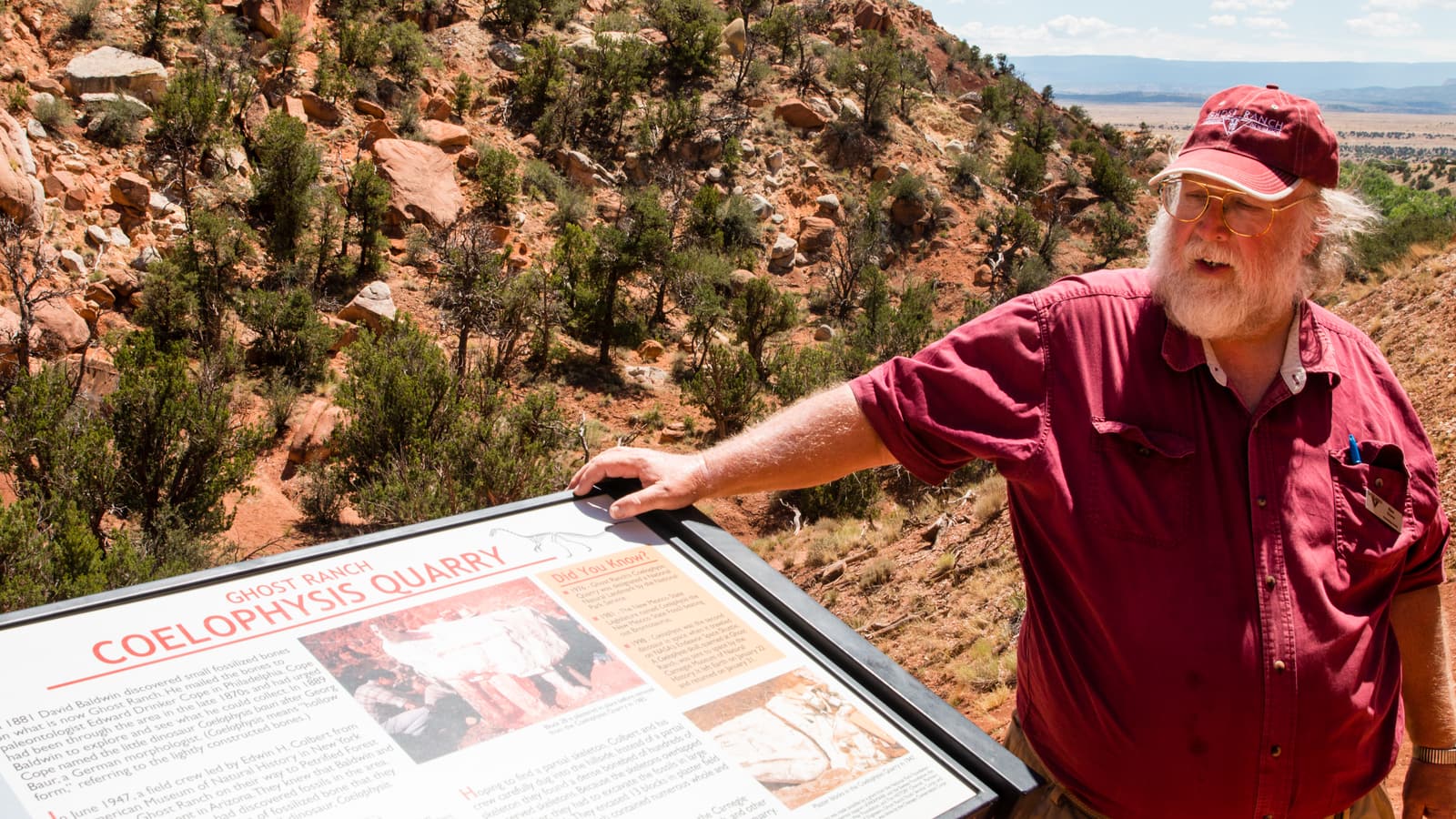
The holotype, AMNH FR 30587, came from Upper Triassic rocks of the Chinle Formation at Ghost Ranch in northern New Mexico. Edwin Colbert's American Museum of Natural History team collected large blocks from the Coelophysis Quarry—also called Whitaker Quarry—in 1947. The quarry was famous for dense concentrations of the early dinosaur Coelophysis, so jacketed blocks could be catalogued and stored long before every bone inside them was fully prepared.[2][4]
Sterling Nesbitt recognized the different animal while working through that historic material in 2004. Nesbitt and Mark Norell named Effigia okeeffeae in 2006; the genus evokes a “ghost,” both for Ghost Ranch and for a fossil that had remained hidden in a museum collection, while the species honors Georgia O'Keeffe, whose life and art were closely tied to the landscape.[1][4]
This is not merely a charming discovery anecdote. It explains the evidentiary shape of the animal. The holotype includes a nearly complete skull and much of the skeleton, while additional specimens fill some gaps; even so, the distal tail, exact vertebral count, and some proportions remain uncertain in the published whole-body reconstruction.[2] Effigia was discovered twice: once when rock entered a field jacket, and again when preparation turned stored material into readable anatomy.
Image context: the cover is a real National Park Service photograph of the Ghost Ranch National Natural Landmark and Coelophysis Quarry. It belongs here because the collection history is part of the species. The image shows the source landscape, not the precise position of the holotype and not a reconstructed animal.[6]
The silhouette really is extraordinary
The resemblance to later ostrich dinosaurs is not a popular-media invention. The original description identified convergence across multiple regions of the skeleton, not just a vaguely birdlike stance. Effigia had toothless upper and lower jaws, very large orbits, a long neck, a lightly built bipedal frame, forelimbs reduced relative to the hind limbs, and an elongated tail. Later functional work used a body estimate of roughly two meters long and one meter high, giving the animal a compact but unmistakably long-legged profile.[1][2][3]
The beak requires one important qualifier. Bone shows that the premaxilla, maxilla, and dentary lacked teeth. A keratinous covering, or rhamphotheca, is a reasonable inference from those toothless margins, but its exact outline and thickness are not preserved. The familiar finished beak in a reconstruction is therefore a modeled soft-tissue boundary, not a fossilized surface.[2][3]
The same discipline applies to posture. Limb proportions and joints support habitual bipedality, but no skeleton is a frame of live footage. Speed, gait range, resting pose, and neck carriage remain functional questions. A species profile can call Effigia bipedal without quietly converting it into a Triassic ostrich.
The family tree is not decided by outward resemblance
Archosaurs contain two great living branches: the bird line and the crocodile line. Effigia is a pseudosuchian—a member of the crocodile-line branch—and, more specifically, a shuvosaurid. That does not make it a direct ancestor of modern crocodiles, nor does it imply a flat skull, sprawling walk, or semiaquatic life. “Crocodile-line” is a statement about relationship, not a lifestyle template.[1][2]
Its placement rests on a suite of anatomical characters and a phylogenetic comparison, including details of the skull, pelvis, ankle, and other parts of the skeleton. The original analysis found that forcing Effigia next to ornithomimids made the evolutionary tree substantially less economical, despite their spectacular visual overlap.[1] In other words, the same broad body solution was assembled on opposite sides of the archosaur split.
The closest comparative material also keeps the profile provisional in the right places. A 2024 redescription of Shuvosaurus inexpectatus, a close relative from Texas, notes that several elements missing in Effigia are better preserved in Shuvosaurus. The comparison sharpens shuvosaurid anatomy, but it does not license every feature of one genus to be copied into the other. Related animals can repair a question; they cannot silently replace the specimen.[5]
The skull breaks the easy ostrich analogy
For years, the “ostrich-like” frame encouraged an ecological shortcut: perhaps Effigia used its toothless mouth in roughly the same way as an ostrich or an ornithomimid. A CT-based study published in 2022 tested that assumption rather than repeating it. Researchers digitally separated and repositioned the crushed holotype skull, reconstructed jaw muscles, added alternative plausible beak extents, and compared finite-element models of Effigia, Ornithomimus, an ostrich, and an alligator under several bite and pecking loads.[3]
The result was not one universal ostrich machine. Effigia combined relatively strong and weak regions in a distinctive way. Its mandible and nasal bridge were mechanically vulnerable, habitual feeding was most plausible toward the front of the jaws, and hard-object crushing was a poor fit. The authors favored selective herbivory in which the beak cropped soft plants or softer new growth. Pecking may have been possible, but the model did not support treating the living ostrich's feeding repertoire as a ready-made behavioral script.[3]
That conclusion is strong precisely because it stays narrow. Finite-element analysis tests how reconstructed structures respond under specified loads; it does not preserve a menu. No gut content ties Effigia to one plant, the keratinous beak outline remains unknown, and neck musculature limits how confidently any particular cropping motion can be restored. “Soft-plant specialist” is the best current mechanical inference, not an eyewitness account.[3]
Convergence is the question, not the answer
Effigia matters because it exposes two kinds of lazy thinking at once. A dinosaur-shaped animal need not be a dinosaur. More subtly, two lineages can converge on a strikingly similar frame without converging on every function inside it. Long legs, a long neck, enlarged eyes, reduced arms, and toothless jaws may define a recurring archosaur solution, while jaw construction and feeding mechanics still divide the occupants of that shape.[1][3]
The animal also restores variety to the crocodile-line Triassic. Pseudosuchians were not simply rehearsing the low, armored predator body of living crocodilians. They included lineages experimenting with sails, armor, quadrupedal predation, and—in shuvosaurids—light bipedal herbivory. Effigia is memorable because it looks misplaced. It is scientifically valuable because careful anatomy shows that the “misplacement” is our expectation, not the fossil's.[1][2][5]
The cleanest final profile is therefore not “crocodile ostrich.” It is a Late Triassic shuvosaurid from Ghost Ranch, preserved well enough to demonstrate extreme skeletal convergence and incompletely enough to keep reconstruction honest: a toothless biped whose shape anticipated later dinosaurs, while its skull retained a feeding system of its own.
Sources
- Sterling J. Nesbitt and Mark A. Norell, “Extreme convergence in the body plans of an early suchian (Archosauria) and ornithomimid dinosaurs (Theropoda),” Proceedings of the Royal Society B 273 (2006)—the naming paper and original phylogenetic case for convergence.
- Sterling J. Nesbitt, The Anatomy of Effigia okeeffeae (Archosauria, Suchia), Theropod-Like Convergence, and the Distribution of Related Taxa, Bulletin of the American Museum of Natural History 302 (2007)—the full osteological description, specimen inventory, locality, and reconstruction boundaries.
- Jordan Bestwick et al., “Cranial functional morphology of the pseudosuchian Effigia and implications for its ecological role in the Triassic,” The Anatomical Record 305 (2022)—CT reconstruction, finite-element comparisons, and the bounded soft-plant feeding inference.
- American Museum of Natural History, “Fossils of Ghost Ranch: Ancient Treasures” (2015)—museum account of the Ghost Ranch assemblage, Effigia, and Sterling Nesbitt's collection-based discovery.
- Sterling J. Nesbitt and Sankar Chatterjee, “The osteology of Shuvosaurus inexpectatus, a shuvosaurid pseudosuchian from the Upper Triassic Post Quarry, Dockum Group of Texas, USA,” The Anatomical Record 307 (2024)—updated comparative anatomy and explicit limits created by elements missing in Effigia.
- National Park Service, “Ghost Ranch NNL (Coelophysis Quarry)”—source page for M. Reed's photographic view of the fossil locality used as the article image.