Paraceratherium usually enters the room as a number. Largest land mammal. Taller than a giraffe. Heavy enough to make every modern rhinoceros look like a downscaled experiment. Those headlines are useful because the animal really was enormous, but they are also the easiest way to lose the fossil. The exact mass is one of the least stable parts of the story, because giant-rhino remains are uneven and many classic estimates were inflated by reconstructions built from incomplete material.[1][2]
The stronger profile starts elsewhere. Paraceratherium matters because several anatomical systems line up on one feeding solution. The skull is long, hornless, and lightened relative to the body; the front teeth are reduced to a single enlarged pair of incisors in each jaw; the nasal region suggests a prehensile upper lip or short trunk; and the neck and limbs stretch that head into a high-browsing envelope rather than a low, bulldozing rhino profile.[2][3][4] Height is the consequence. Browsing mechanics are the reason.
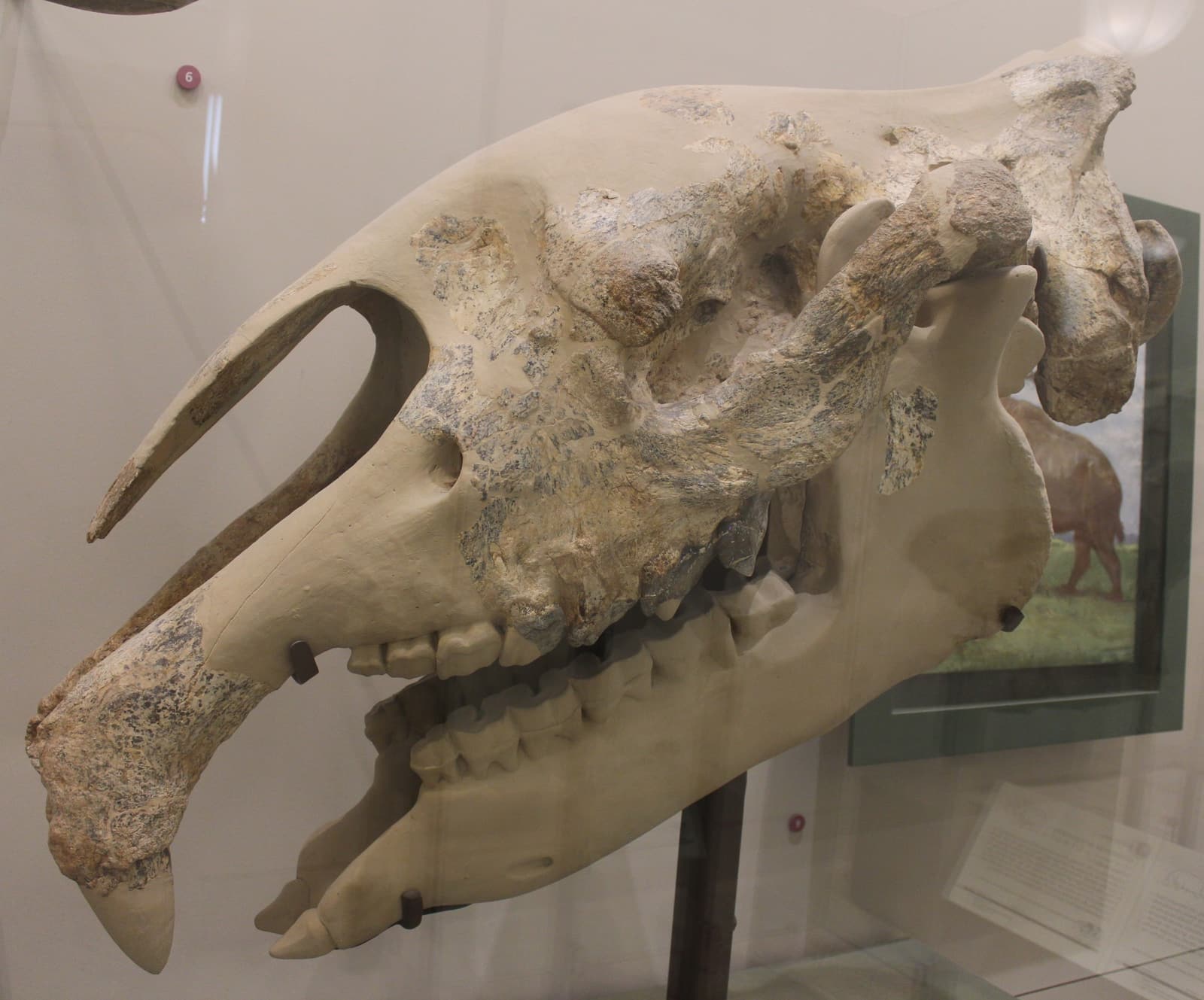
Image context: the lead image uses a real photograph of an AMNH Paraceratherium skull from Wikimedia Commons. It belongs here because the article's main claim begins with visible structure. The deep nasal notch, long toothless gap behind the incisors, and hornless face make clear that this animal's giant body was organized around reach, not around horn combat or a modern white-rhino style of bulk grazing.[5]
The size headline is real, but it is the least stable part of the profile
The classic legend made Paraceratherium almost too gigantic to think about clearly. Fortelius and Kappelman argued in 1993 that the best-supported mean mass estimate for the biggest indricotheres sat around 11 tonnes, with a probable upper limit somewhere between 15 and 20 tonnes, not the casual 20-30 tonne figures that circulated in older popular accounts.[1] That correction still matters because it changes the reading discipline. When a fossil animal becomes famous for maximum scale, every bone gets pushed toward the biggest imaginable answer.
Later work did not erase the giant. It refined the engineering. Li, Jiangzuo, and Deng's 2022 body-mass study on giant rhinos emphasized that the limb allometric trend of paraceratheres differs from that of other rhinocerotoids and that their bones were, in some respects, more slender than those of living rhinos.[2] The point is not that the animal was suddenly delicate. The point is that giant size in Paraceratherium was not achieved by simply turning a modern rhino into a thicker version of itself.
That is why this taxon stays interesting. Large terrestrial mammals can solve mass in different ways. Elephants concentrate on a short-necked, trunk-led architecture with columnar limbs. Paraceratherium kept the rhino relationship but built a different silhouette: a smaller head relative to body size, long forelimbs, long cervical reach, and a browsing package that gains height by stretching the front end as much as by thickening the frame.[2][4]
The head is where the browsing story starts
The 2021 Communications Biology paper on Paraceratherium linxiaense gives the cleanest recent view of why the skull matters so much.[3] The new material from the Linxia Basin preserved a complete skull and mandible with an associated atlas, which is exactly the sort of linked anatomy giant rhinos rarely offer. The authors describe a giant hornless rhinocerotoid with long premaxillae, a downward-turning incisor, and a very deep nasal notch above the middle of M2.[3]
That deep notch is more than a descriptive flourish. Deng and colleagues interpret it as evidence for a short prehensile nose trunk.[3] Even if one prefers the more cautious phrase "prehensile upper lip or short trunk," the functional direction is clear. This was not a low-headed grazer whose face terminated in a blunt cropping edge. It was a browser that needed the front of the head to reach, strip, and gather foliage at height.[3][4]
The incisors matter for the same reason. Britannica's overview keeps the older big-picture point intact: Paraceratherium had a skull more than 1.2 meters long, relatively long front legs, and a long neck that made tree browsing plausible.[4] The enlarged incisors in the recent Chinese material sharpen that public picture into anatomy. A giant browser does not need catlike slicing teeth or a rhino horn to explain its success. It needs a front end that can select and pull plant matter efficiently while the rest of the skull remains manageable enough to lift repeatedly.[3][4]
Neck and limbs stretched the browsing envelope
The new Linxia fossils also help because they tie the skull to the neck instead of leaving the head to float as a museum icon. Deng and colleagues describe P. linxiaense as having slender skull and cervical vertebrae, and they argue that the atlas and axis reflect a long, more flexible neck within the genus.[3] This is a more useful claim than any poster slogan about "biggest." It tells us what the extra height was for.
The 2022 body-mass paper lands the same point from the limb side. Li and coauthors argue that in giant rhinos the proximal limb bones elongated faster than the distal ones, especially in the hindlimb, and that these trends reflect adaptation to great body mass while retaining a distinctive long-limbed profile.[2] In plain terms, Paraceratherium supported size without collapsing into the short-limbed, compact look many readers instinctively expect from a giant rhino.
That difference is the real visual achievement of the animal. A modern rhinoceros carries most of its drama low to the ground. Paraceratherium lifted the drama upward. Neck length, front-leg height, and head geometry all cooperate. Once those pieces are read together, the animal stops looking like "a rhino scaled up until it broke the meter." It starts looking like a specialized high browser built on a rhinocerotoid base.[2][3][4]
Oligocene Asia gave that body plan room to work
The environment in the 2021 paper matters because it shows that the animal's shape was not an abstract possibility.[3] Deng and colleagues place the Linxia fossils at 26.5 million years ago and describe a late Oligocene fauna consistent with open woodland in northwestern China.[3] Their paleogeographic discussion also argues that giant rhinos dispersed across Central and South Asia through a Tibetan region that likely still included low-elevation passages rather than the fully elevated barrier familiar today.[3]
That context strengthens the browsing interpretation. Open woodland is exactly the sort of landscape where height and selective reach matter. A tall browser can work across tree and shrub layers that are awkward for a lower-bodied ungulate, while still moving through more open country than a dense-forest specialist would prefer.[3] The article does not need Paraceratherium to become a giraffe analog or an elephant analog. Its own anatomy already provides the better answer: a giant Asian rhinocerotoid using elevation, lip control, and long-limbed support to exploit foliage above the normal rhino zone.[2][3][4]
What should stay fixed in memory
The safest conclusion is narrower than the legend and stronger than it. The exact top-end mass of Paraceratherium remains model-sensitive because the skeleton is incomplete and the scaling history is messy.[1][2] The exact shape of the soft tissue on the nose also remains an inference rather than a preserved fact.[3] Those boundaries matter.
What does not need much softening is the basic profile. Paraceratherium was a hornless giant rhinocerotoid from Oligocene Asia whose skull, incisors, nasal region, neck, and limbs all point toward a high-browsing lifestyle.[2][3][4] If the public wants one memory hook, it should be this: the animal was not important only because it got huge. It was important because it turned height into a feeding strategy.
Sources
- Mikael Fortelius and John Kappelman, "The largest land mammal ever imagined," Zoological Journal of the Linnean Society 108, no. 1 (1993) - classic reassessment of indricothere mass estimates and the inflation problem in older reconstructions.
- Shuai Li, Qigao Jiangzuo, and Tao Deng, "Body mass of the giant rhinos (Paraceratheriinae, Mammalia) and its tendency in evolution," Historical Biology 37, no. 11 (2022) - limb allometry, body-mass estimation, and the distinctive long-bone trend of giant rhinos.
- Tao Deng, Xiaoqiang Lu, Shiqi Wang, Lawrence J. Flynn, Donglin Sun, Wen He, and Shaokun Chen, "An Oligocene giant rhino provides insights into Paraceratherium evolution," Communications Biology 4 (2021) - complete skull, mandible, and atlas of P. linxiaense, plus neck, nasal, environment, and dispersal implications.
- Encyclopaedia Britannica, "Indricotherium" - concise overview of the giant hornless rhino's age, proportions, and browsing interpretation.
- Wikimedia Commons, "File:Paraceratherium AMNH.jpg" - museum photograph of the AMNH skull used as the lead image.