Palaeospondylus is the kind of fossil that punishes confidence. The Scottish species, Palaeospondylus gunni, is represented by many specimens from the Middle Devonian Achanarras quarry in Caithness, yet more than a century of study has not turned abundance into easy classification.[1][4] The animal was small, eel-like, and visually slight. Under magnification it becomes more consequential: a vertebral column, a skull region, a mineralized internal skeleton, and a set of features that have pulled researchers toward jawless vertebrates, jawed vertebrates, lungfish, chondrichthyans, tetrapods, and stem positions at different times.[1][3][4]
That is why the useful story is not "mystery solved." It is a method story. Palaeospondylus matters because the fossil record gives paleontologists thousands of flattened Scottish bodies, then one younger generation of CT interpretations, and now an older Australian species with a three-dimensionally preserved braincase.[1][2][4] Each layer changes what kind of claim can be made. The animal is therefore best read as a braincase argument: a test of how much early vertebrate history can be reconstructed when the skull is tiny, cartilage-based, distorted, and repeatedly reinterpreted.
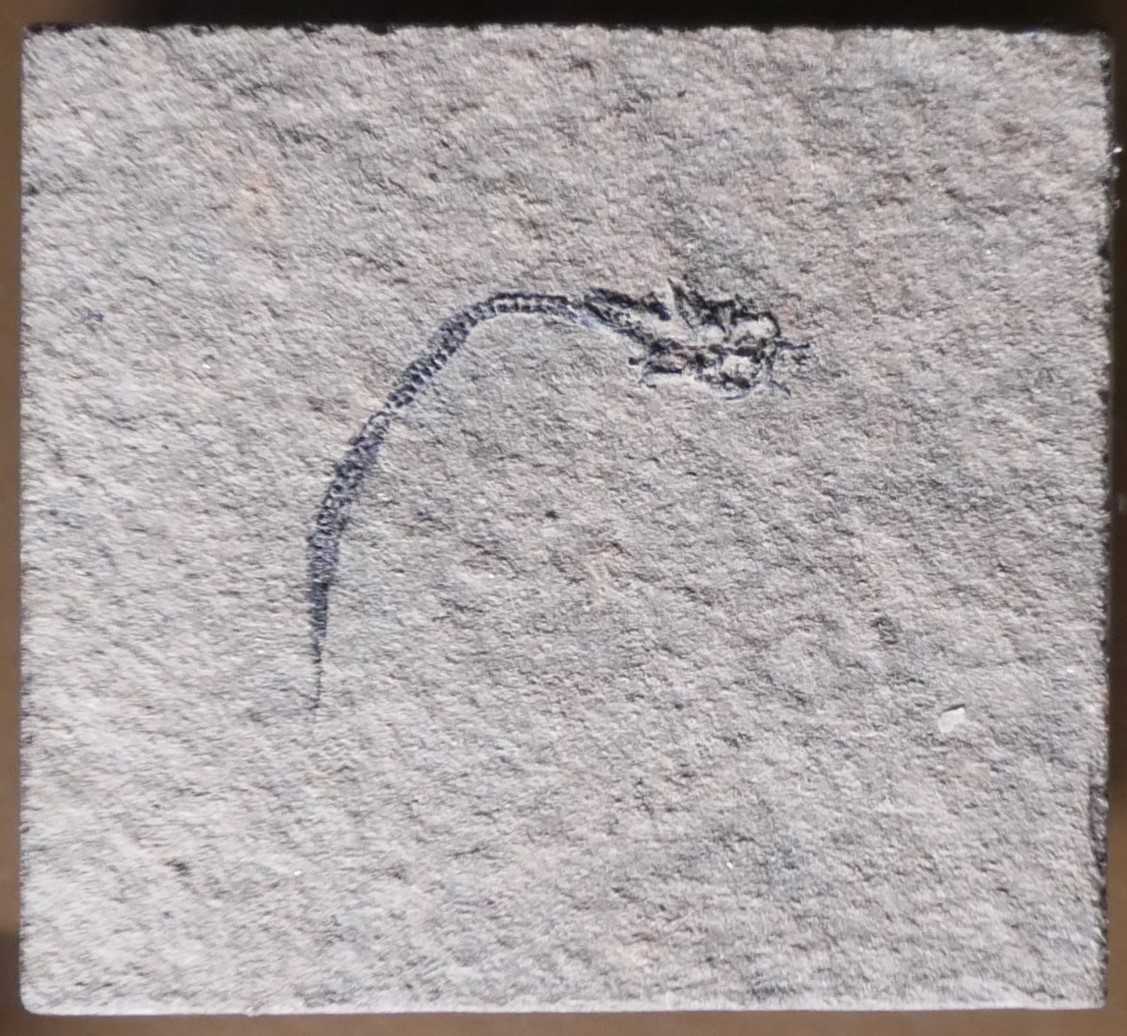
The first constraint is preservation. The new National Science Review description is blunt about the Scottish material: nearly all known P. gunni specimens came from one locality, and they are strongly compressed, with skeletal elements effectively welded together by preservation.[1] That helps explain why the taxon has been so unstable. A fossil can be abundant and still be anatomically evasive if the key surfaces overlap, crush, or merge. In Palaeospondylus, the very feature that makes the material collectible, many small articulated bodies on slabs, also makes the skull hard to parse.
The ANU account of the 2025 work gives the public version of the same problem. The Scottish fossils were described as having made skeletal elements "melt" together, so interpretation has always required more imagination than paleontologists would like.[4] That phrase is useful because it names the danger. When anatomy is compacted into a small dark mark, the temptation is to turn uncertainty into a clean reconstruction. A disciplined reading does the opposite. It asks which structures are visible, which have been inferred from crushed relationships, and which may be artifacts of looking at a three-dimensional skull through a flattened fossil.
This is where the 2022 Nature paper became important. Hirasawa and colleagues used synchrotron radiation X-ray micro-computed tomography on carefully selected Scottish specimens and argued that Palaeospondylus was a sarcopterygian, probably close to stem tetrapods.[2] The appeal of that conclusion is obvious. If correct, this small, toothless, scale-less animal from roughly 390 million years ago would sit near one of vertebrate evolution's most famous transitions: the movement from fish-bodied relatives toward limbed land vertebrates.[2][5]
The 2022 study also showed why the fossil could not be dismissed as a vague smudge. The RIKEN summary emphasizes that high-resolution scans revealed inner-ear features of jawed vertebrates and cranial characters used to place the animal among tetrapodomorphs.[5] It also notes the interpretive tension: unlike many tetrapodomorphs, Palaeospondylus has not yielded associated teeth, dermal bones, or paired appendages.[5] That mismatch is exactly what made the result interesting. A tetrapod-adjacent placement would not simply fill a gap. It would require an unusual explanation for why an animal close to that branch looked so stripped down.
But Palaeospondylus did not stay settled. Brownstein's 2023 Nature comment challenged the tetrapod reading and reframed the animal as a problem for early gnathostome evolution rather than as a secure pan-tetrapod.[3] The details of that dispute matter less than the methodological lesson: even high-resolution scans do not remove character interpretation. CT data can expose hidden anatomy, but researchers still have to decide what a process, fissure, canal, or apparent joint corresponds to in a comparative skull. Better images make the argument sharper. They do not make the argument automatic.
The 2025 Australian material changed the balance again because it changed the preservation regime. Burrow and colleagues described Palaeospondylus australis from Early Devonian rocks of central Australia, about 400 million years old, roughly 10 million years older than the Scottish species.[1] The specimen is not a beautiful complete animal. Its importance is narrower and better: a three-dimensionally preserved braincase and associated elements extracted from limestone, studied with high-resolution CT.[1][4]
That braincase matters because it removes some of the flattening problem. The paper reports primitive gnathostome features, including an anteriorly positioned transverse cranial fissure of uncertain homology, a large dorsal fontanelle, and a small hypophysial fossa.[1] Just as important, the authors argue that the new braincase lacks both a postorbital process and an intracranial joint, contrary to recent tetrapod-oriented interpretations of P. gunni.[1] In other words, the Australian fossil does not merely add a second species. It tests whether structures inferred from crushed Scottish material were really part of the neurocranium.
That is the center of the anatomy deep dive. The classification problem is not only about choosing a branch on a tree. It is about deciding where the skull parts begin and end. If an apparent joint is real and homologous with structures in tetrapodomorphs, one evolutionary story becomes plausible. If the supposed joint is a preservational or interpretive composite, that story weakens. If a fissure exists but its homology is uncertain, it can support a jawed-vertebrate reading without locking the fossil into a familiar modern group.[1][3]
The 2025 phylogenetic result keeps that caution in view. Burrow and colleagues' analysis places Palaeospondylus as sister to Chondrichthyes, while acknowledging that some neurocranial characters could instead indicate a position within the gnathostome stem group.[1] That is not a failure of the paper. It is the right kind of bounded conclusion for a fossil like this. The strongest current claim is not that Palaeospondylus has been finally domesticated into the shark line, the tetrapod line, or any other tidy bucket. The stronger claim is that the new braincase pulls it away from the recent tetrapod hypothesis and back into the harder problem of early jawed-vertebrate skull evolution.[1][3]
Per Ahlberg's accompanying essay catches the scientific mood well. He writes that the Australian material shows Palaeospondylus is clearly neither a hagfish nor a tetrapod ancestor, while also stressing that the character suite remains conflicting and may be complicated by larval or paedomorphic features.[3] That boundary is important. A fossil can rule out some ideas while still leaving more than one live placement. In fact, that may be the most honest outcome for an animal with unusual cartilage tissue, no obvious external dermal armor, and a skull plan that resists standard vertebrate construction.[1][3][4]
The broader lesson is that tiny fossils can be scientifically large without becoming icons. Palaeospondylus is not a charismatic predator, a display skeleton, or a simple missing link. Its value is procedural. It shows how early vertebrate classification depends on specimen selection, preparation, CT resolution, comparative character coding, and the humility to revise a headline when a better-preserved skull region appears.[1][2][3]
That also makes the image important. The photographed P. gunni slab from the Cincinnati Museum Center does not resolve the classification debate by itself.[6] It does something more basic. It reminds the reader that all these evolutionary claims begin with a small fossil that could be mistaken for a thread with a knot. The distance between that slab and a phylogenetic placement is the whole story: scanning, segmentation, argument, correction, and restraint.
The best 2026 reading is therefore deliberately narrow. Palaeospondylus is a Devonian jawed-vertebrate problem with Scottish abundance, Australian three-dimensional evidence, and no license for a single triumphant origin story.[1][3][4] The new braincase makes the fossil clearer, but not simple. That is why it remains useful. It keeps early vertebrate evolution from becoming a row of confident silhouettes and forces the argument back into the skull, where the evidence is small, damaged, and still worth reading carefully.
Sources
- Carole J. Burrow, Gavin C. Young, John A. Long, Tim J. Senden, Jan L. den Blaauwen, Jie Yang, and Jing Lu, "A 3D braincase of the early jawed vertebrate Palaeospondylus from Australia," National Science Review 12, no. 5 (2025), via PubMed Central.
- Tatsuya Hirasawa, Yuzhi Hu, Kentaro Uesugi, Masato Hoshino, Makoto Manabe, and Shigeru Kuratani, "Morphology of Palaeospondylus shows affinity to tetrapod ancestors," Nature 606 (2022).
- Per E. Ahlberg, "Re-examining the strangest early vertebrate," National Science Review 12, no. 5 (2025), via PubMed Central.
- Australian National University College of Science and Medicine, "A 380-million-year-old fossil 'fish' from Scotland has been discovered in Australia" (2025).
- RIKEN, "Palaeospondylus: long-standing mystery of vertebrate evolution solved using powerful X-rays" (2022).
- Wikimedia Commons, "File:Palaeospondylus CMC.jpg" - source page for the real fossil photograph used as the lead image.