Hadrocodium wui is a small fossil with an unfair amount of work placed on it. The skull is only about 12 millimeters long, small enough to be held between two fingers, and the whole animal has often been estimated at roughly two grams.[1][3][6] That scale makes the first temptation obvious: turn it into a miniature ancestor, a tiny mascot for the origin of mammals. The better reading is stricter. Hadrocodium matters because one Early Jurassic skull keeps several mammalian characters close together while also showing how dangerous it is to let one tiny specimen carry a finished origin story.[1][2][3]
The fossil came from the Lower Lufeng Formation of Yunnan, China, and was discovered in 1985 before its importance became clear through preparation and study.[1][4] In the 2001 description, Luo, Crompton, and Sun treated it as a new mammaliaform near the living-mammal side of the broader mammal-line tree.[1] The phrase "near" is doing important work. Hadrocodium is not useful because it gives a direct ancestor portrait. It is useful because it sits close enough to the mammalian threshold to show how skull size, jaw architecture, teeth, brain space, and ear-region anatomy were changing in a body much smaller than the public usually imagines for major evolutionary transitions.[1][2][4]
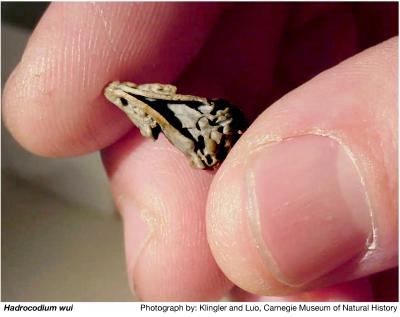
The first close-reading lesson is that smallness was not a side note. The 2018 Nature study on miniaturization and the mammalian jaw-middle-ear transition gives Hadrocodium a larger mechanical setting.[4] Mammal-line evolution did not simply add a modern jaw joint and detach the old jaw bones into a middle ear by one clean leap. As bodies became smaller, jaw loads, chewing mechanics, and the postdentary bones faced a different physical regime.[4] Miniaturization could reduce the mechanical burden on the old jaw-joint system, opening conditions in which a new dentary-squamosal jaw joint and a more independent auditory system could become viable.[4]
That framing improves Hadrocodium because it keeps the skull from becoming a miracle. A 12-millimeter cranium is not just a cute version of a larger mammal. At that size, the relationship between chewing force, jaw stability, sensory tissue, and ear bones changes. The animal's importance is therefore not only that it was tiny. It is that tiny size may have helped make certain mammalian arrangements mechanically available.[1][4] The fossil turns scale into a causal question.
The jaw and ear are where the story has become more disciplined over time. The original 2001 description emphasized advanced mammaliaform traits, including a middle-ear region that seemed to approach the fully mammalian condition.[1] NASA's contemporary summary captured that public implication clearly: the skull suggested mammal features evolved step by step and that Hadrocodium represented a very late stage in the separation of middle-ear bones from the mandible.[1][7] That was a powerful reading because the mammalian middle ear is one of the great transformation stories in vertebrate anatomy: bones once tied to the jaw become tiny hearing bones.
But a close reading has to include the later correction. Luo, Bhullar, Crompton, Neander, and Rowe's 2022 reexamination of the mandible and dentition used CT visualization to revisit features that earlier optical study could not fully resolve.[2] Their paper argued for a more primitive mandibular middle-ear condition than the clean fully detached story implied.[2] In plain terms, Hadrocodium did not simply hand paleontologists the finished mammalian ear. It preserved a more awkward and more useful condition: a skull close to the threshold, with jaw and ear anatomy still requiring careful distinction between what is present, what is inferred, and what later mammals complete.[2][4]
That makes the fossil stronger, not weaker. A transitional fossil is often more informative when it resists the smooth diagram. If Hadrocodium had supplied an uncomplicated "before-and-after" answer, it would be easier to celebrate and easier to overuse. The revised reading makes it a better specimen-level problem. It shows that the mammalian jaw-ear package was assembled through stages that can look deceptively finished from the outside and become more complex once CT data enter the argument.[2][4]
The braincase adds a second evidence layer. Rowe, Macrini, and Luo's 2011 Science paper used CT scanning of early mammaliaform skulls, including Hadrocodium, to reconstruct internal cranial spaces without destroying rare fossils.[3] The study argued that mammalian brain expansion began early and was tied especially to olfaction, tactile sensitivity, and sensorimotor integration.[3][5] The public shorthand is "big brains for better smell," but the method matters just as much as the result. A tiny skull that once could only be studied from the outside became an internal archive once CT made the braincase digitally readable.[3][5]
This is why Hadrocodium should be read as a technology story as well as an anatomy story. Preparation first made the specimen visible. CT then made hidden spaces testable. Later CT-based redescription changed the jaw and ear interpretation again.[2][3] The fossil did not stop changing because the animal changed. It changed because the evidence surface expanded. Paleontology here is not a single discovery moment; it is a sequence of access methods applied to a very small object.
There is also an ecological boundary. A 2025 cranial-anatomy study asked whether Hadrocodium's skull supports a fossorial, or digging, lifestyle by comparing it with living moles and shrews and with other mammaliaforms.[5] The cautious value of that paper is not that it turns Hadrocodium into a finished miniature mole. It is that it treats ecology as a test from preserved cranial form, not as a free reconstruction. The species is known only from cranium and mandible, so any lifestyle claim has to pass through that narrow gate.[2][5] The current picture can allow soft-invertebrate feeding or some burrowing-adjacent comparisons without pretending the whole body is known.[5]
That restraint is essential because Hadrocodium is visually vulnerable to overinterpretation. The skull is so small that it invites intimacy; the evolutionary position is so interesting that it invites ancestry language; the mammalian traits are so recognizable that they invite a modern animal to be drawn around them. The fossil itself asks for less certainty and more precision. It gives a skull, teeth, mandible, braincase space, and ear-region evidence. It does not give a complete skeleton, fur, gait, burrow, litter, or daily behavior.[1][2][5]
The best conclusion is therefore a bounded one. Hadrocodium wui was an Early Jurassic mammaliaform from China whose tiny skull helped show that several mammal-like features were assembled before crown mammals became ecologically dominant.[1][3][4] It also shows why "assembled" is the better word than "arrived." Brain expansion, olfactory emphasis, jaw-joint mechanics, dental form, and middle-ear separation did not all snap into place at the same tempo.[2][3][4] Some traits look advanced. Some need revision. Some are visible only through scanning. Some remain unavailable because the postcranial body is missing.
That is why the fossil still matters. Hadrocodium does not make the origin of mammals simple. It makes the threshold small enough to inspect.
Sources
- Zhe-Xi Luo, Alfred W. Crompton, and Ai-Lin Sun, "A new mammaliaform from the Early Jurassic and evolution of mammalian characteristics," Science 292 (2001), PubMed record.
- Zhe-Xi Luo, Bhart-Anjan S. Bhullar, Alfred W. Crompton, April I. Neander, and Timothy B. Rowe, "Reexamination of the mandibular and dental morphology of the Early Jurassic mammaliaform Hadrocodium wui," Acta Palaeontologica Polonica 67 (2022).
- Timothy B. Rowe, Thomas E. Macrini, and Zhe-Xi Luo, "Fossil evidence on origin of the mammalian brain," Science 332 (2011), PubMed record.
- Stephan Lautenschlager, Pamela G. Gill, Zhe-Xi Luo, Michael J. Fagan, and Emily J. Rayfield, "The role of miniaturization in the evolution of the mammalian jaw and middle ear," Nature 561 (2018).
- Mackenzie Tumelty and Stephan Lautenschlager, "Is cranial anatomy indicative of fossoriality? A case study of the mammaliaform Hadrocodium wui," The Anatomical Record (2025), PubMed record.
- University of Texas at Austin Jackson School of Geosciences, "Mammals First Evolved Big Brains for Better Sense of Smell" - press page carrying the real Hadrocodium wui skull photograph and Carnegie Museum credit used for the article image.
- NASA Astrobiology Institute, "Jurassic Spark: Early Ancestor of Mammals Found" - public summary of the original discovery context and 2001 interpretation.