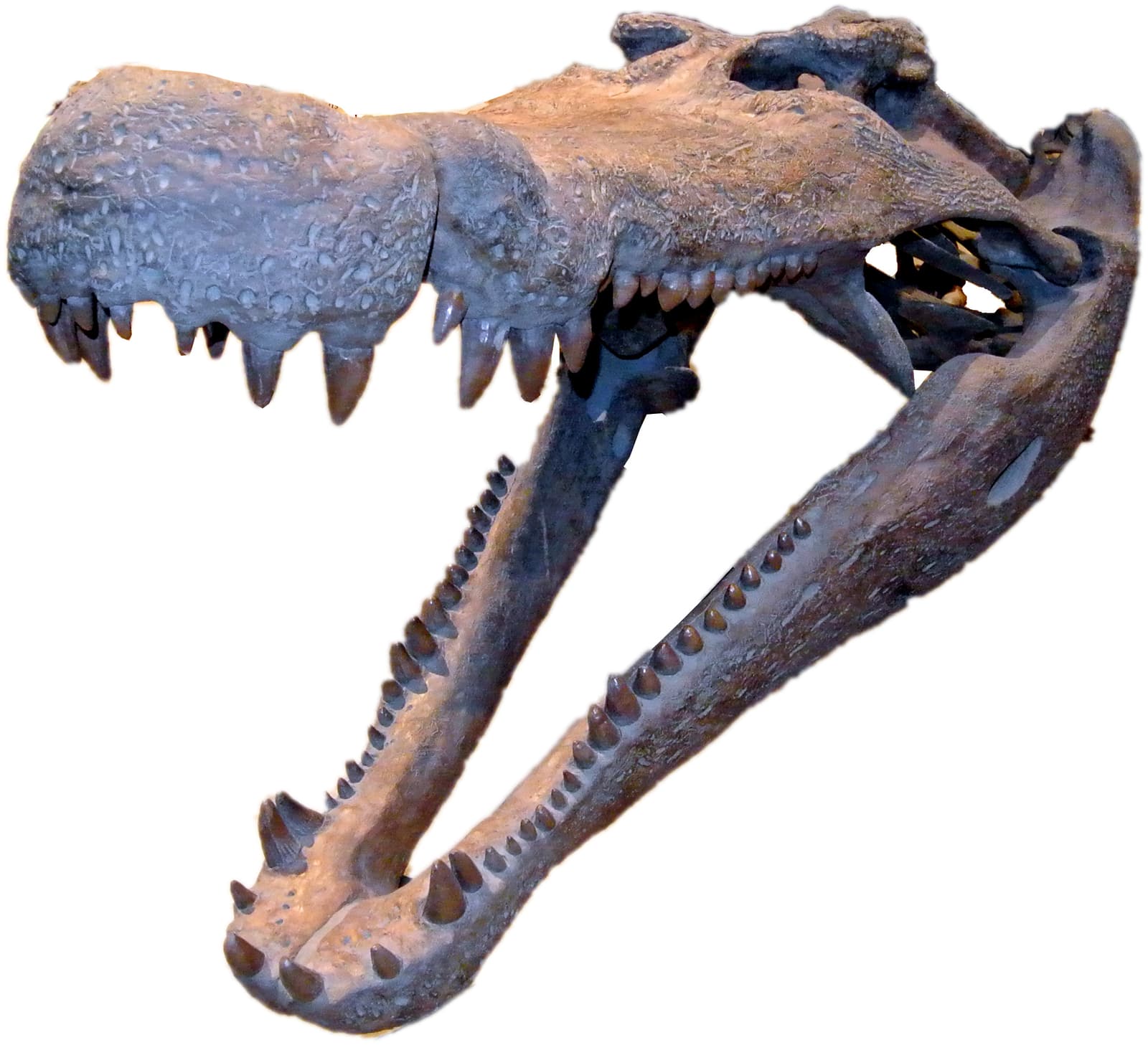
Deinosuchus is too often introduced at maximum volume: a "terror croc" large enough to drag dinosaurs from the water's edge. The image is not pure fantasy. Bite-mark evidence does connect the animal to dinosaur bones, and recent work still treats some specimens as very large crocodyliforms of Late Cretaceous North America.[1][2][3] But the headline is a weak way to read the fossil. Deinosuchus becomes more interesting when the animal is kept in its actual evidence stack: skull shape, tooth form, turtle shells, dinosaur bone marks, coastal wetlands, and a family-tree problem that has changed since the old giant-alligator shorthand.
The useful profile starts with the skull because the skull is where the public myth and the scientific animal first diverge. The cover photograph shows a Deinosuchus hatcheri skull at the Natural History Museum of Utah, not a painted reconstruction.[5] The broad snout, inflated front end, and large conical teeth immediately explain why the animal became memorable. Yet they also show why "big crocodile" is too lazy. The skull does not simply scale up a living alligator or crocodile. It preserves a distinctive front-of-mouth architecture, a heavy biting apparatus, and tooth positions that have to be compared with fossil relatives rather than borrowed whole from one modern species.[1][2]
That distinction matters because even the taxonomic story has shifted. The 2020 review framed Deinosuchus as an enormous crocodylian close to alligators and recognized several species distributed across western and eastern North America, including D. hatcheri, D. riograndensis, and D. schwimmeri.[2] A 2025 expanded phylogenetic analysis then argued for a different placement: Deinosuchus and several other forms previously treated near alligatoroids fit better as stem-crocodylians outside the crown group.[1] That does not make older work useless. It makes the animal a better case study in how paleontology revises a famous label when more characters and a wider comparison set are added.
The correction changes more than a nameplate. If Deinosuchus is forced into a modern alligator frame, its distribution becomes harder to explain because living alligators lack the kind of saltwater tolerance that would make long marine crossings routine. The 2025 paper uses the revised tree to reopen that problem. It argues that a stem-crocodylian placement makes saltwater tolerance more plausible and helps explain Deinosuchus occurrences on both sides of the Western Interior Seaway through dispersal rather than only by populations being split apart as the seaway opened.[1] In plain terms, the animal's map becomes part of its body plan. Shoreline life, seaway geography, and osmoregulation inference have to be read together.
That is the first reason the dinosaur-killer slogan is too small. It imagines one dramatic shoreline scene and misses the shoreline system. Deinosuchus lived around productive coastal plains, deltas, estuaries, and nearshore settings where water, land animals, turtles, fish, and carcasses all came within reach.[1][4] Its importance is not that it occasionally crossed paths with dinosaurs. Its importance is that it occupied an aquatic-to-marginal world big enough and productive enough to support an enormous ambush predator.
The bite marks sharpen the profile, but they also discipline it. Schwimmer's bite-mark work described large, blunt, sometimes penetrating traces on Late Cretaceous bones, including turtle shells and several dinosaur specimens, attributable to Deinosuchus by size, age, habitat, and prey context.[3] That is strong evidence for interaction. It is not a wildlife documentary. A mark on bone can show feeding, scavenging, predation, or postmortem handling depending on context. The best reading is therefore not "it always hunted dinosaurs." The best reading is that Deinosuchus was large and powerful enough for dinosaur remains to enter its feeding record.
The Mexican material from Coahuila makes that boundary especially useful. Rivera-Sylva and colleagues described diagnostic D. riograndensis remains from the Aguja Formation near La Salada, including teeth, osteoderms, vertebrae, and a local association with herbivorous dinosaurs and trionychid turtles.[4] They also noted a hadrosaurian vertebra with a bite mark attributed to Deinosuchus and interpreted the local setting as deltaic, with marsh, lagoonal, and shallow marine influence.[4] That is a better scene than the monster poster. The animal is not floating in generic swamp darkness. It is part of a coastal drainage system where turtles, dinosaurs, fish, and brackish water all help define the possible menu.
The teeth belong in the same argument. The 2020 review release emphasized the famous scale of the teeth and the crushing jaw strength implied by the skull, while also describing bite marks on turtle shells and dinosaur bones.[2] But the diet signal is not only about maximum prey size. A crocodylian with heavy teeth, turtle-shell evidence, and dinosaur bone marks was not a specialist in one cinematic meal. It was an opportunistic predator and feeder whose power worked across several prey types.[2][3][4] A turtle shell requires crushing. A dinosaur bone mark may record an attack or carcass processing. Fish and smaller shoreline animals would have been easier, more routine targets. The skull does not need every meal to be spectacular.
Size needs the same restraint. Older estimates could push Deinosuchus toward the largest numbers because fragmentary skulls and jaws were scaled from living crocodylians that may not have matched its proportions well. The 2025 analysis explicitly warns that cranial length can overestimate body length in long-snouted forms and uses a skull-width proxy with phylogenetic correction.[1] Its preferred high-end percentile estimates are lower than some popular figures for sampled specimens, while still leaving D. riograndensis in the very large crocodyliform category and noting that the largest material may exceed the studied specimen.[1] That is exactly the kind of correction a good species profile should welcome. A slightly less inflated animal can be more real, not less impressive.
What survives the correction is the ecological pattern. The 2025 paper treats very large crocodyliform body size as repeatedly associated with warm, highly productive aquatic or semi-aquatic ecosystems.[1] Deinosuchus fits that pattern cleanly: coastal megawetlands along the Western Interior Seaway and Atlantic side, large vertebrate communities, and enough food-web density for a shoreline predator to keep growing. Gigantism becomes less like a freak mutation and more like an ecosystem achievement.
Read closely, Deinosuchus is not diminished by moving beyond the dinosaur-killer tagline. It becomes sharper. The animal really was a giant Late Cretaceous crocodyliform. It really did leave feeding traces in dinosaur-adjacent worlds. It really did sit near the top of its local food web. But its strongest profile is wider than one ambush: a skull that cannot be borrowed from a living analogue, a bite record that includes turtles and dinosaurs, a coastal map shaped by the Western Interior Seaway, and a phylogeny that keeps rewriting what "alligator-like" is allowed to mean.[1][2][3][4]
That is the better memory hook. Deinosuchus was not simply a crocodile big enough to scare dinosaurs. It was a shoreline giant whose body only makes sense when power, habitat, prey evidence, and evolutionary placement stay in the same frame.
Sources
- Jules D. Walter et al., "Expanded phylogeny elucidates Deinosuchus relationships, crocodylian osmoregulation and body-size evolution," Communications Biology 8, Article 611 (2025).
- Adam P. Cossette and Christopher A. Brochu, "A systematic review of the giant alligatoroid Deinosuchus from the Campanian of North America and its implications for the relationships at the root of Crocodylia," Journal of Vertebrate Paleontology 40 (2020), NYIT repository record.
- David R. Schwimmer, "Bite marks of the giant crocodylian Deinosuchus on Late Cretaceous (Campanian) bones," New Mexico Museum of Natural History and Science Bulletin 51 (2010), Columbus State University PDF.
- Hector E. Rivera-Sylva et al., "A Deinosuchus riograndensis (Eusuchia: Alligatoroidea) from Coahuila, North Mexico," Revista Mexicana de Ciencias Geologicas 28, no. 2 (2011), SciELO HTML article.
- Wikimedia Commons, "File:Deinosuchus hatcheri skull.jpg," source page for the real skull photograph used as the article image.