Pakicetus still has the power to surprise because its name promises one animal while its silhouette delivers another. If the first whale is expected to look like a half-finished dolphin, Pakicetus seems almost perverse: a long-legged carnivorous mammal from the early Eocene of Pakistan, built for land in every obvious way.[1][3][4] The reason it matters is precisely that mismatch. Whale identity shows up here first in the skull and the hearing apparatus, not in flippers, tail flukes, or a fully aquatic body.[1][2][3]
That makes Pakicetus one of the most clarifying species profiles in paleontology. It keeps the origin of whales from being told as a smooth cosmetic fade from wolf to dolphin. The fossils instead suggest a staggered sequence. The ear region starts to carry cetacean identity early. The skeleton, locomotion, and overall body outline lag behind.[1][2][3][4] By the time later archaeocetes push farther into the water, Pakicetus has already done the conceptual work of showing that a whale can begin as a sensory and anatomical category before it becomes an unmistakably marine shape.
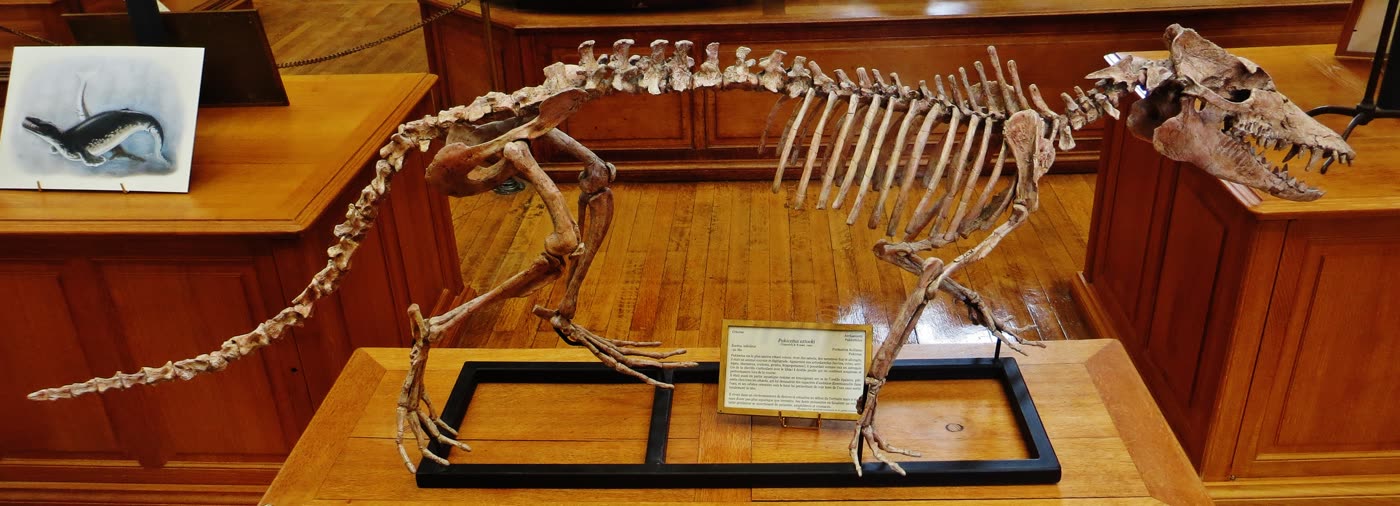
Image context: the lead image uses a photographed Pakicetus attocki skeletal mount from the Galerie de Paleontologie in Paris. It belongs here because the article depends on the body plan staying visible. A real mount keeps attention on the long limbs, level back, and ordinary-looking feet that make the species such a useful corrective to the usual first-whale imagination.[5]
The first whale was named from the ear, not from the outline
The original 1981 description of Pakicetus inachus was based on a skull from the Kuldana Formation and mattered because the skull carried archaeocete features in the auditory region.[1] That is the key ordering point. Paleontologists did not identify the animal as an early whale because it already looked externally whale-like. They identified it as one because the head, especially the ear region, carried the anatomical signature that mattered taxonomically.[1][4]
This is why Pakicetus is stronger than its museum-label shorthand. It is not just "the first whale." It is a reminder that classification can move ahead of appearance. A reader expecting the earliest cetacean to advertise itself through a modern marine body will miss what the fossil is actually showing. The earliest durable whale signal is tucked into the skull.[1][2]
That also explains why the species remained central even after better material turned up. Later fossils did not erase the importance of the original skull. They clarified the rest of the animal around it. The body that accumulated around the whale-marked head was not a miniature dolphin body waiting to be improved. It was a terrestrial mammal body standing close to the shoreline of a much larger evolutionary transition.[1][3][4]
The 2001 skeletons killed the proto-dolphin fantasy
The 2001 Nature paper on pakicetid skeletons changed the public picture decisively.[3] With skeletons of Pakicetus attocki and Ichthyolestes pinfoldi in hand, early cetaceans no longer had to be imagined from skulls and teeth alone. What emerged was not an animal halfway to a modern whale in overall build, but a terrestrial cetacean with long limbs and feet that still belonged on the ground.[3]
That matters because it puts the body back under evidentiary discipline. It becomes harder to smuggle later whale anatomy backward into the first chapter. Pakicetus was associated with water, but association is not the same thing as locomotor commitment. The skeleton does not support a sleek, otter-like swimmer as the default reading. It supports an animal whose body remained fundamentally land-running even while the lineage had already crossed into cetacean identity.[3][4]
The same paper also mattered for a second reason: the ankle helped lock early whales into the artiodactyl story.[3] Molecular work had already been pointing toward a close relationship between cetaceans and even-toed ungulates, and the pakicetid material helped show that whales were closer to artiodactyls than to the old mesonychian alternative.[3] In other words, Pakicetus was not only resetting the body plan of the first whale. It was helping reset the family argument too.
The hearing system changed before underwater hearing fully arrived
If the full skeleton explains why Pakicetus did not yet look like a modern whale, the 1993 hearing paper explains why it still belonged at the beginning of the whale story.[2] Thewissen and Hussain described the hearing organ of Pakicetus as intermediate between land mammals and aquatic cetaceans. The incus fell between the two conditions, while the incus and mandible suggested that sound still reached the ear in a way closer to land mammals than to fully aquatic whales.[2]
That boundary is exactly what makes the species so useful. Pakicetus is not interesting because it had already solved underwater hearing. It is interesting because it had not. The fossil preserves a transitional stage where the ear region is already moving into cetacean territory while the sound path and the rest of the skull still keep one foot in the terrestrial condition.[2][4]
This is the place where whale origins stop looking like costume change and start looking like systems evolution. Different parts of the body do not transform in one synchronized wave. Hearing anatomy, locomotion, habitat use, and feeding behavior each move on their own timetable. Pakicetus matters because it captures that desynchronization cleanly. The head is ahead of the body. The lineage is ahead of the lifestyle most readers expect from the word "whale."[2][3][4]
The right mental image is a shoreline predator with a whale-marked skull
By 2009, Thewissen, Cooper, Clementz, Bajpai, and Tiwari could describe whale origins as one of the best documented macroevolutionary transitions in the fossil record, and pakicetids sit at the front of that sequence.[4] Read from that longer arc, Pakicetus becomes less a curiosity than a rule about how deep evolutionary changes often begin. New identity may arrive first in a specific anatomical system before the whole organism starts to advertise it clearly.
That is why the best reconstruction of Pakicetus remains restrained. Fossil evidence supports an early Eocene pakicetid from the Kuldana Formation, a skull with whale-defining ear anatomy, a transitional hearing apparatus, and a long-legged terrestrial skeleton.[1][2][3][4] Comparative and environmental inference can carry us farther, toward an animal living at the water's edge and feeding as a predator in that setting.[2][4] What the fossils do not justify is a retrofitted miniature whale with land feet pasted on for convenience.
The species profile therefore sharpens into one sentence. Pakicetus matters because whale origins began as an anatomical and sensory shift before they became an obvious aquatic silhouette. The body would change dramatically later. The first decisive signal was already there, inside the ear.
Sources
- Philip D. Gingerich and Donald E. Russell, Pakicetus inachus, a new archaeocete (Mammalia, Cetacea) from the early-middle Eocene Kuldana Formation of Kohat (Pakistan), University of Michigan Deep Blue record for the 1981 description.
- J. G. M. Thewissen and S. Taseer Hussain, "Origin of underwater hearing in whales," Nature 361 (1993).
- J. G. M. Thewissen, E. M. Williams, L. J. Roe, and S. T. Hussain, "Skeletons of terrestrial cetaceans and the relationship of whales to artiodactyls," Nature 413 (2001).
- J. G. M. Thewissen, Lisa N. Cooper, Mark T. Clementz, Sunil Bajpai, and B. N. Tiwari, "Whales originated from aquatic artiodactyls in the Eocene epoch of India," Journal of Biosciences 34 (2009), review of early whale evolution on the Indian subcontinent.
- Wikimedia Commons, "File:Pakicetus attocki skeleton.jpg" — photographed skeletal mount in the Galerie de Paleontologie, Paris, used for the lead image.