Charnia masoni still has the power to reset a reader's sense of time because it first looks familiar in exactly the wrong way. The fossil resembles a leaf, a sea pen, or a fern pressed into stone. That surface resemblance is part of the history, but not the reason the specimen matters. Charnia changed paleontology because a large, branching body turned up in rocks old enough that many mid-twentieth-century geologists still assumed complex visible life should not be there at all.[1]
That is why the best way to read Charnia is not as a pretty precursor to later plants or animals, but as a close reading problem in geology, body construction, and developmental timing. The fossil mattered first because it made the Precambrian harder to keep empty.[1] It matters now because later work on anatomy and growth shows that the frond's repeating branches belong to a rangeomorph body plan that does not map cleanly onto any living organism.[2][3][4]
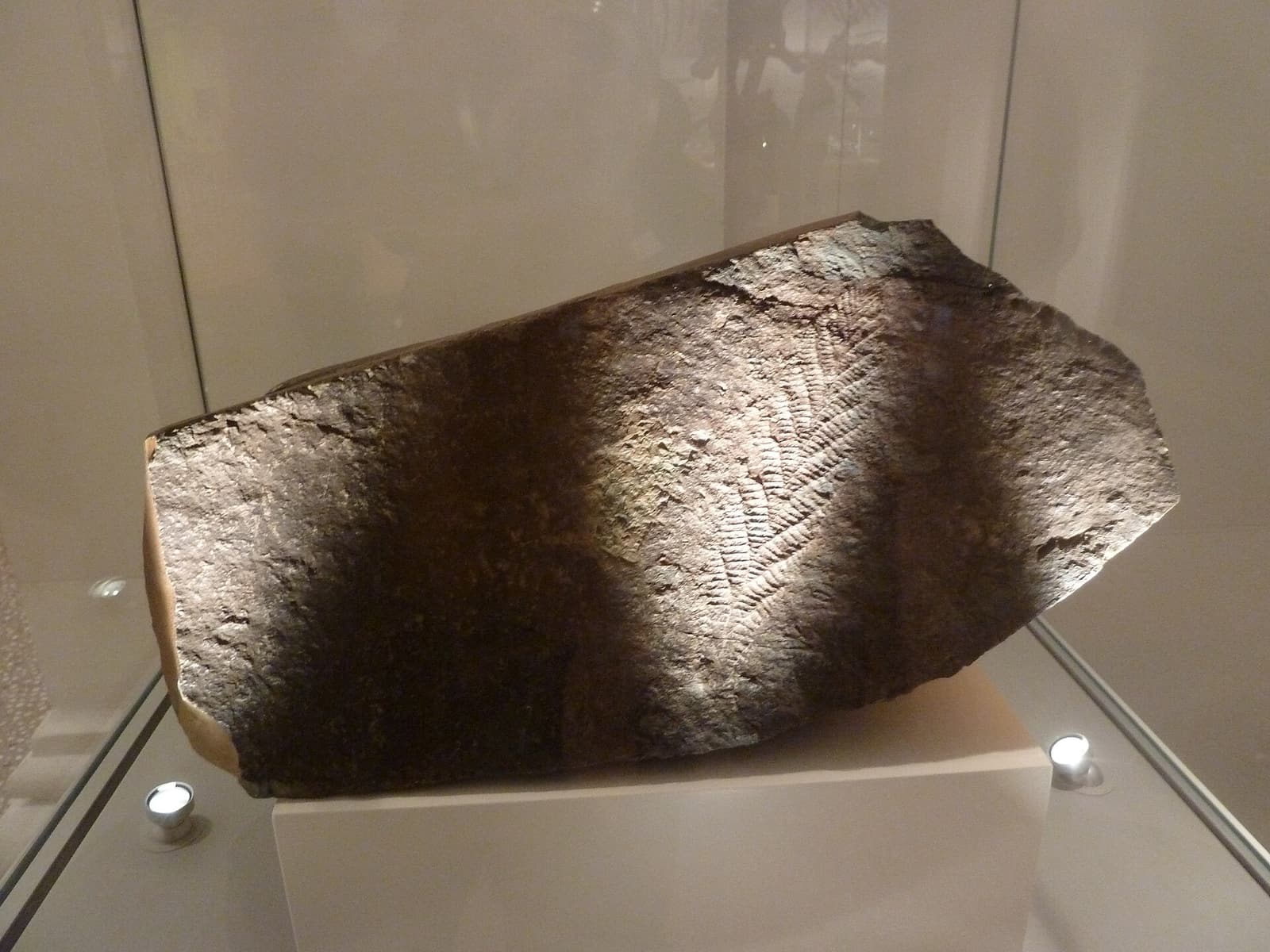
Image context: the lead image uses a real photograph of the Charnia masoni specimen at New Walk Museum in Leicester. It belongs here because the article's claim begins at the slab surface. The narrow midline, alternating branches, and dark fossil relief against pale stone make the argument visible before any reconstruction tries to tidy it into a familiar organism.[5]
The first shock was chronological before it was biological
The discovery story has become famous because it collided with an old absence. Standard reference accounts note that schoolchildren Tina Negus and Roger Mason found the fossil in Charnwood Forest, and Trevor Ford formally described it in 1958.[1] The deeper importance lies in the intellectual climate around that moment. Rocks of such age were still widely treated as a prelude to visible life, not as a place to expect macroscopic organisms.[1]
That is why Charnia was more disruptive than its outline alone suggests. A fernlike frond in younger strata could have been filed away as a strange plant or colonial invertebrate and left there. A branching fossil in Ediacaran rock forced a different question: if the age was right, then the standard picture of the Precambrian as biologically barren at human scale was wrong.[1] The later recognition of a global Ediacaran biota did not begin from nowhere, but Charnia became one of the specimens that made those older hints newly legible.[1]
The fossil therefore carries two histories at once. One is the history of the organism itself in late Ediacaran seas. The other is the history of scientific permission. Once Charnia was accepted, paleontologists had stronger grounds for treating similar pre-Cambrian impressions from elsewhere as fossils rather than as sedimentary curiosities or misdated younger life.[1]
The frond matters because it has architecture, not because it resembles a leaf
Once the age barrier fell, the next temptation was morphological shorthand. Charnia looks plantlike enough that plant metaphors arrive almost automatically. That shortcut weakens the fossil. The 2018 large-sample anatomical study by Dunn and colleagues is valuable because it slows the eye down.[2] Their analysis across specimens from the UK, Canada, and Russia argues that some older reconstructions imported structures the fossil does not actually require, including assumptions about a simple internal stalk and overly uniform higher-order branches.[2]
That correction changes how the fossil should be read. Charnia is not just a leaf silhouette with texture added later. It is a branching construction built from repeated units whose variation matters.[2] The central axis, first-order branches, and smaller subordinate branching are not decorative detail. They are the body plan.
The 2021 Science Advances paper pushed that point further by arguing for the internal interconnected nature of rangeomorph branches and by showing that in Charnia new branches derived successively from pre-existing ones during growth.[3] That is the kind of result that turns an enigmatic surface fossil into a developmental organism. The slab stops being a flat icon and becomes evidence for how a body was built over time.[3]
Deep water broke the fern analogy
The reason the plant comparison finally gives way is not only anatomical. It is environmental. Dunn's 2018 paper frames rangeomorphs as dominant elements of late Ediacaran deep-marine benthic assemblages, and Charnia sits squarely inside that setting.[2] Once the fossil is placed in a deep-water marine world, the easy photosynthetic reading collapses. The frond may look leafy to us, but the habitat stops that likeness from doing much interpretive work.[2]
This is one of the strongest lessons in the whole specimen. Paleontology often has to choose between outline and context, and outline is usually the more seductive liar. Charnia teaches the opposite order. Start with the rock, then the environment, then the body architecture. Only after those three are in place should resemblance be allowed back into the conversation.[1][2]
That is also why Charnia still feels modern as a fossil problem. It punishes superficial comparison. The organism looks familiar enough to invite quick analogies and alien enough to keep breaking them. A reader who comes to the fossil asking "What living thing was this most like?" will leave with a weaker answer than a reader who asks "What kind of body could produce this pattern in this environment?"[2][3]
The fossil now matters as an early animal experiment, not just as a geological milestone
Modern work has not made Charnia ordinary. It has made it stranger in a more disciplined way. Dunn and colleagues' 2021 phylogenetic analysis resolved Charnia as a stem-eumetazoan and argued that rangeomorphs expand the anatomical disparity of early animals to include a body plan that later disappeared entirely.[3] That claim does not turn Charnia into a familiar ancestor marching neatly toward later animal forms. It does something more interesting: it makes the fossil evidence for an extinct experiment in multicellular construction near the base of animal history.[3]
The broader rangeomorph story has sharpened in the same direction. A 2025 Nature Communications study on Fractofusus argues for a developmental framework that helps rationalize differences among Fractofusus, Charnia, and other rangeomorphs, implying that surprisingly complex developmental regulation was already in play among these early eumetazoan-grade organisms.[4] Read back onto Charnia, that result strengthens the sense that the fossil is not an isolated oddity from a vanished sea floor. It is part of a larger and more coherent developmental world.[4]
That is the strongest close reading outcome. Charnia mattered first because it made it impossible to treat the Precambrian as a humanly blank stage. It matters now because the frond itself has become more informative, not less. The closer paleontologists look, the less it behaves like a fossil fern and the more it behaves like a record of early animal-grade construction from a body plan the modern world no longer keeps.
Sources
- Wikipedia, "Charnia" - discovery history (including Tina Negus, Roger Mason, and Trevor Ford's 1958 description), scientific context, and references for further verification.
- Frances S. Dunn et al., "Anatomy of the Ediacaran rangeomorph Charnia masoni," Papers in Palaeontology 5:1 (2018) - large-sample anatomical study and revised morphological model.
- Frances S. Dunn et al., "The developmental biology of Charnia and the eumetazoan affinity of the Ediacaran rangeomorphs," Science Advances 7 (2021) - growth model, internal branch connectivity, and stem-eumetazoan interpretation.
- Frances S. Dunn, Philip C. J. Donoghue, and Alexander G. Liu, "Morphogenesis of Fractofusus andersoni and the nature of early animal development," Nature Communications 16 (2025) - rangeomorph developmental framework used here as context for reading Charnia.
- Wikimedia Commons, "File:Charnia masoni fossil, New Walk Museum.jpg" - museum photograph used for the lead image.