A paddlefish announces itself with its snout: a long extension projecting well beyond the mouth. In a fossil, that outline is an invitation to imagine the living American paddlefish cruising through clouds of plankton. Yet some fossil paddlefishes swallowed other fish. The family resemblance survived across substantially different ways of eating.[1][2]
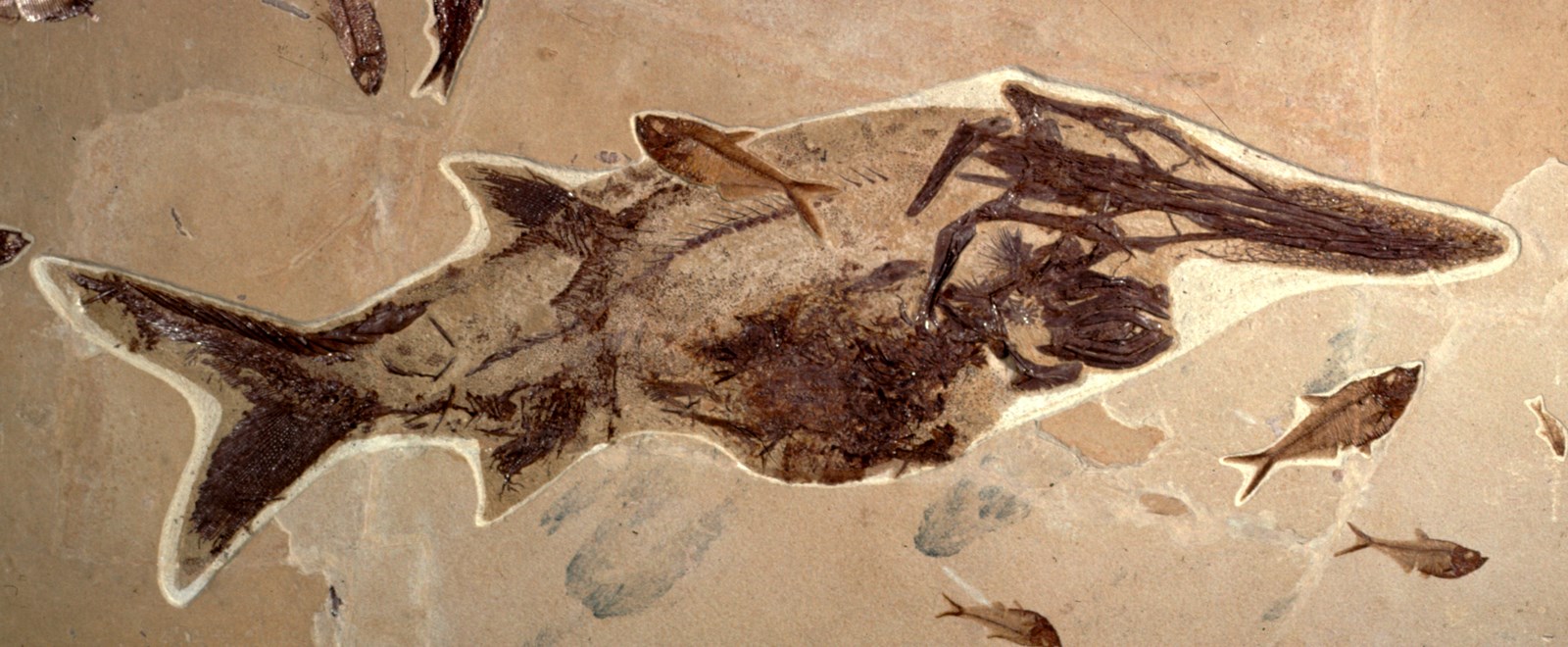
A familiar outline, a different meal
About 52 million years ago, during the Eocene, Crossopholis magnicaudatus lived in the waters recorded by Wyoming's Fossil Butte Member of the Green River Formation. Its body carried thousands of tiny, fringed scales. More revealing for its ecology are specimens preserving fish inside the stomach: direct evidence that this paddlefish ate fish.[1]
The distinction between a small skeleton beside a predator and one inside its digestive tract matters. A slab can gather animals through burial; a stomach preserves a feeding relationship. That relationship still leaves questions unanswered. It cannot supply a complete annual menu, the frequency of successful hunts, or the movements used to capture a particular meal. But it gives the anatomical comparison a firm starting point: the recognizable paddle belonged to an animal with a different menu from the one we might casually assign it.
Look behind the mouth
The living American paddlefish, Polyodon spathula, has long, closely spaced gill rakers associated with filtering zooplankton. A Late Cretaceous relative described by Eric Hilton and colleagues in 2023, Parapsephurus willybemisi, retained short, widely spaced rakers. Its fossils come from the Tanis site in North Dakota's Hell Creek Formation. The authors inferred that it probably ate fish.[2]
Here, the evidence changes from a preserved meal to a functional interpretation. Short rakers support a comparison with fish-eating relatives; they do not record an actual capture. The long snout and the filtering apparatus must be considered separately.
Nor can Crossopholis simply be inserted as an ancestor before Polyodon: the fossil species Polyodon tuberculata is known from the early Paleocene, earlier than the Eocene Crossopholis. Hilton and colleagues also emphasized the need to reassess relationships among fossil and living paddlefishes.[2] These finds reveal overlapping branches and different feeding equipment. Arranging them by familiarity would manufacture a tidy evolutionary sequence that the evidence does not establish.
Finding food is a separate task
Experiments on living paddlefish help explain what a conspicuous snout can contribute. In 1997, Lon Wilkens and colleagues studied juveniles under infrared illumination, excluding vision. The fish captured individual planktonic prey and struck at electrodes producing weak electrical signals. Recordings from their sensory organs showed responses to electrical signals generated by Daphnia, small water fleas.[3]
The paddle therefore provides space for a sensitive food-detection system. That result concerns locating prey; it does not make the paddle itself a plankton filter. It also concerns juvenile fish taking individual prey, rather than a direct experiment on adult filtering behavior.[3]
For paleontology, this is a useful separation of questions. What could the animal detect? What could enter its mouth? What happened once food was inside? A familiar external shape may help address the first question while leaving the others dependent on structures preserved elsewhere in the body. Modern experiments supply a functional comparison, not a recording of an extinct animal's senses.
Water does some of the sorting
Even the modern filtering apparatus is more complicated than a kitchen sieve. Hannah Brooks and colleagues investigated water movement using three-dimensional printed models and preserved American paddlefish in a flow tank. They found sustained vortices behind the gill-supporting arches. Changing the orientation of the model structures changed the vortices' behavior.[4]
In this proposed mechanism, water moving along the filtering surface interacts with steps formed by the arches. The resulting circulation can help move and concentrate particles while reducing accumulation on the filter. The researchers used mesh to simulate deployed gill rakers in the preserved fish, an important boundary on what the experiment reproduced.[4]
That work makes a fossil comparison more demanding. Reconstructing feeding means considering the arrangement of a mouth, its internal supports and the water passing through them. An isolated structure can constrain the reconstruction without specifying every part of the process.
The living fish still resists a simple story
A 2025 Alabama River study adds a useful complication. Nathaniel Steffensmeier and colleagues examined 409 paddlefish and tracked a subset with transmitters. Rostrum damage was associated with lower body condition in males, but not females; upstream dam-passage rates did not differ between damaged and undamaged fish. The measured outcomes therefore did not support treating an injured paddle as universally disabling.[5]
This does not erase the experimental evidence for electroreception. It shows that demonstrating a function and measuring the consequences of losing part of a structure are different investigations. Living animals can expose the limits of an explanation that looked complete from anatomy alone.
Return to the fossil slab with those distinctions in mind. Its great snout remains the first thing the eye notices. The small fish inside the abdomen changes how we read it. Across the paddlefish family, a recognizable outline could accompany different feeding systems; understanding that history requires following the evidence beyond the outline.
Sources
- National Park Service, “Fossil Fish Species,” Fossil Butte National Monument — Crossopholis, stomach contents, age and photograph of FOBU7217.
- Hilton et al., “New paddlefishes (Acipenseriformes, Polyodontidae) from the Late Cretaceous Tanis Site of the Hell Creek Formation in North Dakota, USA.” Journal of Paleontology (2023) — anatomy, inferred diets and unresolved relationships.
- Wilkens, Russell, Pei and Gurgens, “The paddlefish rostrum functions as an electrosensory antenna in plankton feeding.” Proceedings of the Royal Society B (1997) — behavioral and electrophysiological experiments.
- Brooks, Haines, Lin and Sanderson, “Physical modeling of vortical cross-step flow in the American paddlefish, Polyodon spathula.” PLOS ONE (2018) — physical models, preserved specimens and experimental limits.
- Steffensmeier et al., “Effects of rostrum injuries on body condition and dam passage of Paddlefish.” Transactions of the American Fisheries Society (2025) — field observations and measured effects of damage.