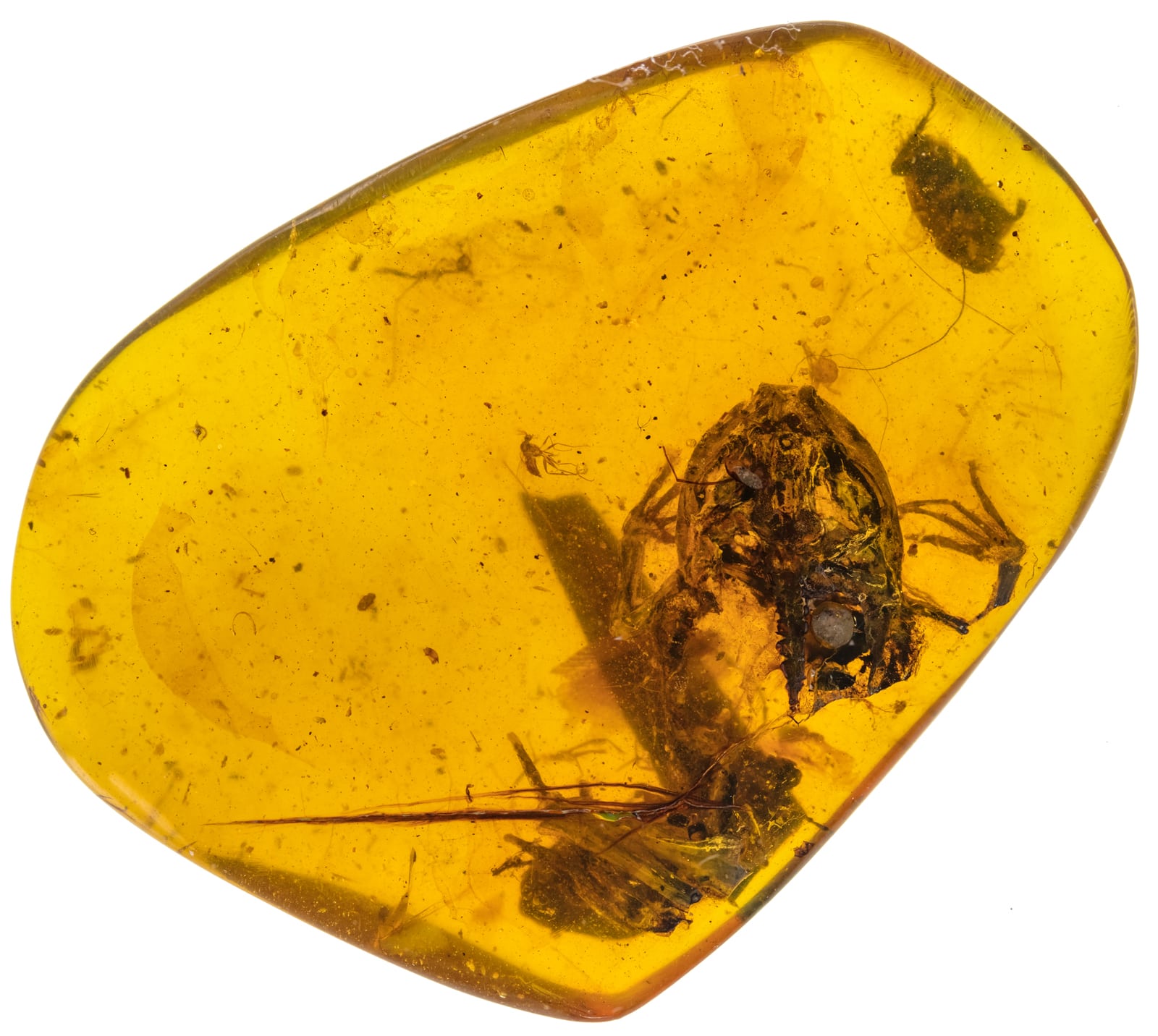
A frog and a beetle share a small piece of amber. The frog's skull and delicate limbs are visible inside; the insect lies nearby. It is tempting to turn their proximity into a final hunting scene. The photograph gives us two neighbors. Whether one was pursuing the other remains a possibility, not a preserved action.[1]
The frog is Electrorana limoae, described by Lida Xing and colleagues in 2018. Its roughly 22-millimeter body survives as a partial skeleton, catalogued as DIP-L-0826 at the Dexu Institute of Paleontology in Chaozhou, China. The specimens were acquired near Angbamo in northern Myanmar's Kachin region.[2]
The forest around the frog
At about 99 million years old, in the Cretaceous Period, the find supplies an unusually early record of a familiar association: frogs inhabiting wet tropical forests. Other inclusions from the amber deposits, including mosses and velvet worms, help establish that environmental setting. The connection matters because small, lightly built frogs preserve poorly; their fossil record favors sturdier animals and often more seasonal, drier environments.[1]
The apparent familiarity of a frog in a forest can therefore conceal a substantial gap in evidence. A modern scene may feel timeless without being well documented through time. Here, the skeleton and the deposit's environmental clues answer different parts of the question. One identifies an inhabitant; the other helps recover its surroundings. Their combination makes the habitat claim stronger than either would be alone.
A small body with unfinished bones
The skeleton retains a free rib and a V-shaped bone associated with the throat apparatus. Such features helped the researchers compare Electrorana with early branches of living frogs. But the pelvis, sacrum and urostyle—the rod at the rear of a frog's backbone—are absent. Three analyses using different sets of anatomical characters produced different placements, leaving its precise relationships unresolved.[2]
Youth complicates that absence. Some bones in the specimen had not finished developing; the museum's account notes that structures useful for reconstructing relationships and life history are either missing or immature. Comparisons with living fire-bellied and midwife toads were suggestive, rather than a settled identification.[1]
An absent structure can carry several meanings: the species lacked it, this individual had not developed it, or preservation removed it. Those possibilities cannot be treated as interchangeable. The useful question is what a particular gap allows us to conclude. A missing pelvis does not undo the presence of a frog in the forest; it limits the anatomical comparisons that can follow.
Resin did not preserve everything
Another specimen in the described set makes the distinction especially tangible. It retains a frog's general outline, yet CT scanning revealed no skeleton inside. The shape survived where the bones did not.[2]
Experimental work helps explain why an amber enclosure need not halt destruction. In 2018, Victoria McCoy and colleagues placed fruit flies in modern resins and examined their decay. Resin chemistry and the composition of the flies' gut microbes affected deterioration; drying before entombment unexpectedly increased decay. These were experiments on insects, so they cannot diagnose what happened to Electrorana. They do demonstrate that entrapment and preservation are separate processes.[3]
That distinction changes how to look at the photograph. The clear enclosure invites an impression of completeness, but a recognizable body can retain uneven anatomical information. The most convincing outline may still surround an important blank.[2][3]
There is a second limit to the view through amber. Mónica Solórzano Kraemer and colleagues compared arthropods caught in modern resin with those collected using other traps in a Madagascar forest. Resin represented life around the resin-producing trees better than the whole forest community. Their study concerned arthropods and a different resin system, not a numerical estimate of Cretaceous frog abundance.[4]
For Electrorana, the useful inference stays close to the specimen. A frog belonged to this ancient forest, but a few amber pieces cannot tell us how many frogs called there or how many species shared the habitat. The find's achievement is already substantial: it gives a familiar ecological relationship a physical foothold in deep time, while leaving room for the next skeleton to change the family history.
Sources
- Florida Museum of Natural History, “Amber fossils provide oldest evidence of frogs in wet, tropical forests”—research account and specimen photographs.
- Lida Xing et al., “The earliest direct evidence of frogs in wet tropical forests from Cretaceous Burmese amber,” Scientific Reports (2018).
- Victoria E. McCoy et al., “Unlocking preservation bias in the amber insect fossil record through experimental decay,” PLOS ONE (2018).
- Mónica M. Solórzano Kraemer et al., “Arthropods in modern resins reveal if amber accurately recorded forest arthropod communities,” PNAS (2018)—author-hosted paper.