The little feet end where you might expect a tail. In Aysheaia pedunculata, the rings of the trunk run straight into the last pair of legs, leaving barely a point of body between them. At the other end, two branched appendages flank a mouth that opens straight ahead. Once you know which end is which, there is a pleasure in following this animal from nose to heels. The whole journey, on the Royal Ontario Museum specimen pictured here, takes two centimetres.[1][2]
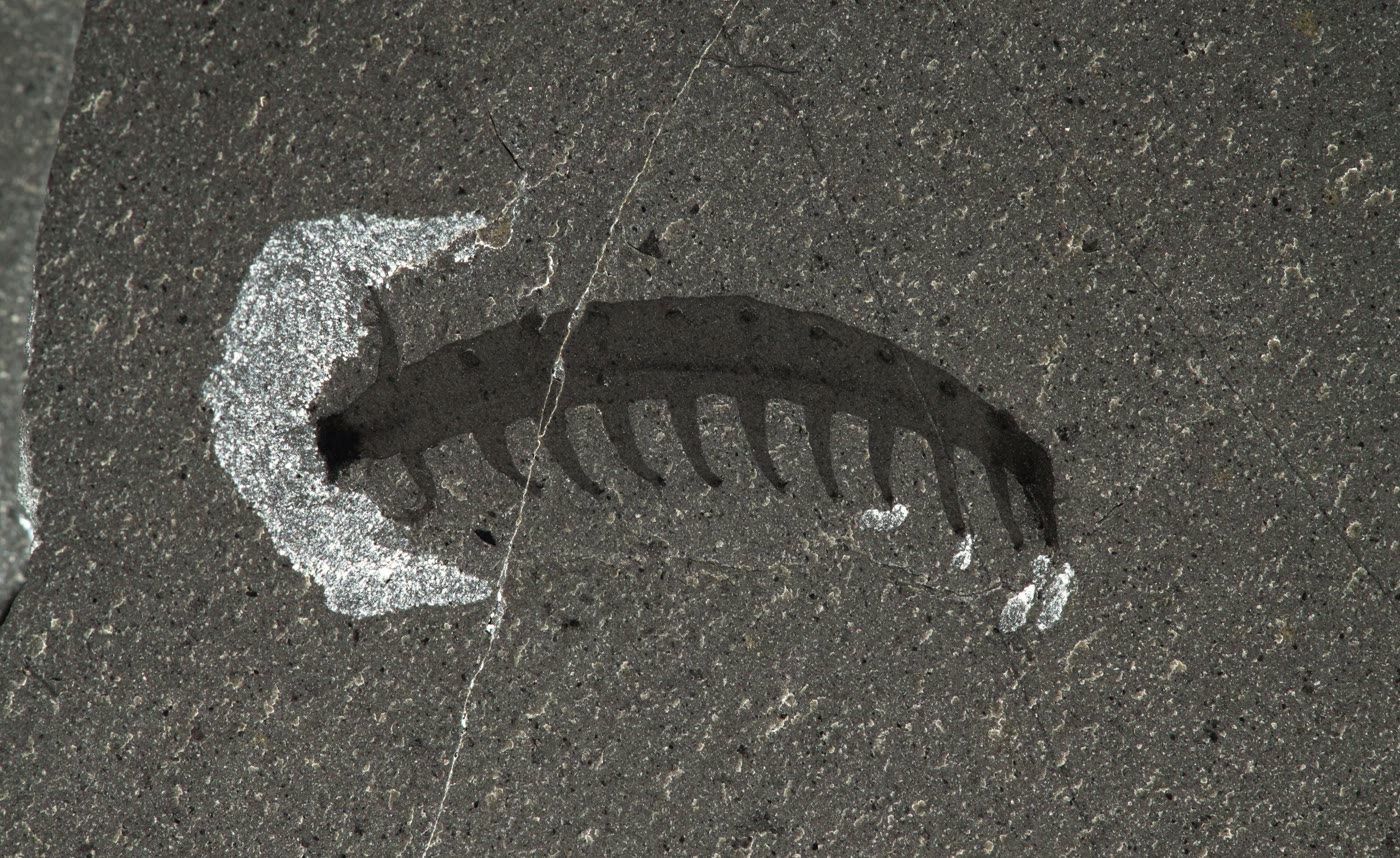
About 505 million years ago, this was a soft-bodied animal on a marine seafloor. Charles Walcott, who named it in 1911, described it among the annelids, the group that includes bristle worms. He saw the fine divisions across the body and counted tiny pits along them. The marks are real enough. Run your eye along one flank, though, and the feet keep a different beat. Several rings of skin fit between one leg and the next. Counting the rings as segments would give quite the wrong idea of how the body was put together.[1][2][3]
A different grip at the back
In 1978 Harry Whittington described fifteen specimens he had prepared and photographed. A split piece of shale can leave some of a leg on one face and the rest on its counterpart. Matching the two faces and comparing individuals let him recover a detail that the tidy procession of legs conceals. Each of the ten pairs ends in a blunt foot bearing a little group of curved claws. On the first eight pairs, the claws sit on the rear face of the tip. On the last two, they sit on the front. Those hind feet look much like their neighbours until you get down to the parts that touched the world.[2]
Paleontologists call Aysheaia a lobopodian, a name for animals with fleshy, unjointed limbs like these. The resemblance to a living velvet worm is easiest to see in the legs. It gets harder at the mouth, where the fossil preserves a fringe of slender projections and researchers have yet to identify velvet-worm jaws. Comparisons also draw in tardigrades, the tiny animals known as water bears. Where Aysheaia branches among these relatives depends on how researchers weigh characters across the whole body.[1][2]
A sponge underfoot
Among the fossils lying close to Aysheaia in the Burgess Shale, Whittington noticed an unusual frequency of sponge fragments. A sponge offers something that a stretch of soft mud scarcely can. It rises off the bottom, with a surface that a curved claw might catch. The feet give that recurring association a physical explanation. An animal able to keep its purchase while moving from foothold to foothold could have made a living on a surface that was itself alive.[1][2]
How it ate there is a separate question. Consider another Burgess Shale lobopodian, Ovatiovermis. Its rear limbs carried stout claws, while its long front limbs bore rows of fine spines. Jean-Bernard Caron and Cédric Aria proposed that it anchored itself by the rear and used the front limbs to gather food suspended in the water. The two sets of limbs do different jobs in that reconstruction. Giving Aysheaia a similar perch accounts for its feet, but it leaves us looking for the fine collecting apparatus. Its branched front appendages carry only a few widely spaced projections.[2][4]
Perhaps Aysheaia grazed the sponge itself. Perhaps it picked up food as it moved over the surface. Either meal could leave claws and sponge fragments together in the shale. Even the gut visible in the museum photograph gives us chiefly the route food took through the body. For this small patch of Cambrian seafloor, we can make a better guess at what lay under the animal’s feet than at what went into its mouth.[1][2][4]
Sources
- Royal Ontario Museum, Aysheaia pedunculata. Specimen photographs, quarry context and species account.
- Harry B. Whittington, “The Lobopod Animal Aysheaia pedunculata Walcott, Middle Cambrian, Burgess Shale, British Columbia” (1978). Author’s abstract reproduced in the Onychophora bibliography.
- Charles D. Walcott, “Middle Cambrian Annelids” (1911), pp. 116–117 and plate 23.
- Jean-Bernard Caron and Cédric Aria, “Cambrian suspension-feeding lobopodians and the early radiation of panarthropods” (2017).