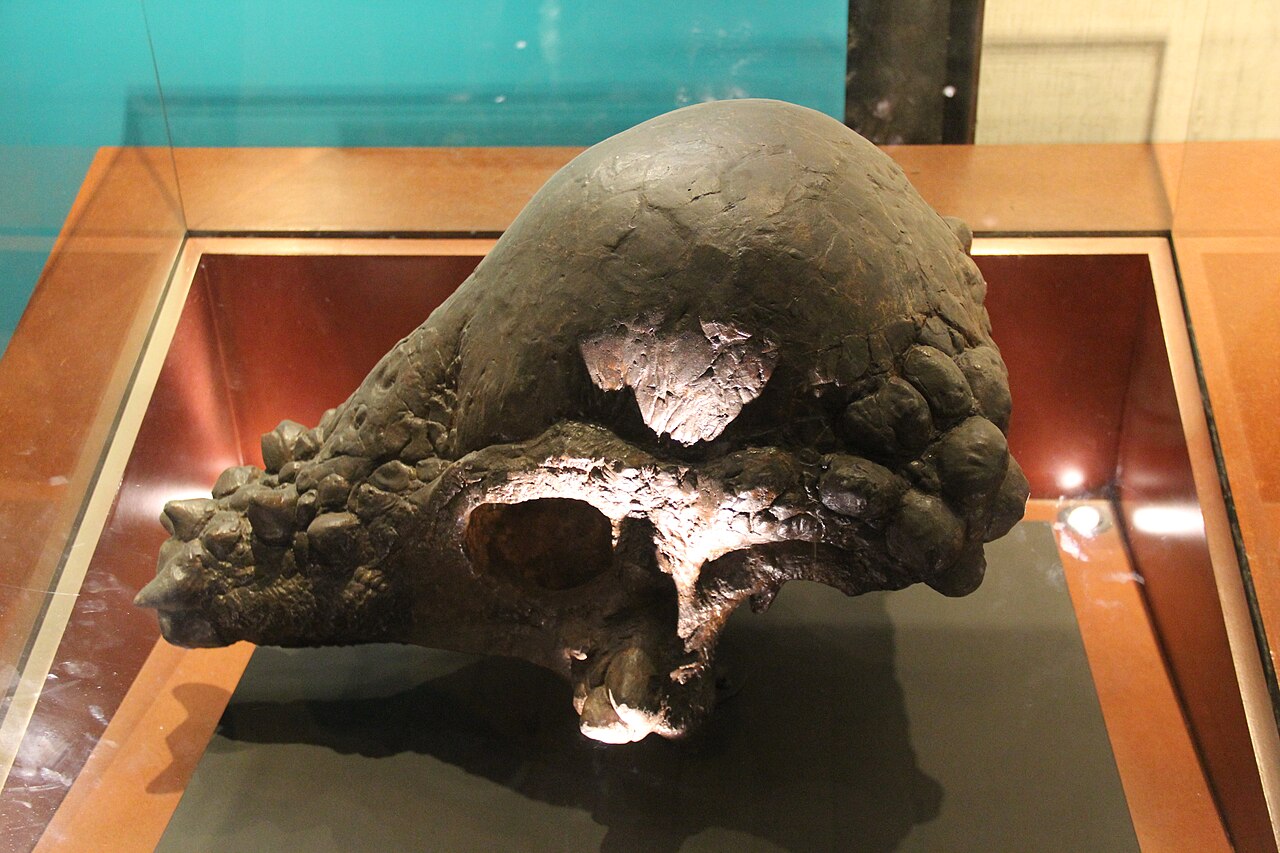
Pachycephalosaur domes are easy to overread because the silhouette arrives before the method does. A thick skull roof, a rounded forehead, a ring of spikes or nodes behind it, and the whole animal starts to look like a fossilized answer to a simple question: did these dinosaurs ram each other like sheep?[4][5] The stronger paleontological answer begins somewhere else. Before the dome becomes behavioral evidence, it has to survive an ontogeny problem. Age changed the skull dramatically enough that some famous horned forms now read less like separate taxa than like earlier growth stages inside the same lineage.[1][5]
That order matters because pachycephalosaurs did not grow by merely scaling up a finished head. In the best-studied material, the frontoparietal dome inflated through development, the rear ornamentation changed shape, and internal bone texture shifted with maturity.[1][2] Once those growth signals are in view, the combat question gets narrower and better. The real issue is not whether every dome-headed dinosaur spent its life head-butting. It is whether some mature, fully domed pachycephalosaurs carried the right combination of anatomy, injury pattern, and internal structure to make head-striking behavior plausible.[2][3][4]
Image context: the lead image is a museum photograph of a Pachycephalosaurus skull from the Natural History Museum in London, sourced from Wikimedia Commons. It belongs here because this article is about reading the skull roof as a changing structure, not as a cartoon weapon. The dome is obvious at a glance, but so are the ornamented margins that help show why age has to be sorted out before behavior can be inferred.[6]
1) The dome is a growth problem before it is a combat problem
The crucial reset came from work on Pachycephalosaurus, Stygimoloch, and Dracorex. Horner and Goodwin argued in 2009 that these skulls line up as a cranial growth series rather than as three cleanly separated terminal forms.[1] In their reading, the younger skulls carry flatter or only emerging domes and more dramatic squamosal horns, while older skulls show a broader inflated dome and blunter rear ornamentation produced through remodeling.[1]
That does not merely tidy the family tree. It changes what counts as evidence. If a spectacular horned skull belongs to a subadult stage, then part of what used to be read as species-level difference is really age structure.[1] The Natural History Museum's current overview reflects how far that interpretation has traveled into museum consensus: it notes that most scientists now treat Stygimoloch and Dracorex as younger forms of Pachycephalosaurus.[5] Once that is accepted, the dome stops being a static object. It becomes a moving target in development.
This is why pachycephalosaur behavior arguments can go wrong so easily. A juvenile or subadult skull can look extravagant for reasons that have more to do with timing than with combat specialization. The headline shape stays memorable, but the biological meaning changes with age.[1][5]
2) Growth changed the skull roof in quantifiable ways
The best anatomical control on that point comes from Stegoceras validum. Schott and colleagues assembled a large growth series and showed that cranial doming was tightly linked to ontogenetic change rather than being a simple mini-adult feature present from the start.[2] As the animal matured, the frontoparietal region changed disproportionately, supporting a model in which dome height and thickness increased through positive allometry.[2]
They also used CT-based histological comparisons to show that bone texture itself shifted across the growth series.[2] Younger domes were more vascular and actively reorganizing; mature domes became denser and less growth-heavy.[2] That matters because internal tissue state is part of functional anatomy. A dome still in fast growth is not the same structure, mechanically or developmentally, as a heavily remodeled adult roof.
This section of the evidence rarely gets popular attention because it is slower than the old "head-butting dinosaur" headline. It is still the part that makes the later behavioral claims worth taking seriously. Without ontogeny, the dome is only a shape. With ontogeny, it becomes a stage-specific structure whose performance has to be judged at the right point in life.[1][2]
3) Lesions make the behavioral case much sharper
Once age is controlled, pathology becomes more informative than outline. Peterson, Dischler, and Longrich surveyed pachycephalosaur domes and found that cranial lesions were not randomly scattered through every skull type.[3] They were concentrated near the apex of the dome, frequent in fully domed pachycephalosaurids, and absent in the partially domed or flat-headed taxa included in their sample.[3]
That distribution is the article's most important behavioral signal. A rounded skull roof could in principle serve display, species recognition, combat, or more than one of those functions.[4][5] Repeated lesions in the thickest impact-facing part of adult domes narrow the range of serious explanations.[3] They suggest trauma was recurring where the skull was best built to take it.
The strength of this evidence is also its restraint. Peterson and colleagues did not claim that every pachycephalosaur behavior question was solved forever.[3] What they showed is that mature domes preserve a damage pattern much harder to explain away as random breakage or preservational noise. In paleontology, that kind of patterned injury usually carries more weight than iconography.[3]
4) Biomechanics supports competence, not a universal ram story
Biomechanical work pushed the case further without making it absolute. Snively and Theodor compared dome-headed pachycephalosaurs with living combative artiodactyls and argued that some pachycephalosaurs shared several functional correlates of head-strike behavior: dome-like cranial form, strong neck-muscle attachments, neurovascular canals tied to a protective covering, and a dense cortical layer over more cancellous bone.[4] In their analysis, Stegoceras in particular looked mechanically more plausible as a head-striking animal than the older caricature of a fragile ornament would suggest.[4]
That does not mean pachycephalosaurs should simply be redrawn as bighorn sheep with tails. Even the comparative literature keeps the behavior question more open than that. Head-to-head impact, flank-butting, or lower-speed shoving behavior may not load the skull in identical ways, and not every pachycephalosaur taxon had the same dome architecture.[4] The point is narrower. For at least some mature dome-headed forms, the skull is not only dramatic to look at. It is internally organized in a way compatible with repeated cranial impacts.[3][4]
This is the right place to keep the article disciplined. The strongest version of the combat claim is not "all pachycephalosaurs were head-butting specialists." It is "some mature dome-headed pachycephalosaurs were anatomically and pathologically consistent with agonistic striking behavior."[3][4]
5) The best evidence order is growth first, lesions second, mechanics third
By now the reading sequence is clear. First, establish what stage of growth the skull represents.[1][2] Second, ask whether the dome carries a patterned injury signal rather than isolated damage.[3] Third, test whether internal architecture makes the proposed behavior mechanically plausible.[4] When that order is respected, the dome becomes one of paleontology's better examples of how behavior can be inferred without fantasy.
It also leaves room for a more mature reading of function. The Natural History Museum still presents the dome as a structure that may have been used in combat, display, or both.[5] That is sensible. Evolutionary structures are often multitaskers, and display does not cancel combat any more than antlers stop being display structures because deer also fight with them.[5] What the last two decades of pachycephalosaur work have done is make the evidence hierarchy firmer. The dome is no longer just a visual cue for violence. It is a developmental structure that only becomes strong behavioral evidence after age, damage pattern, and mechanics are stacked in the right order.[1][2][3][4][5]
That is why growth comes first and impact later. The dome became scientifically sharper the moment paleontologists stopped treating every thick skull roof as a finished weapon and started asking when, in the animal's life, that roof had actually become one.
Sources
- John R. Horner and Mark B. Goodwin, "Extreme Cranial Ontogeny in the Upper Cretaceous Dinosaur Pachycephalosaurus." PLOS ONE 4, no. 10 (2009).
- Ryan K. Schott, David C. Evans, Caleb M. Brown, and Mark B. Goodwin, "Cranial Ontogeny in Stegoceras validum (Dinosauria: Pachycephalosauria): A Quantitative Model of Pachycephalosaur Dome Growth and Variation." PLOS ONE 6, no. 6 (2011).
- Joseph E. Peterson, Casey Dischler, and Nicholas R. Longrich, "Distributions of Cranial Pathologies Provide Evidence for Head-Butting in Dome-Headed Dinosaurs (Pachycephalosauridae)." PLOS ONE 8, no. 7 (2013).
- Eric Snively and Jessica M. Theodor, "Common Functional Correlates of Head-Strike Behavior in the Pachycephalosaur Stegoceras validum (Ornithischia, Dinosauria) and Combative Artiodactyls." PLOS ONE 6, no. 6 (2011).
- Natural History Museum, "Pachycephalosaurus" — museum overview of the dome, growth-stage synonymy, and the current display-versus-combat framing.
- Wikimedia Commons file page for the Natural History Museum Pachycephalosaurus skull photograph used as the article image.