Most people meet Dimetrodon as a mistake that somehow survived childhood: the sail-backed "dinosaur" in a toy bin, a swamp predator filed next to Tyrannosaurus and stegosaurs as if deep time were one crowded room. The error is common because the outline is memorable. The outline is also the least interesting part of the animal. Dimetrodon matters because it belongs to the synapsid line that eventually leads to mammals, because its skull and teeth record an early experiment in serious terrestrial predation, and because the sail that made it famous is anatomically real while still refusing to collapse into a single neat function story.[1][2][3][4]
That combination is why the species keeps returning. In the Early Permian of North America, roughly 286 to 270 million years ago in Britannica's broad summary, Dimetrodon occupied terrestrial ecosystems long before dinosaurs appeared.[4] By the time the public remembers the sail, paleontology has already made a stronger case: this is one of the earliest large-bodied apex predators on land, and its fame should rest on the way several systems lock together rather than on one oversized visual cue.[1][2][4]
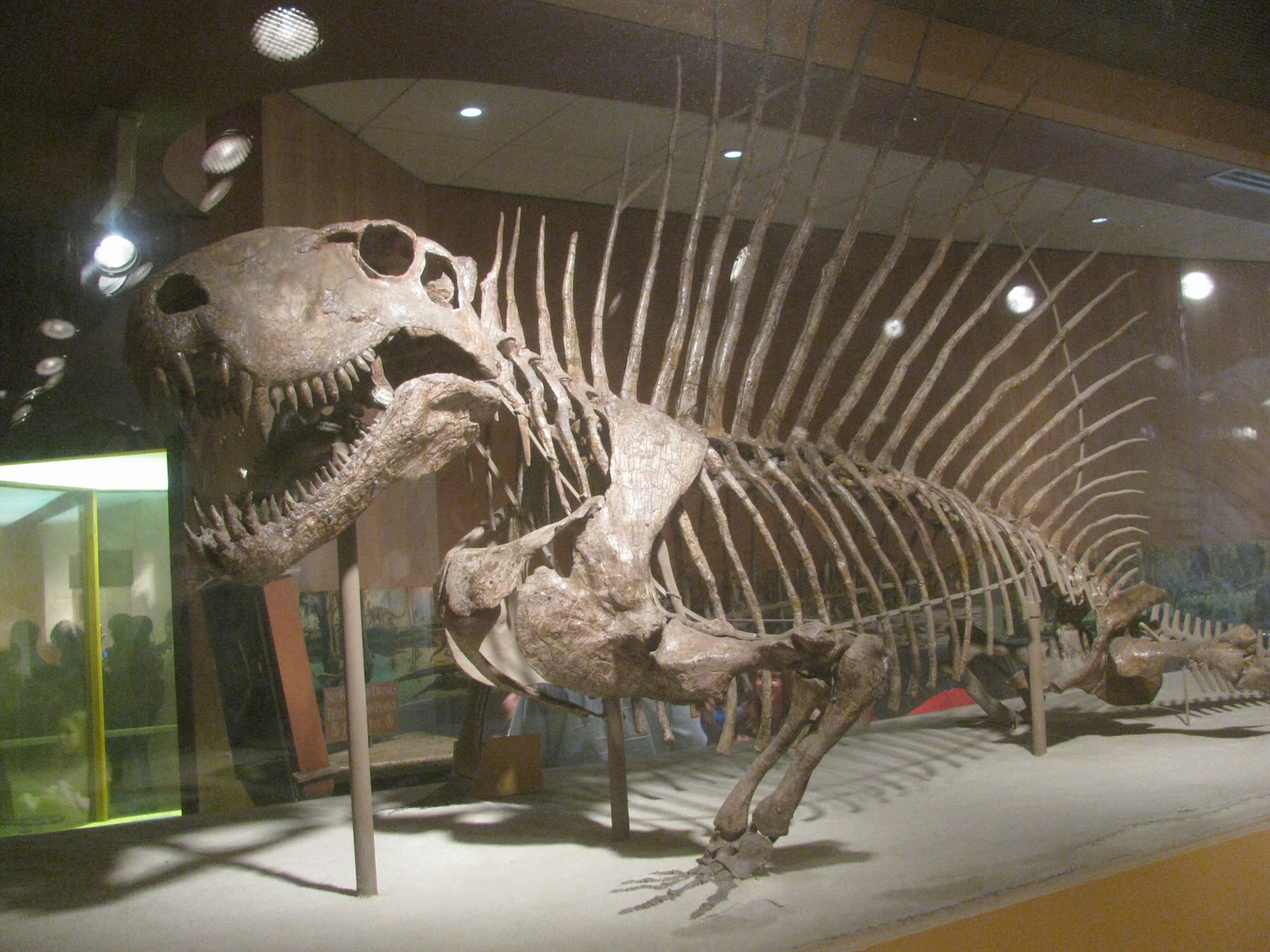
Image context: the lead image is a photograph of a mounted Dimetrodon grandis skeleton at the Smithsonian, sourced from Wikimedia Commons. It suits this article because the full mount resists the cartoon version. You can see at once that the sail rises from a heavy, low body with a long predatory skull; the animal reads as a functional package, not as a reptilian logo with a fin attached.[6]
1) The first thing to fix is its place on the tree
Calling Dimetrodon "not a dinosaur" is useful only if the correction does more than score taxonomy points. Kenneth Angielczyk's synapsid review makes the real point: synapsids are closer to living mammals than to reptiles, and the temporal opening behind the eye socket is one of the characters that links forms as different as Dimetrodon and humans on the same broad line.[3] Once that lands, the animal stops being a failed dinosaur prototype and starts reading as an early chapter in mammalian deep history.
That shift changes how the whole profile is read. The sail no longer marks a weird reptile side branch that happened to look dramatic; it marks one branch among early synapsids experimenting with body plans before mammals existed. Angielczyk also notes that evolutionary trees suggest the sails of Dimetrodon and Edaphosaurus evolved independently, which matters because it keeps the profile from collapsing into a simple "all sail-backed Permian animals were doing the same thing" story.[3] The shared look is real, but the lineage logic is sharper than the silhouette.
2) The teeth are where the animal becomes more modern than its stereotype
Brink and Reisz's 2014 Nature Communications paper is the cleanest place to watch Dimetrodon outgrow its pop-culture shell.[1] Their argument is not just that the teeth were sharp. It is that the dentition was more diverse than the old single-pattern predator image allowed. They describe strong heterodonty, recurved teeth with cutting edges, and, in the largest species, the first clear appearance of true denticles, or ziphodonty, in the fossil record.[1]
That finding matters because it moves the discussion from "large sail-backed carnivore" to feeding mechanics and trophic role. Brink and Reisz argue that dental morphology changed even without major skull-shape shifts, which suggests that feeding style was being fine-tuned through tooth architecture rather than through some wholesale redesign of the head.[1] In other words, Dimetrodon was not impressive just because it had a big jaw full of scary cones. It was already participating in a more sophisticated predatory toolkit, one in which tooth form tracked how flesh was processed and prey was handled.[1]
This is where the animal begins to feel less primitive in the casual sense. The body still belongs to a world of low, sprawling-looking vertebrates and seasonally wet Permian landscapes. The mouth, by contrast, is already telling a more specialized ecological story. That is a better reason to remember the species than the usual toy-store confusion. Famous outline aside, Dimetrodon is one of the early places where terrestrial apex predation becomes anatomically explicit in the fossil record.[1][4]
3) Tooth replacement sharpened the picture further
The 2022 Nature Communications paper by Tea Maho and colleagues adds another useful layer.[2] Looking across early amniotes, the authors argue that dental development and replacement patterns were already surprisingly varied in the Permian. Their result for Dimetrodon is especially clarifying: compared with other contemporaries, the large apex predator maintained greater dental longevity by increasing tooth thickness and massiveness.[2]
That does two things for a species profile. First, it keeps the animal from being reduced to one feature at a time. The teeth are not only diverse in shape; they also sit inside a developmental regime tuned to a particular predatory role.[1][2] Second, it makes Dimetrodon look less like a generic early carnivore and more like a specific solution to large-prey feeding. A predator whose functional teeth last longer because they are thicker and more massive is not just "toothy." It is balancing durability, replacement, and bite demands in a way that already feels ecologically organized.[2]
This also helps explain why Dimetrodon stays central in narratives of early terrestrial ecosystems. The species is not merely large for its time. It is one of the animals through which paleontologists can watch complex feeding behavior becoming legible in bone and dentine rather than being inferred only from body size and fearsome artwork.[1][2]
4) The sail is real evidence, but it is not a solved billboard
The sail deserves its fame. It does not deserve the lazy certainty usually attached to it. Rega, Sumida, Dackiewicz, and Spindler's 2012 study on healed fractures in Dimetrodon neural spines is useful precisely because it brings the sail back under anatomical discipline.[5] Their pathological material indicates that the tall spines were not inert display sticks in a museum silhouette. They were living structures under load, healing after damage, and informative about how soft tissue was organized around them.[5]
That does not settle function. Thermoregulation remains the classic explanation in general accounts, and Britannica still presents it as the likely broad reading.[4] Angielczyk likewise notes thermoregulation as a long-standing interpretation while also treating sail evolution comparatively across early synapsids rather than as a one-line certainty.[3] The fracture evidence does something more valuable than solve the puzzle. It narrows the range of unserious answers. The sail was structurally consequential tissue, not an illustrator's flourish.[5]
This is a good place to keep the profile honest. We can say the sail was biologically expensive, mechanically meaningful, and central to the animal's appearance.[4][5] We should be slower to pretend that one tidy adaptive sentence closes the case. That restraint makes Dimetrodon more interesting, not less. The same body carries a well-documented predatory dentition and a still-partly-open dorsal structure, which means one part of the animal is becoming sharper in function while another retains real interpretive space.[1][5]
5) Why the species still matters
The best reason to keep writing about Dimetrodon is that it disciplines several bad habits at once. It stops the public from treating all charismatic Paleozoic vertebrates as proto-dinosaurs.[3] It forces attention away from outline and toward teeth, feeding, and evolutionary placement.[1][2] It also reminds readers that famous structures can be genuine and still incompletely understood.[5]
Put differently, the sail made Dimetrodon easy to remember. The rest of the skeleton is what made it scientifically durable. Once the animal is placed on the synapsid line, once the dental evidence is taken seriously, and once the sail is read as anatomy rather than logo, the species profile becomes much stronger. What remains is not a mislabeled dinosaur substitute. It is an Early Permian predator whose fame is finally proportionate to the evidence.
Sources
- Kirstin S. Brink and Robert R. Reisz, "Hidden dental diversity in the oldest terrestrial apex predator Dimetrodon." Nature Communications 5 (2014).
- Tea Maho, Sigi Maho, Diane Scott, and Robert R. Reisz, "Permian hypercarnivore suggests dental complexity among early amniotes." Nature Communications 13 (2022).
- Kenneth D. Angielczyk, "Dimetrodon Is Not a Dinosaur: Using Tree Thinking to Understand the Ancient Relatives of Mammals and their Evolution." Evolution: Education and Outreach 2 (2009).
- Encyclopaedia Britannica, "Dimetrodon" — age range, North American fossil range, and the standard sail overview.
- Elizabeth A. Rega, Stuart S. Sumida, Paul Dackiewicz, and Frederik Spindler, "Healed Fractures in the Neural Spines of an Associated Skeleton of Dimetrodon." Fieldiana Life and Earth Sciences 5 (2012).
- Wikimedia Commons file page for the Smithsonian Dimetrodon grandis mount photograph used as the lead image.