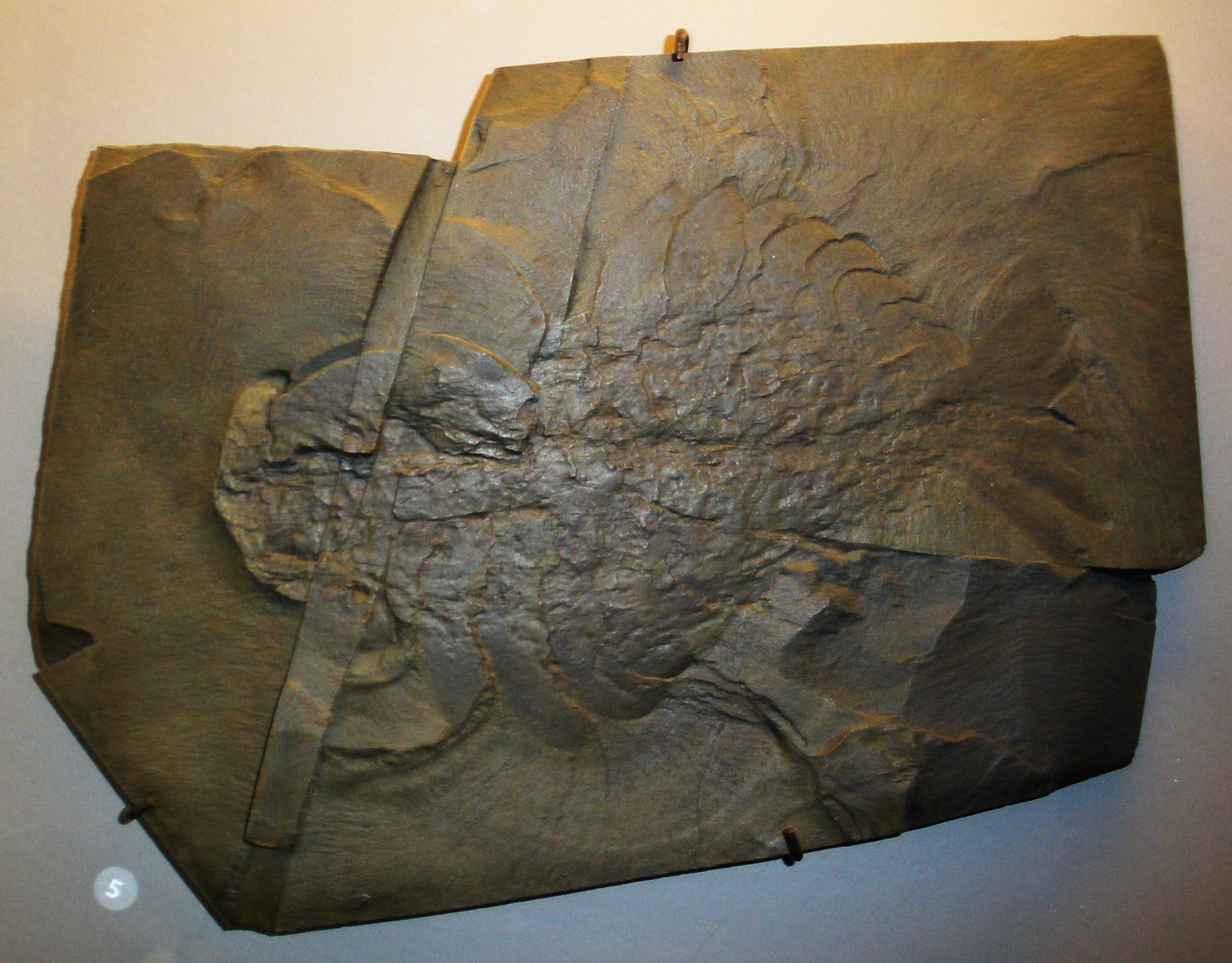
Anomalocaris canadensis has long been cast as the Cambrian's nightmare animal: huge for its time, equipped with grasping frontal appendages, ringed mouthparts, and the swagger of an apex predator before vertebrates mattered very much in the sea. That image survives because it is memorable. It also blurs the more interesting scientific story. The closer paleontologists have read the mouth, body, and appendages, the less Anomalocaris looks like a crude shell-crushing monster and the more it looks like a highly specific swimming predator built for a narrower set of jobs.[1][2][3][4]
That correction matters because Anomalocaris is one of those fossils that still organizes how the public imagines Cambrian life. From the Burgess Shale of British Columbia, it remains among the largest known animals of its interval, reaching roughly half a meter in length in the 1985 reconstruction by Harry Whittington and Derek Briggs.[1] Yet size is not the real reason the animal keeps returning. It returns because it was assembled out of parts once misunderstood as different organisms entirely, and each later revision has made the animal stranger but also more defensible.[1][2][3]
Image context: the lead image is a museum photograph of an Anomalocaris canadensis fossil from Wikimedia Commons. It works for this article because the specimen itself, flattened and incomplete, makes the main point visible at once: this animal has always had to be reconstructed by reading preserved pieces carefully rather than by inheriting the most dramatic old reconstruction.[5]
1) The first surprise was that the parts belonged to one animal
The classic 1985 paper mattered because it consolidated what had previously looked like separate Cambrian oddities.[1] Isolated frontal appendages had been described under the name Anomalocaris canadensis. The strange oral structure had been treated as the medusoid Peytoia. Other body material had circulated under yet another taxonomic label. Whittington and Briggs showed that these belonged to the same broad animal complex, turning a taxonomic collage into a coherent predator.[1]
That act of assembly is part of the species profile, not just a preface to it. Anomalocaris entered paleontology as a reconstruction problem before it entered as an ecological character. The 1985 description already gave it the outlines that still matter: a large body for the Cambrian, paired lateral eye lobes on short stalks, one pair of spinose frontal appendages at the front, and a swimming body plan rather than a benthic crawler's frame.[1]
This is why Anomalocaris remains such a useful animal to profile. It reminds readers that some famous fossils are not important because one perfect specimen settled everything. They are important because later work keeps tightening the fit between parts that were once overread, separated, or forced into the wrong organismal template.
2) The mouth changed the animal more than the size did
For years the public image of Anomalocaris carried a rigid, pineapple-ring mouth: a classic "Peytoia" oral cone with four large plates in a neat tetraradial pattern. Daley and Bergström's 2012 paper reset that picture.[2] Their conclusion was blunt. The oral cone of Anomalocaris was not the classic peytoia form. Instead, it had three large plates and a more variable arrangement of medium and small plates.[2]
That sounds like a small anatomical correction. It is not. Once the mouth is no longer imagined as a symmetrical crushing device, the whole feeding story shifts. Daley and Bergström argued that the functional morphology points more toward suction than toward forceful biting, and more toward varied predatory or scavenging strategies than toward one specialized role as a trilobite breaker.[2]
This is the point where Anomalocaris becomes more convincing, not less theatrical. The old shell-crusher image was vivid because it was mechanically simple: big claws, hard mouth, smashed trilobites. The revised oral cone makes the animal less cartoonish and more biologically specific. It suggests a predator whose feeding apparatus had real constraints, a mouth that did not solve every prey problem the same way, and an ecology that has to be inferred from structures that do not all push toward brute force.[2][4]
3) The 2014 morphology paper made the body read as a swimmer, not a floating head with claws
Daley and Edgecombe's 2014 redescription is where the species becomes anatomically higher-resolution.[3] Looking across all known A. canadensis material, including previously unpublished specimens, they described a small oval carapace associated with paired stalked eyes, a ventral surface bearing only the triradial oral cone, and a posterior body equipped with digestive, respiratory, and locomotory structures more elaborate than many older reconstructions had conveyed.[3]
The details matter because they pull Anomalocaris away from the monster-poster silhouette. The body included a differentiated foregut and hindgut, a midgut with paired glands, gill-like setal blades, and evidence of muscle bundles and internal supports linked to the swimming movement of the flaps.[3] The tail fan also gained a central blade in addition to the lateral blades already known.[3] Put together, this is not a generic "top predator body." It is a carefully organized radiodont body built to move water, process food, and stay mechanically coherent.
That is a better way to understand why Anomalocaris mattered in the Cambrian. Not because it was simply large and armed, but because it represented an early arthropod-grade experiment in coordinated swimming predation. The body plan now reads as an engineered package: eyes, mouth, appendages, flaps, gill structures, and tail elements all contributing to motion and capture in the water column.[1][3]
4) The appendages no longer support the old trilobite-crusher legend very well
The 2023 Proceedings of the Royal Society B paper by Bicknell and colleagues attacked one of the most durable stories around Anomalocaris: that it was the obvious culprit behind injuries on Cambrian trilobites and that its frontal appendages were built to tackle biomineralized prey head-on.[4] Their approach combined three-dimensional modelling, kinematics, finite-element analysis, and computational fluid dynamics to test what an A. canadensis appendage could plausibly do.[4]
The answer was narrower than the legend. The appendages still read as raptorial, but not as good tools for durophagy.[4] Under the loads expected from handling hard-shelled prey, parts of the appendage would have been prone to substantial deformation.[4] The same structures performed better in a speed-oriented capture scenario aimed at softer prey.[4]
That does not demote Anomalocaris from predator status. It sharpens the predator profile. An animal can be an apex hunter without being a universal shell-crushing solution to every Cambrian food-web puzzle. In fact, the newer model is stronger precisely because it limits the claim. Anomalocaris looks more like a fast, visually guided capture predator working within material constraints than like a mythic machine for shredding trilobites on command.[2][3][4]
5) What the species profile can support, and what it should leave alone
High confidence first. Anomalocaris canadensis was a large Cambrian radiodont from the Burgess Shale, assembled historically from once-separated body parts, equipped with stalked eyes, raptorial frontal appendages, a now-revised oral cone, and a swimming body plan that included flaps and a structured tail fan.[1][2][3] The best current functional reading also supports a predator oriented more toward soft-prey capture and speed than toward cracking mineralized armor with brute force.[4]
The boundaries matter too. This article does not prove that every injured trilobite in the Cambrian was misattributed, and it does not turn Anomalocaris into a gentle filter-feeder by overcorrecting against older drama. The point is narrower. Once the mouth and appendages are read on their own terms, the strongest version of the animal is no longer the loudest one.[2][4]
That is why Anomalocaris canadensis still deserves its fame. It remains one of the iconic predators of early animal history, but its scientific value now lies less in raw ferocity than in revision discipline. Paleontology kept the animal famous while stripping away the parts of the legend that were mechanically too easy. What remains is better: a Burgess Shale hunter whose body makes sense when the evidence is allowed to be exact.
Sources
- Harry B. Whittington and Derek E. G. Briggs (1985), Philosophical Transactions of the Royal Society B: "The largest Cambrian animal, Anomalocaris, Burgess Shale, British Columbia."
- Allison C. Daley and Jan Bergström (2012), Naturwissenschaften: "The oral cone of Anomalocaris is not a classic 'peytoia'."
- Allison C. Daley and Gregory D. Edgecombe (2014), Journal of Paleontology: "Morphology of Anomalocaris canadensis from the Burgess Shale."
- Russell D. C. Bicknell, Lars E. De Vivo, Javier Ortega-Hernández, and colleagues (2023), Proceedings of the Royal Society B: "Raptorial appendages of the Cambrian apex predator Anomalocaris canadensis are built for soft prey and speed."
- Wikimedia Commons file page for the photographed Anomalocaris canadensis fossil used as the lead image.