Berlin-Ichthyosaur State Park is easy to misread because it offers two kinds of spectacle at once. One is the preserved Nevada mining town. The other is the Fossil House, where giant marine-reptile bones remain in the rock instead of being cleaned into a conventional museum mount.[1][2] The stronger field reading starts with the second spectacle and narrows it. This site matters less because Shonisaurus popularis was huge and more because the quarry keeps a long argument visible: how a concentration of giant Late Triassic ichthyosaurs formed, whether it records one disaster or repeated returns, and what that says about marine-tetrapod behavior roughly 225 million years ago.[1][3]
That is why the park still feels current in 2026. Nevada State Parks describes Berlin-Ichthyosaur as the place where North America's most abundant concentration of the largest known ichthyosaur remains is protected and displayed, and it emphasizes that the fossils stay at the park's Fossil House rather than disappearing into a generic gallery case.[1] The historical page adds the institutional reason this matters: the park was established in 1957 specifically to protect and display this concentration, long before most visitors arrived for the ghost-town half of the experience.[2] The site is therefore not just a scenic container for old bones. It is a preserved field problem.
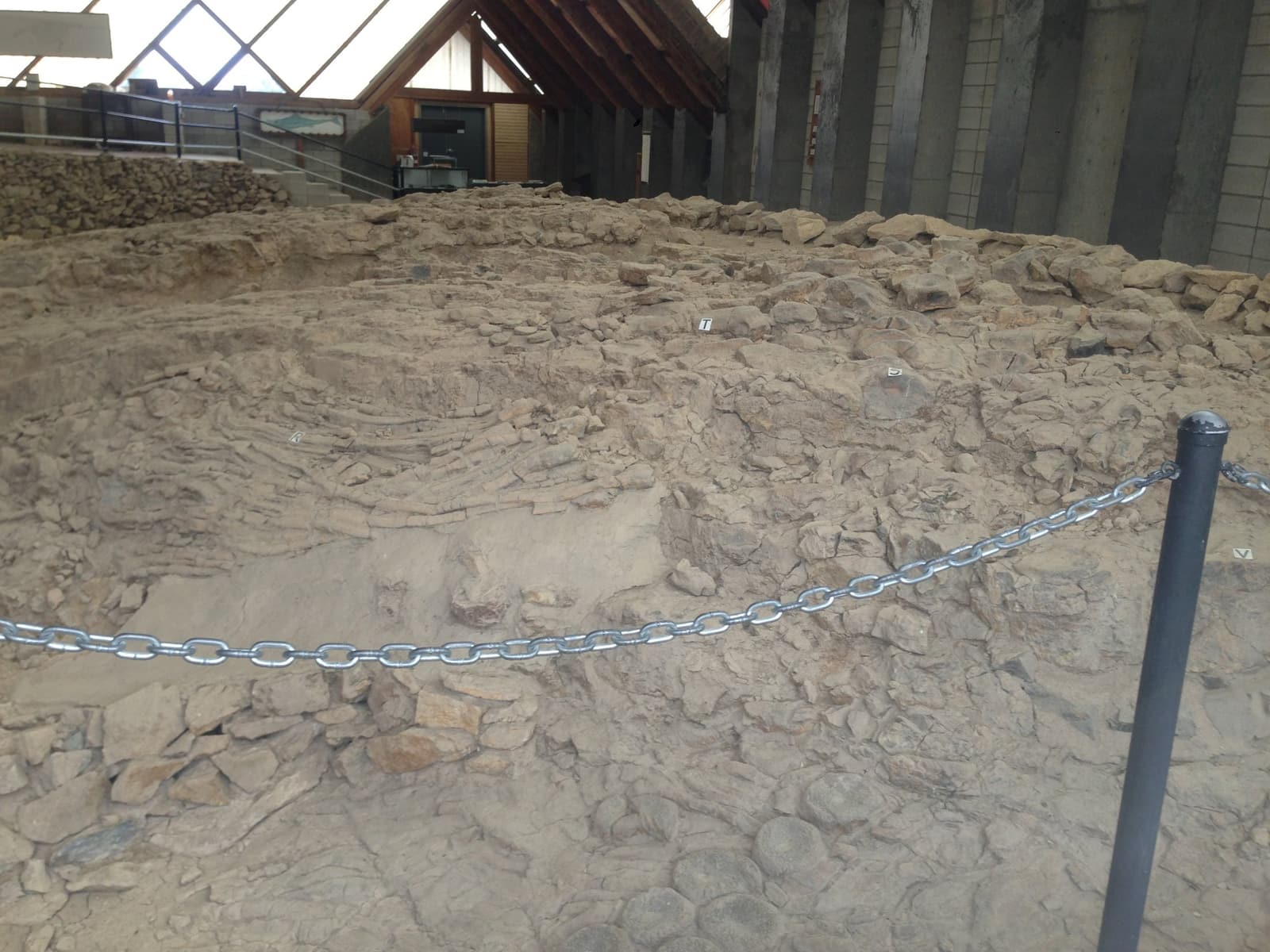
Image context: the cover uses a real Wikimedia Commons photograph taken inside the fossil shelter at Berlin-Ichthyosaur State Park. It belongs here because this article is about in-place accumulation and bedding-plane context. The exposed bones and quarry surface show why the site works better as a geological and behavioral puzzle than as a simple "largest ichthyosaur" postcard.[6]
The Fossil House changes the scale of the argument
The park page gives the broad frame in one sentence: central Nevada lay under a warm ocean about 225 million years ago, and the remains now protected at Berlin-Ichthyosaur belong to giant ichthyosaurs that swam there.[1] That sounds like standard deep-time scene setting until the reader reaches the Fossil House. There, the site stops behaving like a taxon label and starts behaving like an outcrop. The bones are still laid out across the quarry floor, and the visitor is forced to see the assemblage as a patch of rock with multiple individuals, orientations, and stratigraphic relationships rather than as one idealized animal.[1][5][6]
That shift in scale is the entire value of the locality. A skeleton on a museum armature can teach anatomy. A preserved quarry can also teach distribution, association, and the difference between a single carcass and a long-lived accumulation. Berlin-Ichthyosaur remains valuable because it never fully lets the reader forget that Shonisaurus is being studied through a site, not through a lone celebrity specimen.[1][3][5]
The older story was one dramatic die-off
The park's scientific afterlife began with a dramatic interpretation for good reason. Smithsonian's 2015 reconstruction of the field history notes that the main bone bed was discovered in 1928, then excavated heavily in the 1950s and 1960s by Charles Camp and Samuel Welles.[5] Those excavations revealed nearly 40 individuals of one of the largest marine reptiles known at the site, and the density of the concentration encouraged a familiar comparison: a mass stranding analogous to modern whales beached together.[5]
That older reading had real intuitive force. A giant body concentration invites catastrophe language. But the same Smithsonian account also records why the model weakened. The bones and surrounding rock did not behave like a shoreline death scene. Later work showed the animals had been deposited in deeper water, which made a simple mudflat-stranding story harder to sustain.[5] Once that shoreline analogy loosened, Berlin-Ichthyosaur became scientifically better, because the site had to be explained from sediment, demography, and repeated occurrence rather than from one memorable disaster image.
The newer story is repeated return, not one afternoon
The 2022 Current Biology paper is the cleanest reason the site has changed meaning.[3] Kelley and colleagues kept the famous bedding plane in view but widened the frame far beyond it. Their summary states that Shonisaurus remains are preserved across roughly 10^6 square meters and about 200 stratigraphic meters of outcrop, representing an estimated more than 10^5 to 10^6 years of accumulation.[3] That scale alone pushes against the fantasy of one singular event.
The demographic pattern matters even more. The paper reports that the assemblage is essentially monotaxic, that other vertebrates are rare, and that large adults dominate except for multiple embryos or neonates.[3] Nature's research highlight translated the implication into plainer language: adult and infant fossils together make the site look less like a random graveyard and more like a place where giant ichthyosaurs congregated to have their young, in a way loosely analogous to migratory whale breeding grounds.[4] The point is not that every detail of Shonisaurus social life has been solved. The point is that the quarry now supports a repeated-return model better than a single-kill model.
The authors were also careful about what the rocks do not show. Their highlights note that they found no evidence for a major environmental perturbation driving the concentration.[3] That negative result is important. It keeps the article from drifting back into bloom, poison, or sudden basin-crisis storytelling just because those stories are vivid. Berlin-Ichthyosaur is now strongest as a locality where behavior, basin setting, and demographic filtering all have to be argued together.
Why the site still holds
The most defensible field report is therefore a layered one. Berlin-Ichthyosaur is still a ghost town, still a state park, still a dramatic road-trip stop.[1][2] But its real paleontological force sits one level deeper. The quarry records giant marine reptiles in place, preserves the history of an older mass-death interpretation, and now points toward repeated adult use of a low-diversity latest-Carnian marine setting in which embryos or neonates also appear.[3][4][5]
That is why the Fossil House matters more than the postcard image of a Triassic leviathan. The site keeps the reader inside the evidentiary middle distance where paleontology does its best work. You can see the bones. You can see that they belong to more than one animal. And you can see why the argument shifted from one catastrophic afternoon to a longer ecological return. Berlin-Ichthyosaur remains compelling because the quarry still makes that shift visible.
Sources
- Nevada State Parks, "Berlin-Ichthyosaur State Park" - official park page covering the 225-million-year setting, the Fossil House, and the protected concentration of giant ichthyosaur remains.
- Nevada State Parks, "History of Berlin Ichthyosaur State Park" - official history page noting the park's 1957 establishment to protect and display the fossil concentration.
- Neil P. Kelley and others, "Grouping behavior in a Triassic marine apex predator," Current Biology 32, no. 24 (2022) - summary page with assemblage scale, demographic structure, and the reproductive-grouping interpretation.
- Nature, "Bone bed hints at a birthing ground for marine reptiles bigger than buses" (2022) - research highlight summarizing the adult-and-infant pattern and breeding-ground interpretation.
- Smithsonian Magazine, "What Killed These Marine Reptiles Found in a Nevada Ghost Town?" (2015) - field-history summary of the 1928 discovery, Camp and Welles excavations, and the shift away from a simple stranding explanation.
- Wikimedia Commons file page for the Fossil House quarry photograph used as the article image.