A fossil fish need not arrive with a spine, fins or even a tooth. It can arrive as a small mineral object that once sat inside its head. Otoliths, the ear stones used in hearing and balance, have become the basis of an extensive fossil catalogue: Dirk Nolf's 2013 synthesis recognized 1,391 valid fossil species in its survey of otolith diversity.[1][3]
The attraction is easy to understand. A recognizable fragment can restore an animal to a vanished sea. The difficulty begins with that word “recognizable.” An ear stone carries anatomical information, but the fish it resembles today may be a misleading guide to the fish that produced it millions of years ago.[5]
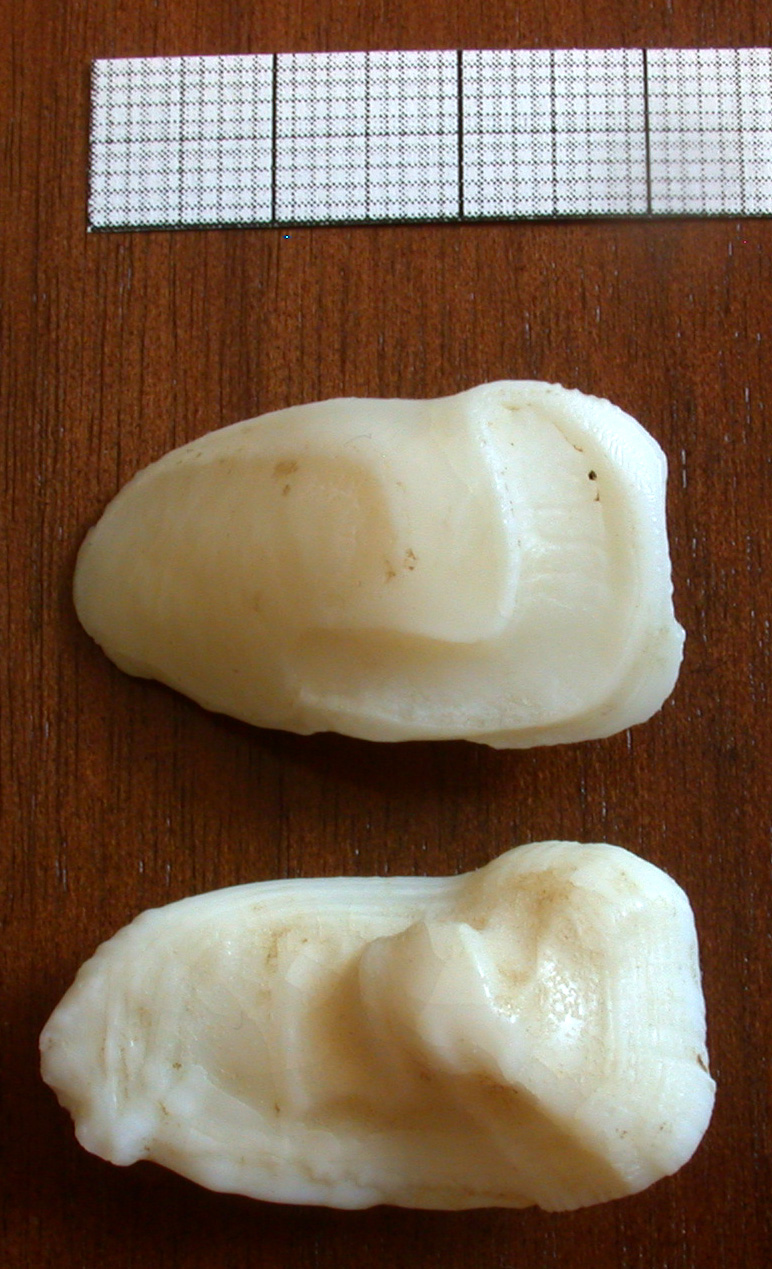
A mineral object grown by an animal
Ear stones are calcium carbonate structures associated with the inner ear. Bony fish have three pairs, varying in size and shape. They grow by adding material to their surfaces throughout the animal's life. Seasonal differences in that growth can produce alternating translucent and opaque zones, which fisheries scientists use to estimate age.[1]
This gives the object two different kinds of information. Its overall form can help identify its owner; its internal growth pattern can record something about that individual's life. The distinction matters in paleontology. Recognizing a fossil's outline does not automatically establish how much of its original internal record survives.
A reference collection makes those comparisons possible. Nolf's catalogue illustrates otoliths from nearly all living fish families and subfamilies, alongside fossil material. It also records the geological and geographical origins of fossil type specimens and, where available, their museum numbers and repositories.[3] The name on a specimen is therefore attached to a comparison that another researcher can revisit. An isolated stone remains part of a larger body of evidence.
Reassembling a sea from fragments
The scale of that contribution becomes clearer in a regional inventory. Konstantina Agiadi's review of Greece's fossil otolith record reported 122 fish species from 27 localities. Different fish groups were represented unevenly by skeletons and otoliths, making the two records complementary.[4]
The strongest Greek record in that review came from marine Pleistocene deposits in the Ionian and Aegean regions. Freshwater fish, by contrast, had received much less research attention. Some intervals also remained poorly documented.[4] A rich collection consequently reflects both the ancient fauna and the places where people have searched carefully enough to recognize it.
That is a useful restraint on the imagined scene. A list of identified species provides evidence for reconstructing an ecosystem; a gap in that list can also record missing work. An empty drawer of freshwater otoliths cannot, by itself, establish an empty ancient lake.
When an outline acquires the wrong name
The comparison becomes harder deeper in time. In a 2018 review of Jurassic and Early Cretaceous otoliths, Werner Schwarzhans treated many assignments to higher fish groups as provisional. Numerous Mesozoic lineages are extinct, and relatively few fossil ear stones had been found inside identifiable fish skeletons.[5]
The same review reassessed species based on very small, probably juvenile specimens or poorly preserved material. Some names were combined; others were considered doubtful. Early otolith shapes could also be remarkably uniform across different environments.[5]
These problems act in opposite directions. A young or damaged specimen may look different enough to encourage an unnecessary new name. A broadly shared shape may make separate lineages appear deceptively alike. A persuasive identification must account for the specimen's condition and the range of plausible owners, rather than choosing the closest modern silhouette.
The fish still holding its ear stones
Occasionally, the two records meet inside a skull. In a separate 2018 study, Schwarzhans and colleagues used micro-computed tomography to investigate otoliths preserved within three-dimensional fossil fish skulls. Scanning revealed concealed structures without cutting the fossils apart.[6]
One result concerned Apateodus, an extinct aulopiform fish from the Late Cretaceous. Its ear stones resembled isolated fossils previously assigned to gempylids, the snake-mackerel family. The association inside the skull changed the identification: the isolated stones could be connected to an extinct fish instead of extending the record of the living family backwards.[6]
The authors interpreted this resemblance as convergence and suggested that similar demands on open-water predators could help explain it. That ecological explanation is an inference; the physical association between skull and otolith is the firmer observation. A tiny object found in place can thus correct the evolutionary story attached to many loose specimens.[6]
What the mineral kept
Preservation poses another question: how much of the original ear stone remains? In 2023, Jarosław Stolarski and colleagues examined fossil hake otoliths from the Korytnica Clays of central Poland, dating to about 14.8–14.6 million years ago, in the Miocene. The specimens retained aragonite, the calcium carbonate mineral that originally formed them, with fine structure closely matching modern examples.[7]
The team reported eleven fish-specific proteins in the fossils. Water-impermeable clay and the exceptionally intact mineral structure provided the setting for this unusual survival. The result extends what an otolith can preserve beyond its external shape, but it depends on the condition of the particular material. It does not make every fossil ear stone a molecular archive.[7]
The photographed modern specimens offer a useful starting point: a tangible object whose contours invite comparison. Recovering an ancient fish requires the rest of the work around it—reference specimens, geological context, scrutiny of preservation and, in especially valuable cases, an ear stone still inside its owner's skull. The smallness of the fossil makes that work easy to overlook. Its contribution can be an entire animal returned to view.
Sources
- NOAA Fisheries, “Age and Growth” — otolith anatomy, lifelong growth and seasonal increments used in fish ageing.
- Gunther Tschuch, “Argyrosomus regius Otolith.jpg,” Wikimedia Commons (2007) — original photograph, identification and attribution.
- Dirk Nolf, The Diversity of Fish Otoliths, Past and Present, Royal Belgian Institute of Natural Sciences (2013) — institutional overview of the reference catalogue and its specimen documentation.
- Konstantina Agiadi, “The fossil otolith record of fishes (Vertebrata: Teleostei) in Greece,” in Fossil Vertebrates of Greece, pp. 143–183 (2021 online publication) — institutional abstract on the regional inventory and research gaps.
- Werner Schwarzhans, “A review of Jurassic and Early Cretaceous otoliths and the development of early morphological diversity in otoliths,” Neues Jahrbuch für Geologie und Paläontologie – Abhandlungen 287 (2018), 75–121 — institutional abstract on taxonomic revision and limits of identification.
- Werner Schwarzhans and colleagues, “Computed tomography scanning as a tool for linking the skeletal and otolith-based fossil records of teleost fishes,” Palaeontology 61 (2018), 511–541 — study abstract and supporting data on Dryad (2019).
- Jarosław Stolarski and colleagues, “First paleoproteome study of fossil fish otoliths and the pristine preservation of the biomineral crystal host,” Scientific Reports 13 (2023), article 3822 — Korytnica material, mineral preservation and protein results.