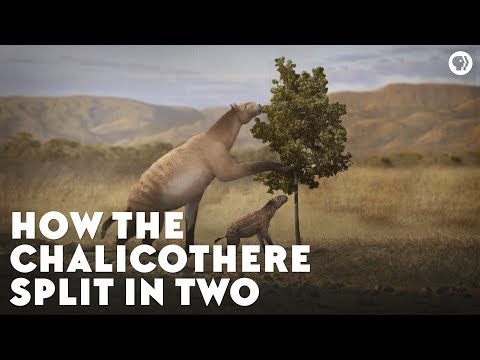
Chalicotheres are easy to turn into a punch line. They were odd-toed ungulates, relatives within the broad perissodactyl world of horses, rhinoceroses, and tapirs, but their hands and feet ended in claws rather than hooves.[2] That single contrast is so strange that it can swallow the animal. A "horse with claws" sounds like a mistake, a fantasy creature, or a prehistoric design problem. The PBS Eons video is useful because it starts with that strangeness and then asks the better question: what kind of herbivore makes sense once the claws are treated as anatomy with a job?[1]
The answer is not one animal, one posture, or one habitat. Chalicotheriidae is a family, and its history is clearest when split into two related but different experiments. A University of California Museum of Paleontology note on Moropus gives the useful starting boundary: chalicotheres were perissodactyls, they had claws instead of hooves, they were herbivores rather than predators, and those claws were probably used to pull vegetation down from trees.[2] The video then broadens that boundary into a family story, where different lineages solved browsing with different limb proportions and postures.[1]
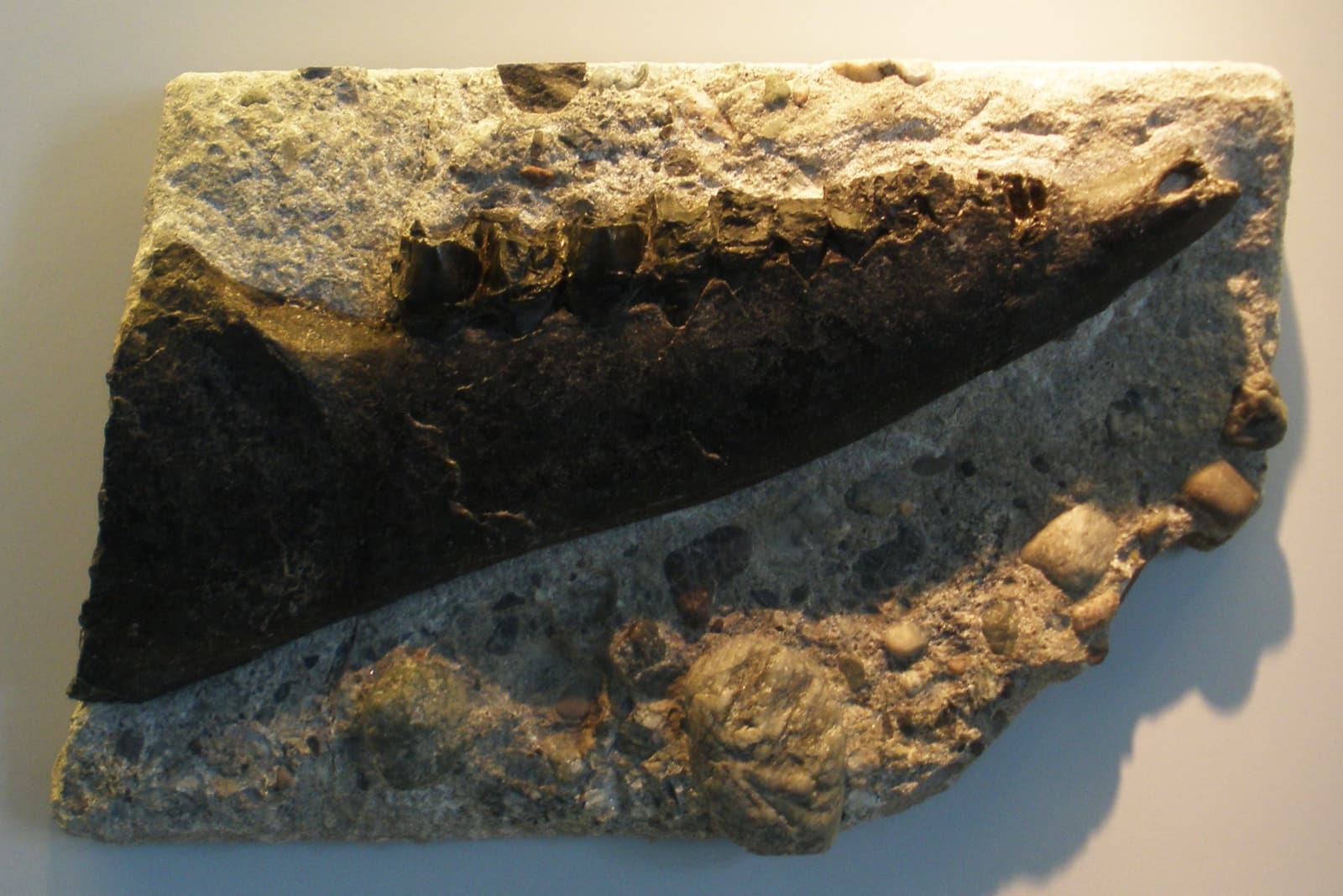
The cover image matters for that reason. It is not a life reconstruction, a diagram, or a joke about a hybrid animal. It is a real photograph of a mounted Chalicotherium fossil at the Paleontology Museum of Zurich.[5] The skeleton makes the article's central problem visible before the video begins. The front half of the animal carries the argument: long forelimbs, a lifted browsing reach, and hands that refuse the normal hoofed-mammal expectation.
The first thing to watch for is how the video treats claws as a functional clue rather than a monster detail.[1] Keratin claws themselves usually do not fossilize, but the bones at the ends of the digits preserve enough shape to show whether those digits carried claws or hooves.[2] That distinction is important because it moves the evidence away from fantasy and back into comparative anatomy. The fossil does not need preserved fingernails to prove the point. Modified hand and foot bones carry the inference.
Once the claws are accepted, the teeth prevent a second mistake. Chalicotheres were not clawed carnivores wearing herbivore bodies. Their dentition fits browsing. UCMP states the point plainly for Moropus: the claws were not for ripping prey apart, because these animals were herbivores.[2] The 2022 description of early Miocene material from the Lanzhou Basin puts the contrast even more directly: chalicotheriids combine claws, which are more familiar in large carnivores, with a herbivorous dental pattern unlike any living or extinct perissodactyls.[3] That is the productive tension. The hands look disruptive, but the mouth keeps the animal inside a plant-eating problem.
The video's title phrase, "split in two," is the key to avoiding a flat reconstruction.[1] Chalicotheres are usually divided into Chalicotheriinae and Schizotheriinae, mainly on dental and postcranial characters.[3][4] A viewer should not imagine a single chalicothere template spreading unchanged across deep time. Some forms kept more conservative limb proportions. Others pushed the long-forelimb browsing body harder. The family reached high diversity in the Miocene and ranged widely across Eurasia, Africa, North America, and even into Central America, but the fossil record does not make that distribution a single ecological story.[3]
That is where the Lanzhou Basin paper helps sharpen the video. Li and colleagues describe a schizotheriine mandible from early Miocene northwest China and interpret the local fauna as suggesting open woodland and a more humid paleoclimate in that basin.[3] The point is not that every chalicothere lived in the same kind of woodland. The point is that the fossils have to be read with locality, age, and associated fauna attached. A clawed browsing ungulate in an early Miocene Chinese basin is not just a body plan; it is part of a regional mammal community and a reconstructed landscape.
The 2023 Romanian material adds a second correction: the two subfamilies did not always occupy the record in neat isolation, but verified coexistence is uncommon.[4] At Pogana 1, researchers identified a schizotheriine, Ancylotherium pentelicum, and an indeterminate chalicotheriine from the same fossiliferous horizon, making the locality one of the few cases where both subfamilies can be securely shown together.[4] That detail changes how to watch the "split" in the video. A split is not a clean map with one kind on one side and one kind on the other. It is a branching family history with rare overlaps, regional filters, and fossil-site limits.
The most useful timestamp habit while watching is to pause whenever the video shifts from silhouette to mechanism.[1] A long arm is not an answer by itself. Ask what the shoulder, wrist, fingers, neck, and teeth allow the animal to do together. A claw is not an answer either. Ask whether it could pull branches, support a rearing posture, or fit a browsing style in which the forelimbs helped bring food within reach. The strongest reconstruction is not "it looked strange." It is "the strange parts agree with each other enough to suggest a feeding strategy."
This also explains why comparisons to gorillas or giant sloths are helpful only if they stay analogies.[1] They point toward posture and branch-pulling, not ancestry. Chalicotheres were perissodactyl mammals, and their oddity sits inside that lineage.[2][3] The better comparison is not a creature mashup; it is a functional question shared by unrelated animals: how does a large herbivore reach, grasp, crop, and process higher vegetation without turning the whole body into a modern giraffe?
The final thing the video gets right is that extinction is part of the shape of the family, not just its ending.[1] UCMP summarizes the wide range simply: chalicotheres lived in North America, Europe, Asia, and Africa, and all are now extinct.[2] The technical literature adds the deeper pattern: Miocene diversity, regional faunas, rare verified coexistence between the two subfamilies, and a fossil record that has to be read site by site rather than as one global silhouette.[3][4] Chalicotheres were not failed horses. They were a long-running mammalian experiment in clawed browsing, with multiple lineages, wide geography, and enough anatomical coherence to last for many millions of years.
That is the reason to give this video an annotated viewing rather than a quick curiosity link. Chalicotheres reward the moment when the viewer stops laughing at the claws and starts asking what the claws solved. The hands make the animal weird; the teeth make it herbivorous; the limb proportions make posture matter; the fossil localities make environment matter; and the subfamily split keeps the reconstruction from collapsing into a single mascot. Once those pieces are held together, the chalicothere stops being a prehistoric gag and becomes a serious browsing machine built on a body plan no living ungulate kept.
Sources
- PBS Eons, "How the Chalicothere Split In Two," YouTube video.
- University of California Museum of Paleontology, "One more Moropus" - short museum note on chalicotheres as clawed herbivorous perissodactyls and the likely vegetation-pulling role of the claws.
- Zhaoyu Li, Thomas Mors, Yunxiang Zhang, Kun Xie, and Yongxiang Li, "New Material of Schizotheriine Chalicothere (Perissodactyla, Chalicotheriidae) from the Xianshuihe Formation (Early Miocene) of Lanzhou Basin, Northwest China," Journal of Mammalian Evolution, 2022.
- Panagiotis Kampouridis, Bogdan Gabriel Ratoi, and Laurentiu Ursachi, "New evidence for the unique coexistence of two subfamilies of clawed perissodactyls (Mammalia, Chalicotheriidae) in the Upper Miocene of Romania and the Eastern Mediterranean," Journal of Mammalian Evolution, 2023.
- Wikimedia Commons, "File:Chalicotherium.JPG" - source page for the real fossil skeleton photograph used as the article image.