When Harry Whittington presented his redescription of Opabinia regalis at a symposium in 1972, the audience reportedly laughed. The laughter was not dismissive but involuntary — the reaction of scientists confronted with an animal so geometrically improbable that the first response was disbelief. Five stalked eyes. A flexible frontal nozzle terminating in a claw. Lateral lobes arranged in pairs along the body. Nothing alive resembles it. Nothing in the fossil record up to that point had prepared anyone to read it correctly either.[1][2]
Whittington's 1975 paper in the Philosophical Transactions of the Royal Society is the founding document.[1] What he produced was not just a description but a demonstration: Cambrian body plans were genuinely strange, not merely incompletely preserved. Opabinia did not fit any existing phylum, and the attempt to force it into one — Charles Doolittle Walcott's original 1911 crustacean interpretation — had simply been wrong for sixty years.[1][2]
1) Age, formation, and material
Opabinia regalis is a middle Cambrian animal, preserved in the Burgess Shale Formation of British Columbia, dated to approximately 505 million years ago. The Walcott Quarry horizon is its primary locality, though Burgess-type preservation windows in other Cambrian sites have since produced related material that informs the broader opabiniid picture.[1][2][3]
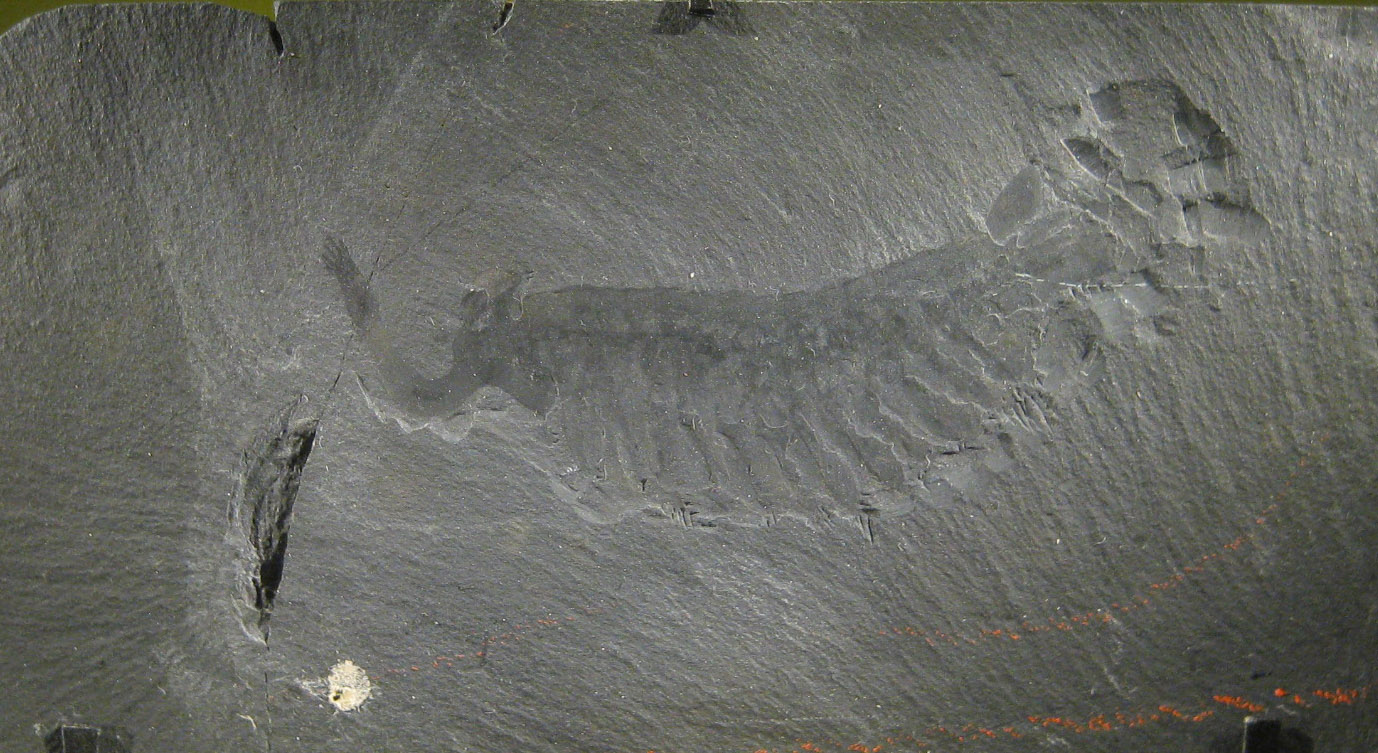
The original Smithsonian specimens — collected by Walcott between 1909 and 1924 — are flat, dark compressions in grey mudstone. Adult body length runs roughly 4 to 7 centimeters. The Burgess Shale's anoxic burial conditions suppressed microbial decay long enough to capture soft-tissue outlines, which is the only reason any of Opabinia's anatomy is readable at all. Remove that taphonomic window and the animal would be unknown.[1][2]
2) What the body actually shows
Five eyes sit on stalks above a head shield: two pairs positioned laterally, and one median eye forward-facing. No living arthropod has five eyes arranged this way. The compound eye hypothesis is debated — they may or may not be structurally equivalent to the compound eyes of living arthropods — but their position and number are stable data points across all specimens.[1][2]
The frontal appendage is the structure that has driven the most theoretical work. It is a flexible, forward-projecting tube that terminates in a spinose claw, giving the animal the appearance of an elephant's trunk ending in a grasping hand. Whittington interpreted it as a feeding organ: extending forward, possibly seizing prey or food particles, then folding back toward a mouth that faces backward and downward on the ventral surface.[1]
That backward-pointing mouth is another Opabinia peculiarity. In most living arthropods, the mouth faces forward or downward in an anterior position. In Opabinia, the arrangement is inverted — which suggests either that the frontal appendage transfers food rearward to the mouth, or that feeding mechanics in this group operated on a fundamentally different spatial logic than anything living today.[1][2]
The lateral lobes — flap-like extensions along each body segment, arranged in overlapping pairs — are the primary swimming apparatus. They are not the jointed appendages of arthropods; they are soft, paddle-like lobes that extend and probably undulated to move the animal through the water column.[1][2]
3) The classification problem: where does Opabinia fit?
For most of its post-1975 history, Opabinia occupied an uncomfortable position: acknowledged as important, but not clearly placed within any existing phylogenetic framework. The animal did not fit Crustacea, did not fit Chelicerata, and did not fit any other arthropod subgroup with confidence.[1][2]
The most productive framing that emerged treated Opabinia as a member of the euarthropod stem group — the broad pre-arthropod grade that includes animals with some arthropod features but not the full complement of jointed appendages and a hardened exoskeleton. Within that stem, the frontal appendage connects Opabinia to a wider group of Cambrian predators now called radiodonts (which includes Anomalocaris and its allies), sharing the basic logic of a frontal grasping appendage even if the specific anatomy differs.[2][3]
The opabiniid position within or beside Radiodonta has been refined by two significant results. Moysiuk and Caron's 2022 description of Utaurora comosa — the second known opabiniid — provided new comparative anatomy for the group.[3] Where Opabinia had been an isolated data point, Utaurora created a minimal phylogenetic cluster, and the shared features between the two (body plan, appendage position, lobe arrangement) tightened the opabiniid diagnosis and allowed more confident placement within the euarthropod stem.[3]
Pates and colleagues in 2022 added a further dimension by describing Ordovician animals with opabiniid-like proboscis structures, which pushed the record of this body-plan element later in time than previously expected and raised questions about the relationship between the proboscis and how the arthropod head was assembled evolutionarily.[4]
4) What the frontal appendage says about arthropod head evolution
The proboscis is not merely a feeding structure. It has become a contested piece of evidence in one of the larger debates in evo-devo and paleontology: how did the arthropod head evolve, and which anterior structures in Cambrian animals are homologous to what?
Living arthropods have a complex head formed by the fusion of multiple segments, each contributing appendages (antennae, mandibles, maxillae) that serve different functions. The evolutionary question is whether the frontal appendage in Cambrian animals like Opabinia and the radiodonts is homologous to arthropod antennae, to the chelicerae of spiders and scorpions, or to some anterior structure that was lost or transformed in the transition to crown-group arthropods.[2][3][4]
No consensus exists, but the question is better constrained than it was before Utaurora and the Ordovician opabiniid material. The proboscis sits at a boundary between "structurally unique to these Cambrian taxa" and "a modified early version of something that later became the arthropod antenna or its developmental precursor." Resolving that boundary requires more opabiniid specimens and, eventually, better data on the developmental genetics of appendage specification — data that fossils alone cannot provide.[3][4]
5) The evidence boundary: what remains uncertain
Several Opabinia claims are better supported than others, and the profile is stronger when those boundaries are kept visible.
The five-eye count is highly stable: it appears consistently across multiple specimens at both Burgess Shale and other Cambrian preservation windows.[1][2]
The frontal appendage's feeding function is a reasonable inference from the anatomy — the spinose claw at the end suggests prey capture rather than substrate filtering — but the exact mechanics are not recoverable from flattened compressions.[1]
Color, behavior, and life mode are not preserved. The lateral lobes suggest a swimmer rather than a benthic crawler, and the soft body without mineralized armor suggests the animal was not using a hard exoskeleton for protection, but neither inference carries certainty.[1][2]
The precise phylogenetic position — whether Opabinia is a radiodont, a sister group to radiodonts, or occupies some other specific node in the euarthropod stem — remains an open question depending on which characters are coded and how they are weighted in any given analysis.[2][3]
6) Why the laughter mattered
The symposium reaction in 1972 is sometimes repeated as a curiosity, but it marks something real in the history of paleontology. Before Whittington's Burgess Shale program, the assumption that Cambrian animals were recognizable precursors of modern phyla was close to universal. Opabinia made that assumption explicitly untenable. An animal with five eyes and a frontal nozzle was not a degraded ancestor of anything living — it was evidence that the Cambrian had produced body plans the subsequent 500 million years simply did not preserve.
That conclusion has been refined but not reversed. Opabinia did not represent a "failed experiment" in the Stephen Jay Gould sense that it was competitively eliminated; it was part of a successful diversification whose survivors went on to become arthropods. But the body plan itself — proboscis, five eyes, lobed body, backward-facing mouth — did not persist. What did persist was something more abstract: the developmental toolkit that built anterior appendages, compound visual systems, and segmented swimming bodies. Opabinia is the best available fossil evidence for what that toolkit looked like before it was standardized.[1][2][3]
Sources
- H.B. Whittington, "The enigmatic animal Opabinia regalis, middle Cambrian, Burgess Shale, British Columbia." Phil. Trans. R. Soc. London B 271(910): 1–43, 1975.
- Royal Ontario Museum Burgess Shale — Opabinia regalis specimen and description overview.
- Joseph Moysiuk and Jean-Bernard Caron, "New opabiniid diversifies the weirdest wonders of the euarthropod lower stem group." Proc. R. Soc. B 289(1968), 2022.
- Stephen Pates, Joseph P. Botting, Lucy A. Muir, et al., "Ordovician opabiniid-like animals and the role of the proboscis in euarthropod head evolution." Nature Communications 13, 6223, 2022.