
Mounted dinosaur skeletons are often introduced as if they sit on a clean line between true and false. Either the bones are "real," in which case the display feels authoritative, or they are casts, in which case the display is quietly demoted to spectacle. The Science Museum of Minnesota's short Diplodocus video is useful because it breaks that bad binary immediately.[1] It teaches the eye to look for texture, color variation, plaster seams, field numbers, and support hardware, then turns a familiar gallery skeleton into a readable object.
That shift matters because large sauropod mounts were almost never built from one magically complete skeleton. The Carnegie Diplodocus carnegii that made "Dippy" famous was mounted in 1907, but later scholarship shows that its composition was always more complex: real bone from four individuals was combined with casts and sculpted replacements from six further specimens, including material now understood to have come from rather distant relatives.[4] Once that history is in view, a composite mount stops looking like a cheat. It starts looking like a record of how paleontology actually works under conditions of incompleteness.
The museum history around Diplodocus makes the same point from another direction. Carnegie's original specimen in Pittsburgh generated a whole network of plaster replicas for London, Berlin, Paris, Vienna, St. Petersburg, Bologna, La Plata, Madrid, and Mexico City, turning one Wyoming sauropod into a global ambassador for dinosaur science.[3][5] The Natural History Museum's own page on Dippy says the London cast was based on Carnegie's original specimen, and also notes that its tail was raised in 1993 after research showed Diplodocus would not have dragged it on the ground.[2] That one correction is the real subject of this article. Museum mounts are not static truth monuments. They are revised arguments in three dimensions.
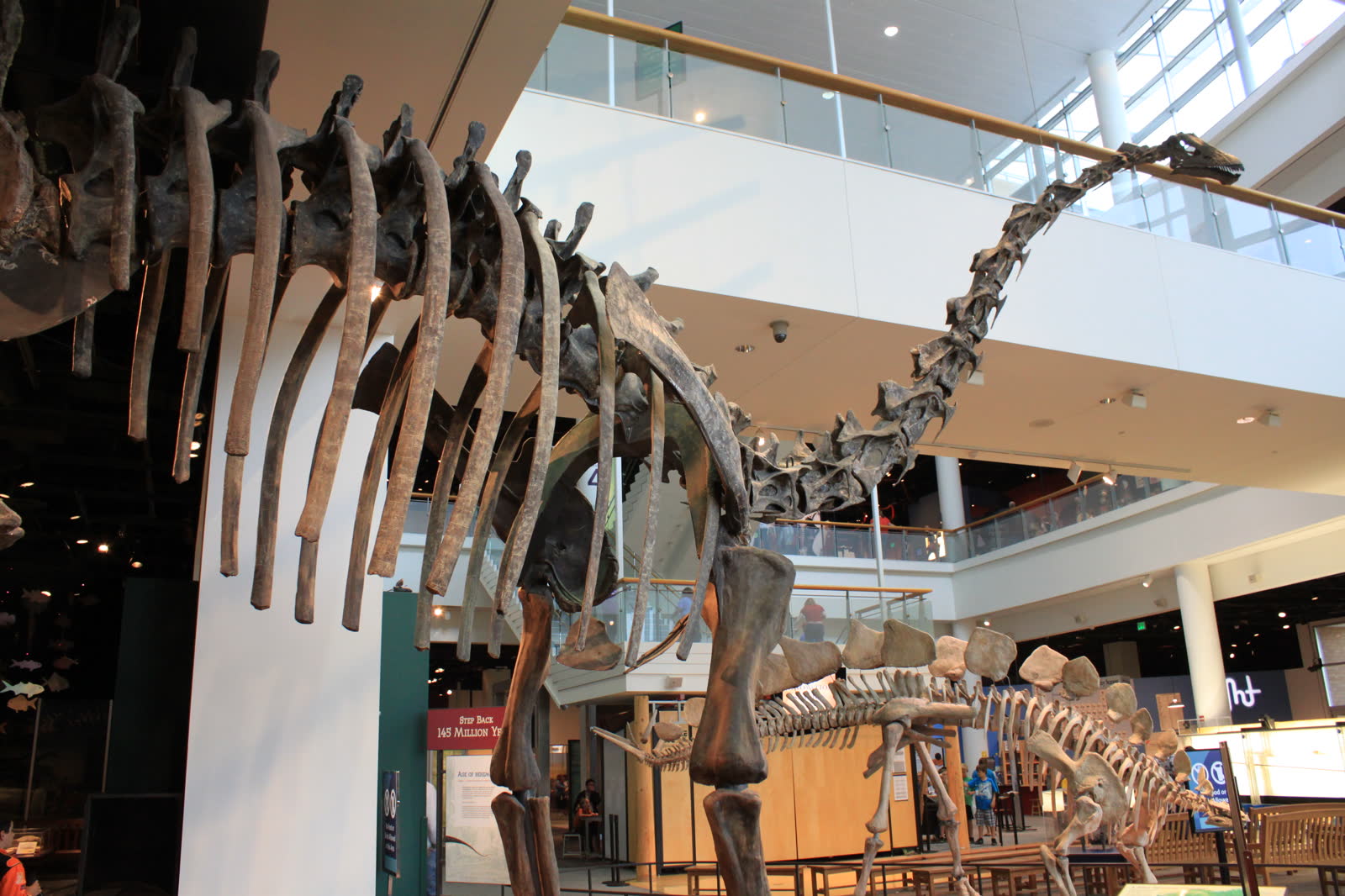
Image context: the cover uses a real museum photograph of the Minnesota Science Museum Diplodocus from Wikimedia Commons. It fits this piece because the whole argument depends on looking at an actual mounted skeleton as an engineered object rather than as an undifferentiated dinosaur silhouette.[6]
Around 0:20, the video clears the first misconception: a dinosaur mount is assembled because the animal is never found whole
Rebecca Newberry's most important statement arrives before the close looking begins. She says plainly that when a dinosaur is excavated, "we never find the entire animal," so missing parts have to be filled when a skeleton is mounted for display.[1] That sounds elementary, but it repairs a public misunderstanding that keeps returning. Visitors often read the gallery skeleton as if it were a one-to-one transfer from quarry to hall. In practice, mounting is always an act of reconstruction.
The Taylor abstract on Carnegie's Diplodocus carnegii makes that reconstruction history impossible to ignore.[4] The iconic specimen that generated the international Dippy casts was not a pure single-individual skeleton even in its original early twentieth-century form. Some of the most visually decisive elements, including the skull and forelimbs, were cast or sculpted supplements.[4] That does not make the skeleton unscientific. It tells you what problem the mount is solving: how to turn fragmentary or distributed evidence into a legible body plan without pretending the gaps never existed.
This is why the video's teaching method is so strong for paleontology. It does not ask the viewer to choose between awe and skepticism. It asks for a more disciplined response: keep the awe, but direct it toward the assembly logic. The mount is evidence, but evidence that has been curated, compared, stabilized, and completed enough to make anatomy visible.
Around 1:08, surface texture becomes a fossil clue rather than a cosmetic detail
The most useful practical section comes when Newberry explains how to spot original fossil material by eye.[1] The real elements, she says, tend to look bumpier, more varied in color, crossed by cracks and glue lines, sometimes even carrying field numbers written directly on them.[1] Replica parts, by contrast, read as smoother and more uniform. That is a deceptively powerful lesson. It turns wear, repair, and heterogeneity into signs of provenance.
Seen against the museum history of Dippy, those surface differences also carry time. Carnegie's own magazine account of the 2007 remount notes that decades of paint, shellac, and varnish had been removed from the original specimen, revealing how older museum practices had literally coated the bones with a previous era's idea of care.[3] A fossil mount therefore preserves more than Jurassic anatomy. It also preserves the history of preparation, restoration, and curatorial taste layered onto that anatomy over generations.
This is where a composite skeleton becomes more honest than a perfectly seamless replica. A mount that still lets you see uneven texture, repair seams, and numbering invites the viewer into the material history of the specimen.[1][3] It shows that paleontology is not the recovery of a pristine object waiting underground in final form. It is a long chain of extraction, stabilization, comparison, replacement, and reinterpretation.
Around 1:47, support hardware reveals the ethics of display
The video's second excellent move is to treat steel armatures as evidence too.[1] Newberry points out that original fossil elements are often held by steel on the outside, while cast parts can hide support internally.[1] That distinction is practical, but it also exposes a curatorial boundary. Real fossil bone is heavy, fragile, and finite. The mount has to support it without asking the original material to bear loads it should not bear.
That is why "real" and "replica" should not be treated as competing moral categories. They do different jobs. Original fossil preserves the irreplaceable texture of the specimen and anchors the display to actual recovered material.[1][4] Casts and sculpted inserts restore anatomical continuity, make missing regions intelligible, and reduce stress on rare bones.[1][4] The steel frame then mediates between the museum's two obligations: showing the animal as a coherent body while protecting the specimen from the cost of that coherence.
Put differently, the visible mount is already an argument about conservation. If a museum used only original material wherever a bone ought to be, it could easily make a worse scientific object by overburdening fragile fossils. Composite construction is not a compromise after science. It is part of the scientific and curatorial solution.
Around 2:00 and beyond, the raised tail reminds you that museum skeletons can be corrected
The strongest outside context for the Minnesota video comes from London and Pittsburgh. The Natural History Museum notes that Dippy's tail was lifted in 1993 once research showed Diplodocus tails would have been raised rather than dragged.[2] Carnegie's magazine account of the remounted original says the same thing more pointedly: the tail is "finally off the ground," a visible admission that older display conventions had been wrong.[3]
That correction matters because it keeps composite mounts from being read as frozen acts of Victorian theatricality. They are historical objects, yes, but they are also revisable scientific models. The same Diplodocus lineage of displays that spread around the world through plaster casts in the early 1900s has also been repeatedly updated as anatomy, biomechanics, and mounting practice changed.[2][3][5] What survives across those revisions is not one fixed pose but one stronger commitment: make the skeleton readable in light of the best available evidence.
That is the real payoff of this annotated viewing. The question "How much of it is real?" is not wrong, but it is too small.[1] A better question is: what kind of truth is the mount trying to show? In a Diplodocus gallery skeleton, truth does not mean untouched completeness. It means the museum is willing to expose a body plan assembled from original fossil, informed replacement, structural support, and later correction. Once you learn to read those layers, the mount stops being less authentic than the animal in your imagination. It becomes more exact about what paleontology can honestly recover.
Sources
- Science Museum of Minnesota, "What part of the Diplodocus is made of 'real' fossils? | Specimen Spotlight," YouTube video.
- Natural History Museum, "Diplodocus" (including Dippy cast history and the 1993 tail-lift correction).
- Carnegie Museums Magazine, "Face Time" (2007 remount context, removed coatings, and tail-off-ground update).
- Mike P. Taylor et al., "The history and composition of the type specimen of Diplodocus carnegii Hatcher 1901" (conference abstract with mount-composition details).
- Carnegie Museum of Natural History, "Celebrate Dippy: 125 Years Since the Discovery of Dippy" (discovery, cast network, and global afterlife).
- Wikimedia Commons file page for the Minnesota Science Museum Diplodocus photograph used as the lead image.