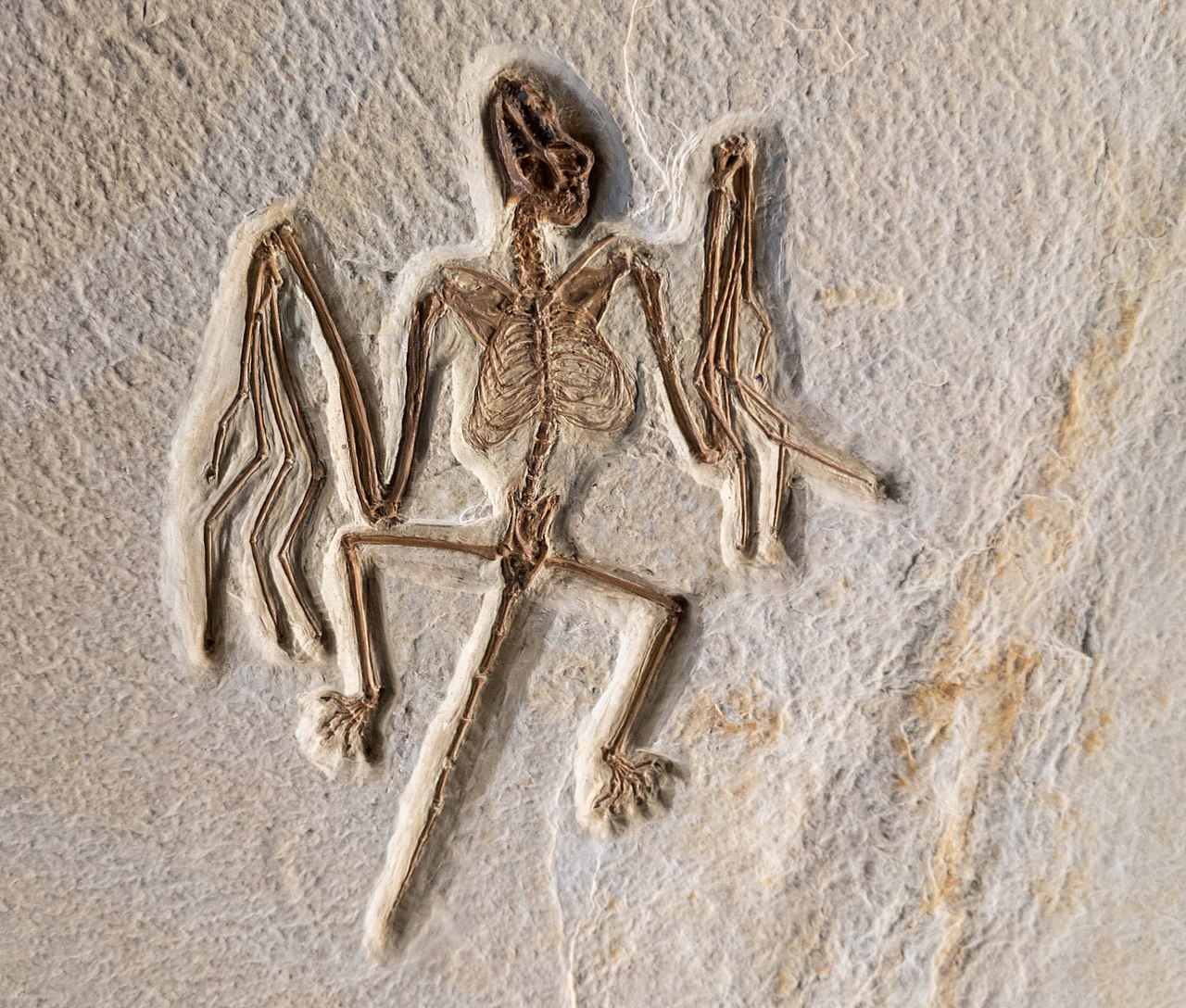
Onychonycteris finneyi is often introduced with one sharp line: bats learned to fly before they learned to echolocate.[1][2] That line is useful, but it is too clean for what the fossil actually preserves. The real strength of the Green River specimen is that it keeps several evolutionary clocks out of sync in one slab. There is already a recognizably bat-like wing. There are also claws on every manual digit, long hind limbs that still read well for climbing, and a long tail that makes the body look less compact than later bats.[1][3] The point is not that Onychonycteris was half bat and half something else. The point is that the modern bat package had not locked together yet.
That is why this fossil deserves a close reading rather than a slogan. Found in the early Eocene Green River Formation of Wyoming and described in 2008, Onychonycteris is known from two nearly complete skeletons about 52.5 million years old.[1][6] Because the material is so complete, the specimen does more than establish age. It lets paleontologists watch flight anatomy, climbing anatomy, and sensory anatomy sit beside each other without yet resolving into the tighter combination seen in most living bats.[1][3]
Image context: the cover uses a real photograph of an Onychonycteris fossil slab from Fossil Butte National Monument.[7] It belongs here because the entire article rests on what the skeleton keeps visible at once: elongated forelimbs for flight, hind feet that still look usable for climbing, and a long tail that reminds the viewer this was not yet the compact modern bat silhouette.
The slab keeps a climbing bat inside a flying body
The original 2008 Nature paper emphasized a feature that still startles even if you know the headline in advance: claws on all five digits of each hand.[1] The Fossil Butte National Monument summary says the same thing in plainer language, noting claws across all 10 wing digits and treating them as evidence that this animal would have been an excellent climber using all four limbs.[3] That matters because living bats usually reduce that older grasping signal. Their wings are hands transformed so thoroughly for flight that only a small part of the ancestral climbing toolkit remains obvious.
Onychonycteris holds on to more of that toolkit. The hind limbs are relatively strong, the feet look operational rather than vestigial, and the tail remains long instead of being compressed into the shortened silhouette familiar from many later bats.[1][3] None of this cancels flight. It tells you that early bat evolution did not move by stripping away every non-flight trait first and then adding a wing. The animal still carried a body that made sense in trees. Flight entered that body before the older climbing grammar disappeared.
This is the detail that keeps the fossil from collapsing into generic "first bat" copy. The specimen is informative because it preserves coexistence. If you only knew the wing, you might picture a nearly modern bat. If you only knew the claws and tail, you might picture a climbing mammal on the way toward gliding. The slab forces both readings into the same skeleton.[1][3]
The wing is early, but not crude
The fossil is sometimes written as though the wing were merely experimental. That undersells the anatomy. Simmons and colleagues argued in 2008 that the forelimb proportions and overall postcranial design already supported powered flight even though the ear region did not clearly support modern laryngeal echolocation.[1] A 2024 Communications Biology study pushed that point further with aerodynamic modeling, concluding that Onychonycteris was capable of both gliding and powered flight, and that the animal sits on a plausible functional gradient from trees-down gliding toward full flapping flight.[6]
That newer modeling matters because it changes the tone of the old argument. The question is no longer whether Onychonycteris was just a clumsy proto-bat waiting to become airborne. The stronger reading is that the wing was already doing real work. What had not stabilized yet was the rest of the package around it.[1][6] In other words, this fossil is valuable not because flight was absent, but because flight was present before several other familiar bat specializations had finished rearranging the body.
The distinction is important. Paleontology is full of cases where a famous transitional fossil gets flattened into "the first appearance" of a trait. Onychonycteris is better read as a timing fossil. It shows that powered flight can arrive while the animal still carries visible traces of a more generalized scansorial body plan.[1][6] That sequencing tells you more than a simple origin story. It reveals the order in which the bat body was assembled.
The head keeps the echolocation question open
This is where the fossil becomes even more useful. The 2008 paper treated the skull and ear region as evidence that flight preceded echolocation.[1][2] Two years later, Veselka and colleagues argued that a stylohyal-tympanic connection in the fossil could indicate laryngeal echolocation after all, reopening the basic chronology.[4] In the same issue, Simmons and co-authors replied that the interpretation of those structures was wrong and that Onychonycteris was still better read as probably non-echolocating.[5]
That disagreement is not a weakness in the article's argument. It is the reason the fossil remains alive. What the specimen gives with unusual clarity is not a permanently settled answer, but a sharply bounded problem. Everyone in the debate is working from a fossil that already had flight anatomy and still looked primitive in other respects. The live question is how far the sensory system had moved by that point.[1][4][5]
The safest reading, then, is not to use Onychonycteris as a courtroom exhibit for one victorious sentence about echolocation. The safer reading is to treat it as a boundary fossil. It preserves the moment when powered flight is already hard to deny, while laryngeal echolocation remains contested enough that the old linear story cannot be repeated with confidence.[1][4][5]
Why this fossil still holds the middle of the story
Many transition fossils become famous because they look like a bridge. Onychonycteris matters because it shows what bridges are made of. The animal does not simply stand between non-flying ancestors and modern bats. It preserves a mismatch among anatomical systems: wings that already work, hands that still carry full sets of claws, a tail that has not yet been reduced away, and sensory evidence that still invites argument.[1][3][4][5][6]
That combination is exactly what a high-value paleontological specimen should do. It narrows the order of events without pretending evolution moved as one synchronized block. The earliest complete bats did not have to wait for every familiar bat specialization before taking to the air. In Onychonycteris, flight is already present, climbing is still legible, and echolocation remains the open frontier. The fossil matters because it keeps those histories separate long enough for us to see them.
Sources
- Nancy B. Simmons, Kevin L. Seymour, Jorg Habersetzer, and Gregg F. Gunnell, "Primitive early Eocene bat from Wyoming and the evolution of flight and echolocation." Nature 451, 818-821 (2008). Deep Blue repository record.
- American Museum of Natural History, "Researchers Find Bats Evolved Ability To Fly Before Echolocation" (February 24, 2008).
- U.S. National Park Service, Fossil Butte National Monument, "Fossil Mammal Species."
- Nina Veselka, David D. McErlain, David W. Holdsworth, et al., "A bony connection signals laryngeal echolocation in bats." Nature 463, 939-942 (2010).
- Nancy B. Simmons, Kevin L. Seymour, Jorg Habersetzer, and Gregg F. Gunnell, "Inferring echolocation in ancient bats." Nature 466, E8 (2010).
- Norberto P. Giannini, Alan Cannell, Lucila I. Amador, et al., "Palaeoatmosphere facilitates a gliding transition to powered flight in the Eocene bat, Onychonycteris finneyi." Communications Biology 7, 365 (2024).
- Wikimedia Commons, "File:Onychonycteris finneyi Fossil Butte National Monument.jpg."