Ambulocetus natans is too easy to remember as a slogan.[1][2] "Walking whale" is memorable, but it also flattens the fossil into a before-and-after cartoon, as if the main point were simply that whales once had legs.[1][2][6] The real force of the specimen is stricter. Ambulocetus matters because one early whale still keeps a substantial pelvis, large hind limbs, and a long, increasingly important tail in the same animal.[1][3][4] That package does not show a tidy halfway point between wolf and whale. It shows a body whose support and propulsion were being redistributed without yet being simplified.
That is why this fossil still deserves a close reading in 2026. The American Museum of Natural History describes Ambulocetus as a roughly 49-million-year-old early whale from what is now northern Pakistan, living around shallow coastal waters and brackish rivers, about 11 to 12 feet long and carrying strong limbs with large hind feet.[2] The original Science paper and the later 2002 redescription make the anatomical point more carefully: this was not a fragmentary rumor assembled from unrelated bones, but a near-complete holotype whose later excavation added both innominates, the sacrum, and much of the thoracic and thoracolumbar skeleton.[1][3] When one specimen preserves that many linked regions, locomotion stops being a generic evolutionary story and becomes a body plan problem.
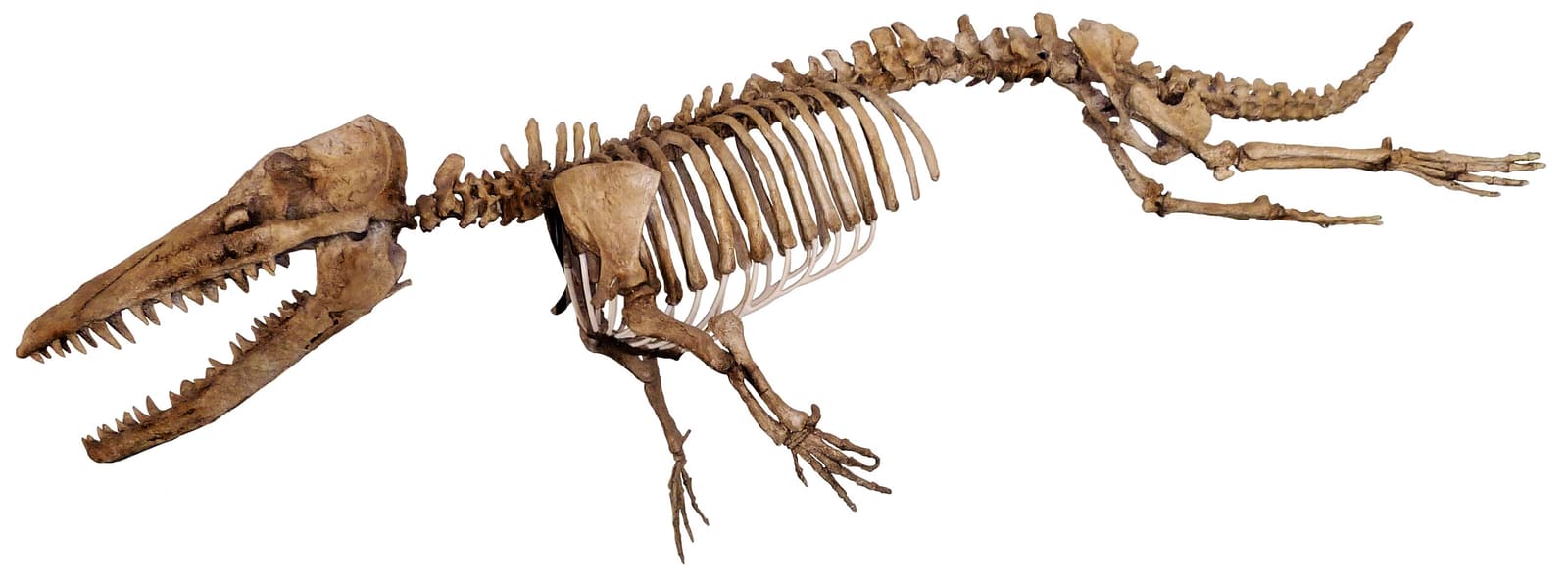
Image context: the lead image uses a real museum mount photograph from Wikimedia Commons.[7] It belongs here because the article's claim depends on whole-body reading. A skull or isolated hind limb would make a narrower point, but the full lateral skeleton keeps the pelvis, ankle, ribcage, and tail inside one frame, which is where Ambulocetus still does its best scientific work.
1) The fossil is strongest because the same individual keeps multiple locomotor signals locked together
Many transition stories are built from serial substitution: one taxon stands in for the ear, another for the ankle, another for the tail, another for the habitat. Ambulocetus is more useful than that.[1][3] The holotype from the Kuldana Formation preserves enough of one individual that paleontologists can ask how support, stride, paddling, and axial motion interacted inside the same skeleton.[1][3] That is a much harder standard than saying early whales were "partly aquatic."
The 2002 paper is especially important here because it expanded the original find substantially.[3] Continued excavation recovered the innominates, sacrum, thoracic cage, and most of the thoracolumbar vertebral column.[3] Those additions matter because they shift the conversation away from a headline creature with feet and toward a mechanically organized trunk. Once the pelvis and vertebral column enter the picture, the fossil stops being a novelty about limbs alone. It becomes evidence for how much of the old terrestrial support system was still present and how much of the new aquatic engine had already begun to take over.[1][3][4]
This is the first reason the fossil still cuts so cleanly. It does not ask the reader to imagine transition in the abstract. It asks the reader to follow support and propulsion through one body.
2) The pelvis and hind limbs show that whales did not surrender support all at once
The popular version of whale evolution often jumps too quickly from land mammal to tail swimmer. Ambulocetus interrupts that jump.[1][2][3] The pelvis was still substantial, the sacrum was still present, and the hind limbs were still large enough that they cannot be treated as decorative leftovers.[1][3] The AMNH summary puts the behavioral consequence plainly: on land, Ambulocetus probably moved awkwardly, more by pulling and waddling than by elegant cursorial walking.[2] That is already enough to tell us the fossil does not belong on the fully terrestrial side of the boundary. But it also tells us the hindquarters had not yet been demoted into the tiny internal remnants seen in living whales.[2][6]
The boundary is worth keeping sharp. A weight-bearing hind limb is not the same thing as efficient terrestrial competence.[2][3][5] Later work complicated the older picture by arguing from thoracic strength that Ambulocetus may have been less capable of full body support on land than the classic "walking whale" image implies.[5] That 2016 study does not erase the pelvis or the hind feet. What it does is force a stricter reading. Instead of imagining a normal quadruped that happened to like water, paleontologists have to consider an animal whose body may already have depended heavily on buoyancy even while retaining obvious hind-limb function.[5]
That is exactly why the fossil remains useful. The skeleton keeps both intuitions in play at once. The pelvis and legs are too large to ignore. The body is too specialized to read as an ordinary shore mammal. The transition is visible as tension inside the specimen, not as a resolved endpoint.
3) In the water, the tail was rising, but it had not yet become the whole whale
The best-known functional interpretation still comes from Thewissen and Fish's locomotor model.[4] Their argument was not that Ambulocetus already swam like a modern cetacean. It was that the fossil fits a combination of pelvic paddling and dorsoventral undulation of the tail, with locomotion in water most closely resembling that of a modern otter rather than a fully caudal-oscillating whale.[4] That distinction matters. A modern whale hands propulsion overwhelmingly to the tail stock and flukes. Ambulocetus had not reached that division of labor yet.[2][4]
This is where the hind feet and ankle complex become especially important. In the original 1994 interpretation, the rear limbs were not passive appendages being carried toward extinction.[1] They were part of the propulsive system. The body had begun to use the spine and tail in the dorsoventral plane that later becomes decisive for whales, but it had not yet stripped the hind limbs out of the motion budget.[1][4] The result is a skeleton that preserves redistribution rather than replacement. The tail is growing in importance, but the pelvis is still in the argument.
That mixed system is stronger science than a smoother story would be. Evolutionary transitions do not usually proceed by politely switching one machine off after another is fully built. They proceed through overlap, awkwardness, and temporary combinations that look unstable only in hindsight. Ambulocetus is one of the fossils that lets us see that overlap directly.[1][3][4]
4) The fossil matters because it keeps the shoreline phase of whale evolution materially real
The broader whale-evolution literature needs fossils that make the shoreline phase hard to sentimentalize.[2][6] AMNH's wider cetacean-evolution overview notes that some of the earliest stem whales were already taking prey in water while still able to move on land, and places Ambulocetus inside that early carnivorous, semiaquatic zone.[6] That framing is useful because it resists two bad habits at once. One habit imagines a sudden leap from fully terrestrial hunting to fully marine life. The other turns every early whale into a generic "missing link" without asking what its body was actually doing.
Ambulocetus is better than both habits. It is not the first terrestrial whale-relative, and it is not the fully aquatic answer that later archaeocetes would become.[1][4][6] Its importance is narrower and more durable. One specimen keeps the old support architecture and the rising aquatic engine in contact: pelvis, sacrum, hind feet, long trunk, and tail all remain part of the same mechanical sentence.[1][3][4][5] That is why the fossil still holds up. It does not merely show that whales once had legs. It shows that early whale evolution spent real time in a body where legs still mattered, buoyancy mattered more, and the tail had started taking command without yet ruling alone.
Sources
- J. G. M. Thewissen, S. T. Hussain, and M. Arif, "Fossil evidence for the origin of aquatic locomotion in archaeocete whales." Science 263, no. 5144 (1994).
- American Museum of Natural History, "A Walking Whale: Ambulocetus."
- Sandra I. Madar, Philip D. Gingerich, J. G. M. Thewissen, and S. Taseer Hussain, "Additional holotype remains of Ambulocetus natans (Cetacea, Ambulocetidae), and their implications for locomotion in early whales." Journal of Vertebrate Paleontology 22, no. 2 (2002).
- J. G. M. Thewissen and F. E. Fish, "Locomotor evolution in the earliest cetaceans: functional model, modern analogues, and paleontological evidence." Paleobiology 23, no. 4 (1997).
- Konami Ando and Shin-ichi Fujiwara, "Farewell to life on land - thoracic strength as a new indicator to determine paleoecology in secondary aquatic mammals." Journal of Anatomy 229, no. 6 (2016).
- American Museum of Natural History, "Whale & Dolphin Evolution: Origin of Cetaceans."
- Wikimedia Commons, "File:AmbulocetusNatansPisa.JPG" - photographic source for the mounted skeleton used as the article image.