A horsetail beside a stream offers an unusually legible piece of plant architecture. The stem repeats itself in sections, with joints marking the places where tiny leaves and, in branching species, rings of branches emerge. Its leaves do little to suggest a forest canopy. Yet its fossil relatives include woody trees large enough to make a person underneath them look small.[1][2]
Place a ribbed Calamites fossil beside that living stem and the resemblance invites a history told entirely through size: first a giant, then a survivor in miniature. Fossil-inclusive evolutionary research gives a more interesting account. The lineage leading to living horsetails and the calamitean tree lineage were already following separate paths in the Carboniferous. Their shared construction belongs to a branching family history.[4]
First, work out which surface survived
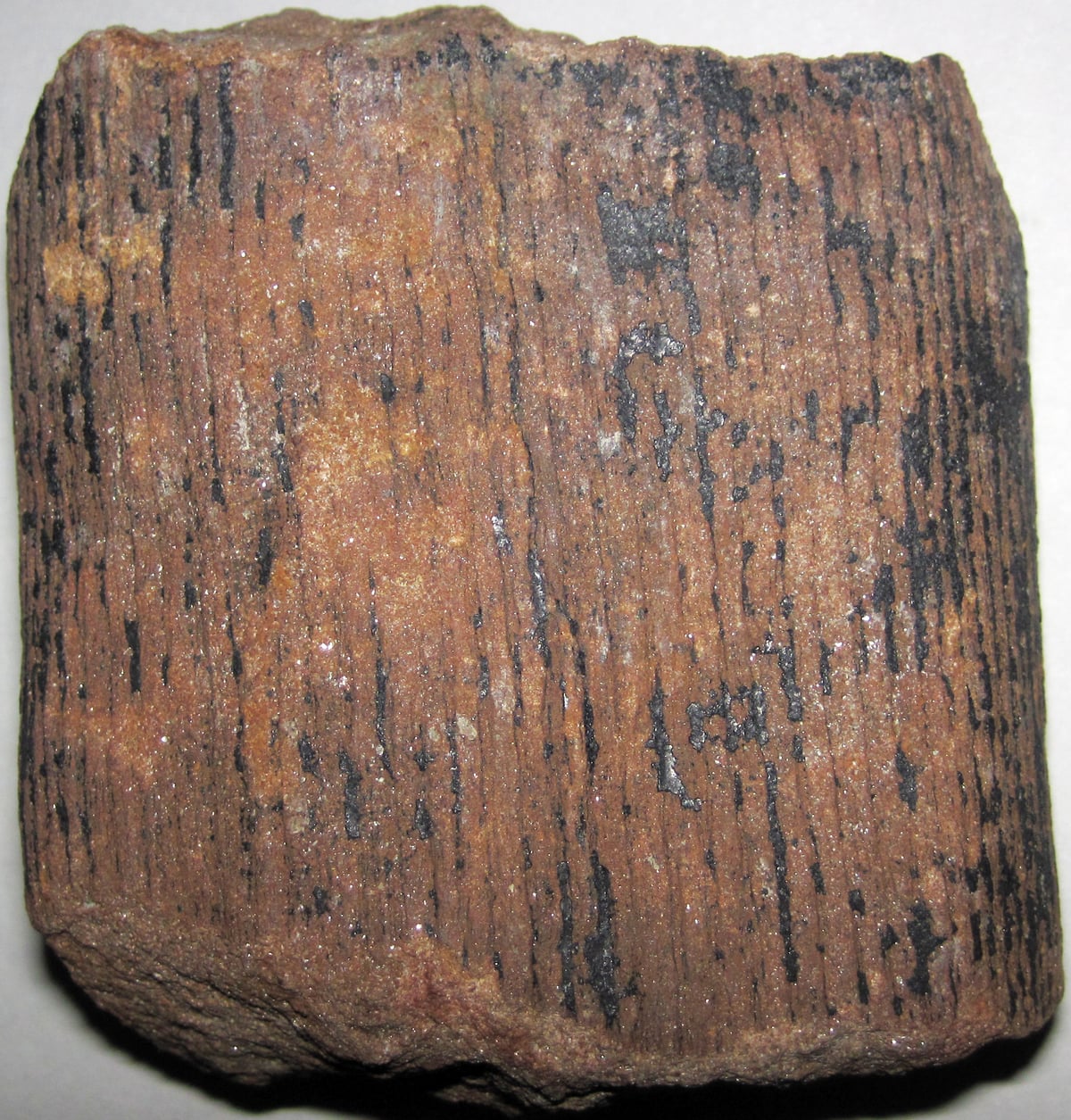
The Kentucky specimen pictured here is a Calamites pith cast. According to the photographer's locality record, it came from construction rubble derived from the Hyden or Pikeville Formation of the Breathitt Group. Its precise formation is therefore uncertain, but its Middle Pennsylvanian setting places it within the later Carboniferous coal-forest world. Sand occupies the former central cavity, with dark carbonized plant material remaining around it.[7]
That distinction changes how the fossil should be read. The ribbed cylinder can preserve the shape of a space inside a stem. Its diameter need not give the diameter of the entire living trunk. Wood and other tissues once lay outside it, and their preservation followed a different course.[2]
Barry Thomas's study of upright calamite remains at Brymbo, North Wales, shows why this is consequential. A cast of an internal cavity and a cast of an external stem can both look convincingly plant-like, yet they record different boundaries. His analysis used branching relationships, nodal features and mineral layers to interpret how the remains formed. A forest reconstruction begins with this small act of anatomical orientation: deciding which part of the plant the rock actually represents.[2]
Wood made another kind of horsetail possible
Anatomically preserved fossils carry the argument further. At Chemnitz in Germany, excavators recovered more than ten metres of an Arthropitys bistriata trunk from Early Permian volcanic deposits. Ronny Rößler, Zhuo Feng and Robert Noll described its internal tissues and branching system in 2012.[3]
Arthropitys is a calamitean genus used for anatomically preserved material, distinct from the stem-fossil name Calamites. Substantial secondary xylem—the tissue we call wood—surrounded this specimen's central region. Multiple orders of woody branches supported its canopy.[3]
The recovered trunk exceeds ten metres; the authors estimated a complete tree at least fifteen metres tall. Those measurements distinguish excavation from reconstruction. Even the preserved portion establishes an impressive tree habit.[3]
Living horsetails reproduce through spores, and the same broad reproductive distinction separates these plants from seed-bearing forest trees. The Sam Noble Museum notes that calamite wood evolved independently of the wood-producing lineage that includes seed plants. A tree is a way to build a plant, and different branches of plant evolution found ways to achieve it.[1]
The family tree changes the direction of the story
The decisive relationship test came from looking beyond the survivors. In 2018, Andrés Elgorriaga and colleagues analysed 43 equisetalean species, including 28 extinct ones, combining anatomical and morphological evidence with molecular data from living plants. Their reconstruction placed the group containing modern Equisetum outside Calamitaceae, the family containing the familiar calamitean trees.[4]
In that analysis, the two lineages had independent histories extending back into the Carboniferous. This makes the familiar giant-to-small sequence an unreliable account of ancestry. A retained jointed stem can establish family resemblance without identifying one particular fossil group as the source of the living genus.[4]
This is a reconstructed relationship, open to testing with new fossils. Extinction makes the living plants alone an incomplete family portrait.
A hot spring preserved a different chapter
The living-horsetail side of the story has its own substantial fossil record. At San Agustín in Patagonia, Jurassic hot-spring deposits preserved slender shoots connected to underground rhizomes, roots and leaf sheaths. Alan Channing and colleagues described the plant as Equisetum thermale in 2011. Silica-rich preservation retained internal anatomy, giving the comparison with modern horsetails much more to work with than a familiar outline.[5]
These remains put horsetails with a recognizably modern combination of features in a landscape more than 150 million years old. The authors interpreted dense stands growing in wetlands influenced by geothermal waters. Connected organs and preserved tissue supply direct evidence; tolerance of particular chemical stresses is inferred from the setting and comparisons with living plants.[5]
The fossil establishes an ancient architecture. As an extinct species with its own character combination, it cannot show that any living species has remained unchanged since the Jurassic.[5]
Survival leaves a distorted family portrait
Dating the living branches introduces another distinction. The age of the broader lineage and the age of the last common ancestor of all living horsetails describe different events. A 2021 study by Maarten Christenhusz and colleagues estimated the earliest split among surviving lineages at roughly 175 million years ago, while discussing younger estimates produced by other analyses. Fossil placement, sampling and clock assumptions influence the answer.[6]
That study also challenged a size-based intuition within the living genus: its evolutionary reconstruction did not place today's giant tropical horsetails at the ancestral base simply because they resemble large fossil forms in stature. Height alone is a poor guide to the direction of descent.[6]
Read together, the specimens ask for three different kinds of attention. The Kentucky cast requires recognition of an internal surface. The Chemnitz tree requires reconstruction from preserved wood and branching. The Patagonian horsetail requires separating anatomical continuity from claims about an unchanged species. None can do all the work of the others.
Beside the stream, the living plant still displays its repeated joints. What has changed is the history visible through them: a once more varied family, including trees with substantial wood, and a surviving branch whose familiar shape contains its own long evolutionary story.
Sources
- Sam Noble Oklahoma Museum of Natural History, “Horsetails”—living habit, spore reproduction and the independent evolution of calamite wood.
- Barry A. Thomas, “In situ stems: preservation states and growth habits of the Pennsylvanian (Carboniferous) calamitaleans,” Palaeontology 57 (2014)—Brymbo preservation; Aberystwyth University record.
- Ronny Rößler, Zhuo Feng and Robert Noll, “The largest calamite and its growth architecture,” Review of Palaeobotany and Palynology 185 (2012)—Chemnitz anatomy and reconstructed height; institutional PDF.
- Andrés Elgorriaga et al., “Origin of Equisetum: Evolution of horsetails (Equisetales) within the major euphyllophyte clade Sphenopsida,” American Journal of Botany 105 (2018)—the fossil-inclusive phylogenetic analysis; author-hosted museum PDF.
- Alan Channing et al., “Equisetum thermale sp. nov. (Equisetales) from the Jurassic San Agustín hot spring deposit, Patagonia,” American Journal of Botany 98 (2011)—anatomy and ecology; institutional PDF.
- Maarten J. M. Christenhusz et al., “Biogeography and genome size evolution of the oldest extant vascular plant genus, Equisetum (Equisetaceae),” Annals of Botany 127 (2021)—divergence dating, its uncertainties and the placement of living giant horsetails.
- James St. John, photograph of a Calamites pith cast from the Breathitt Group near Jackson, Kentucky (2019), via Wikimedia Commons—specimen locality, preservation and image credit, CC BY 2.0.