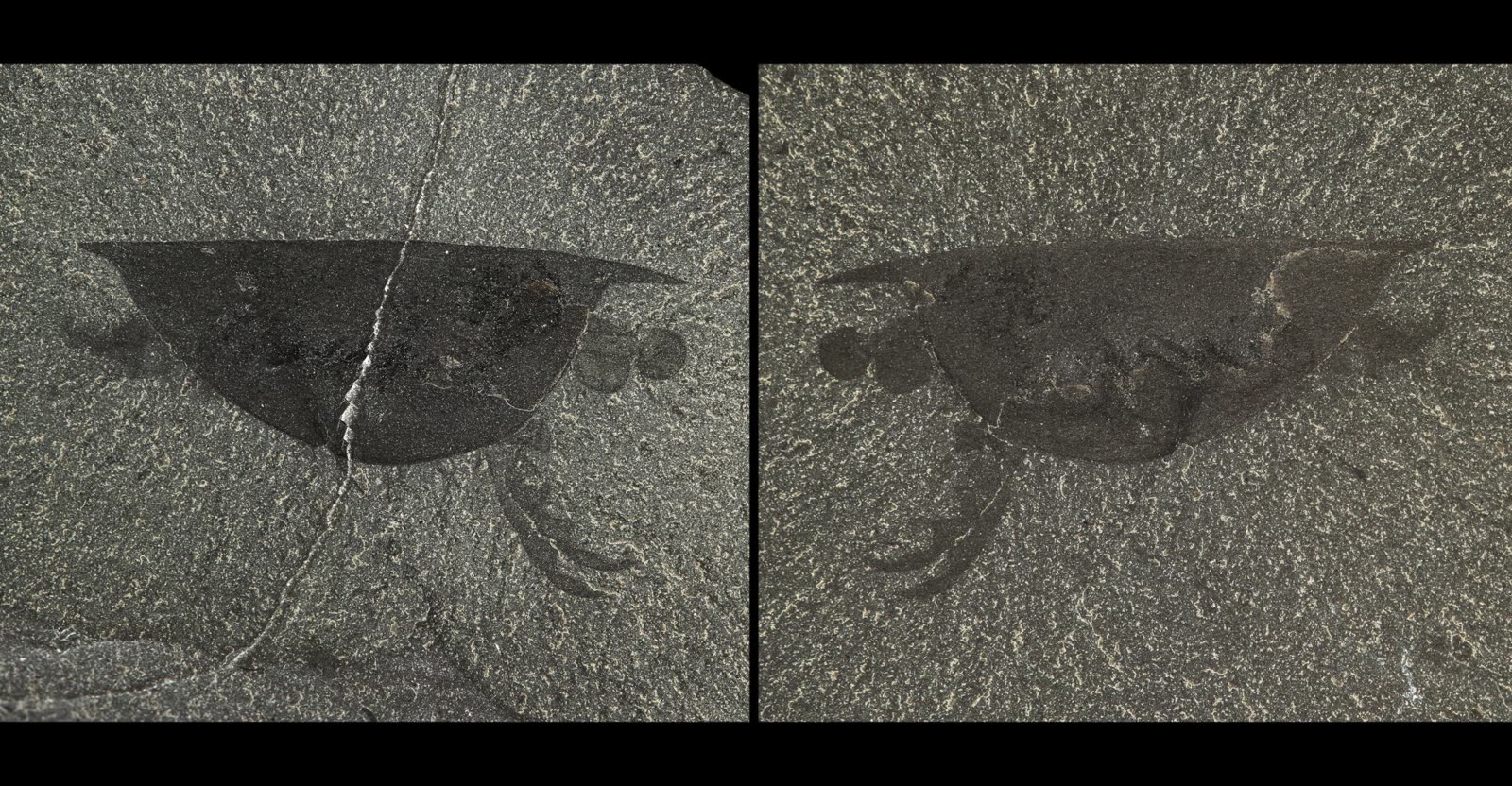
Isoxys acutangulus is the kind of Cambrian fossil that punishes a quick glance. The carapace arrives first: two broad valves, a pointed front, a pointed rear, and a body mostly hidden beneath a shell-like cover. If the reading stops there, the animal becomes another Burgess Shale silhouette, a strange little pod filed beside stranger neighbors. The better reading starts when the eyes come into focus.
Those eyes change everything. The Royal Ontario Museum's Burgess Shale page describes Isoxys as carrying bulbous spherical eyes that protrude forward and laterally from beneath the carapace, mounted on very short stalks, with segmented frontal appendages positioned close by.[1] Add the paddle-like trunk limbs, tail fan, gut glands, and streamlined outline, and the animal stops looking like a passive shell. It begins to look like a swimmer whose cover, vision, feeding tools, and propulsion have to be read together.
That is why Isoxys works best as an anatomy-and-method deep dive. The question is not "what weird thing is this?" It is more disciplined: how much biology can be recovered when a Cambrian arthropod is preserved as a flattened, non-biomineralized body, where the hardest-looking part is not mineral shell and the most important parts are soft traces, eyes, limbs, and gut?
The carapace is a cover, not the whole animal
The historical trap is built into the fossils. Early names and comparisons leaned heavily on carapaces because those were the obvious repeated structures. ROM notes that Walcott originally assigned Burgess material to Anomalocaris, while Simonetta and Delle Cave later used Isoxys acutangulus for the Burgess species and recognized another, rarer species, I. longissimus.[1] That early carapace-first history matters because it explains why the animal was difficult to interpret. If all you have is a two-valved outline with spines, the fossil can drift between arthropod categories without becoming a living animal.
The soft-part work corrected that imbalance. Garcia-Bellido, Vannier, and Collins described Burgess Shale Isoxys material in which eyes, appendages, body traces, and gut structures become part of the same anatomical package.[2] ROM's synthesis gives the public version of that package: the carapace was non-biomineralized, folded into two equal valves, and large enough to cover most of a body that could reach from about 1 cm to almost 4 cm in carapace length.[1] It was not a clam shell in the modern sense, and it should not be treated as armor that explains the animal by itself.
The carapace did real work, but its meaning comes from what sat under and around it. It framed the eyes. It partly covered the trunk. It gave the animal a smooth profile with front and rear spines. But the body underneath still had to see, catch, swim, digest, and steer.[1][2] That is the method lesson: a conspicuous fossil surface can organize attention while also stealing too much of it.
The eyes make the animal active
The strongest reset comes from the visual system. Vannier, Garcia-Bellido, and Chen argued that exceptional soft-part specimens from the Burgess Shale and Chengjiang biotas indicate Isoxys was probably a non-benthic visual predator, with evidence coming from the functional meaning of its eyes, frontal appendages, digestive tract, and hydrodynamic outline.[3] That conclusion is stronger than a vague claim that the animal "had eyes." It ties sensory anatomy to ecology.
Large forward-lateral eyes imply a world in which orientation mattered. They are expensive organs, and in a free-swimming or near-bottom swimmer they make sense as part of a predator-prey problem: detect movement, judge position, and work in three dimensions rather than simply crawl across sediment. ROM's ecology summary matches that reading, treating Isoxys as a free-swimming animal that likely moved just above the seafloor, searching for prey in the water column and near the sediment-water interface.[1]
The eyes do not prove every behavior. They do not tell us exact prey size, hunting rhythm, or daily depth range by themselves. But they change the evidentiary burden. Once the eyes are read with the appendages and swimming limbs, the animal is no longer a mysterious shelled object. It becomes a visually guided body whose anatomy points toward active foraging.[1][3]
The frontal appendages keep predation bounded
The frontal appendages are just as important because they prevent the visual-predator claim from becoming only a vision story. ROM describes the I. acutangulus frontal appendages as flexible, curved, serrated in outline, and built from five segments, including a basal part, three segments with stout outgrowths, and a pointed terminal segment.[1] That is a specific grasping or prey-handling structure, not a decorative whisker.
The caution is that function has to remain anatomical. A serrated appendage near large eyes supports a predatory interpretation, but it does not turn Isoxys into a miniature version of a later shrimp, mantis shrimp, or radiodont. The same body also had 13 pairs of trunk appendages with broad paddle-like flaps and setae, plus a tail fan.[1] Feeding, swimming, and steering were distributed across the whole animal.
This is where Isoxys becomes useful beyond its own genus. Burgess Shale animals are often introduced through one poster feature: the five eyes of Opabinia, the frontal appendages of radiodonts, the shell of Odaraia, the head shield of Marrella. Isoxys teaches a better habit. The right unit is not the feature that makes the quickest drawing. The right unit is the working body system. In this case, the eyes and frontal appendages should be read with the carapace, trunk limbs, tail, and gut glands.[1][2][3]
Swimming is an inference that can be tested
The swimming interpretation is not only a guess from "streamlined" appearance. It has become testable. The 2021 paper on vertically migrating Isoxys placed the genus inside a larger early Cambrian story about pelagic euarthropod zooplankton and argued that some Isoxys species may have participated in vertical movement through the water column, contributing to an early form of the biological pump.[4] That argument matters because it moves Isoxys from isolated morphology into ecosystem function: a swimmer is not only a shape, but a participant in moving energy and carbon through water.
The 2024 hydrodynamic study makes the method even more explicit. Pates, Ma, and Fu modeled the effects of ontogeny and spines on Isoxys hydrodynamic performance, treating the carapace and its spines as structures whose swimming consequences can be quantified rather than merely admired.[5] That is the right kind of modern paleontology for an animal like this. It does not pretend that a model is the same thing as watching a Cambrian animal swim. It asks whether shape, size, spines, and water flow make some ecological readings more plausible than others.
This is also why the spines should be handled carefully. Front and rear spines can tempt a defense story, a hydrodynamic story, a display story, or a developmental story. The fossil record alone rarely lets one sentence settle all of that. The better conclusion is narrower: the spined carapace was part of a body moving through water, and newer work can test how that shape behaved under fluid constraints.[1][5]
The gut makes the predator less abstract
The gut glands are the quiet clue that keeps the article from becoming a vision-and-motion essay only. ROM describes a cylindrical gut running through the body and lined dorsally by large, concatenated triangular gut glands.[1] In a fossil, gut traces are valuable because they connect external anatomy to biological throughput. Seeing, grabbing, and swimming matter because the animal had to process food.
That is why the visual-predator paper's argument is persuasive as a package rather than as a single feature. Eyes without appendages could drift toward sensory speculation. Appendages without gut evidence could drift toward display or substrate contact. Swimming limbs without eyes could become a generic mobility claim. Together, these structures make a more coherent animal: a nektobenthic to pelagic arthropod that could move, see, handle prey, and digest it.[1][3][4]
The word "predator" still needs restraint. It should not be read as a guarantee of dramatic chases or apex status. Isoxys was small, its preserved individuals come from particular Cambrian fossil windows, and its lifestyle probably varied across species, growth stages, and settings. ROM notes that I. acutangulus is known from hundreds of specimens on Fossil Ridge and is relatively common in the Walcott Quarry community, while I. longissimus is extremely rare there.[1] Abundance gives researchers a sample; it does not erase ecological variation.
What Isoxys clarifies
The strongest version of Isoxys is not "a shell with eyes." It is a Cambrian swimmer whose body became legible only after paleontologists stopped letting the carapace do all the explanatory work. The carapace supplied the outline. The eyes supplied an active sensory front. The frontal appendages supplied prey-handling equipment. The trunk limbs and tail fan supplied locomotor evidence. The gut supplied a link between capture and digestion. Hydrodynamic and ecological work now let those structures be tested as parts of a living system rather than as isolated curiosities.[1][2][3][4][5]
That is a useful lesson for paleontology generally. Fossils often become famous because one shape survives public memory. Science begins when that shape is forced back into a body, a rock surface, a sample, and a set of testable inferences. Isoxys only looks like a shell until the eyes start working. After that, it becomes something more exact: a small Cambrian arthropod whose flattened body still preserves enough evidence to show how early marine animals were already turning vision, swimming, and predation into one coordinated way of life.
Sources
- Royal Ontario Museum, "Isoxys acutangulus" Burgess Shale fossil page, including ROM 57898 specimen photography, morphology, abundance, and ecology notes.
- Diego C. Garcia-Bellido, Jean Vannier, and Desmond Collins, "Soft-part preservation in two species of the arthropod Isoxys from the Middle Cambrian Burgess Shale of British Columbia, Canada," Acta Palaeontologica Polonica 54 (2009).
- Jean Vannier, Diego C. Garcia-Bellido, Anne-Laure Chen, and colleagues, "Arthropod visual predators in the early pelagic ecosystem: evidence from the Burgess Shale and Chengjiang biotas," Proceedings of the Royal Society B 276 (2009), via PubMed Central.
- Stephen Pates and colleagues, "Vertically migrating Isoxys and the early Cambrian biological pump," Proceedings of the Royal Society B 288 (2021), via PubMed Central.
- Stephen Pates, Jiaxin Ma, and Dongjing Fu, "Impact of ontogeny and spines on the hydrodynamic performance of the Cambrian arthropod Isoxys," Royal Society Open Science 11 (2024), PubMed record.