Hoplophoneus is easy to misfile. The long upper canines say "saber-toothed cat" before the rest of the skeleton has a chance to speak. That is the trap. Hoplophoneus primaevus was a nimravid, one of the superficially cat-like carnivorans that evolved saber teeth before the famous machairodont cats took over the public imagination.[2][3] The resemblance is real enough to be useful, but not honest enough to carry the animal.
The better profile begins in the Oligocene White River world of North America. Museum and park sources place Hoplophoneus in the Badlands fossil story, where skulls, jaws, and associated bones turn a dramatic predator into a studyable animal rather than a poster silhouette.[4][5] Older anatomical work by Jean Hough is still valuable because it starts by resisting the obvious pose: most restorations had made the animal too feline, while the skeleton pointed toward a large head, long neck, plantigrade feet, and limb proportions that do not simply copy modern cats.[1]
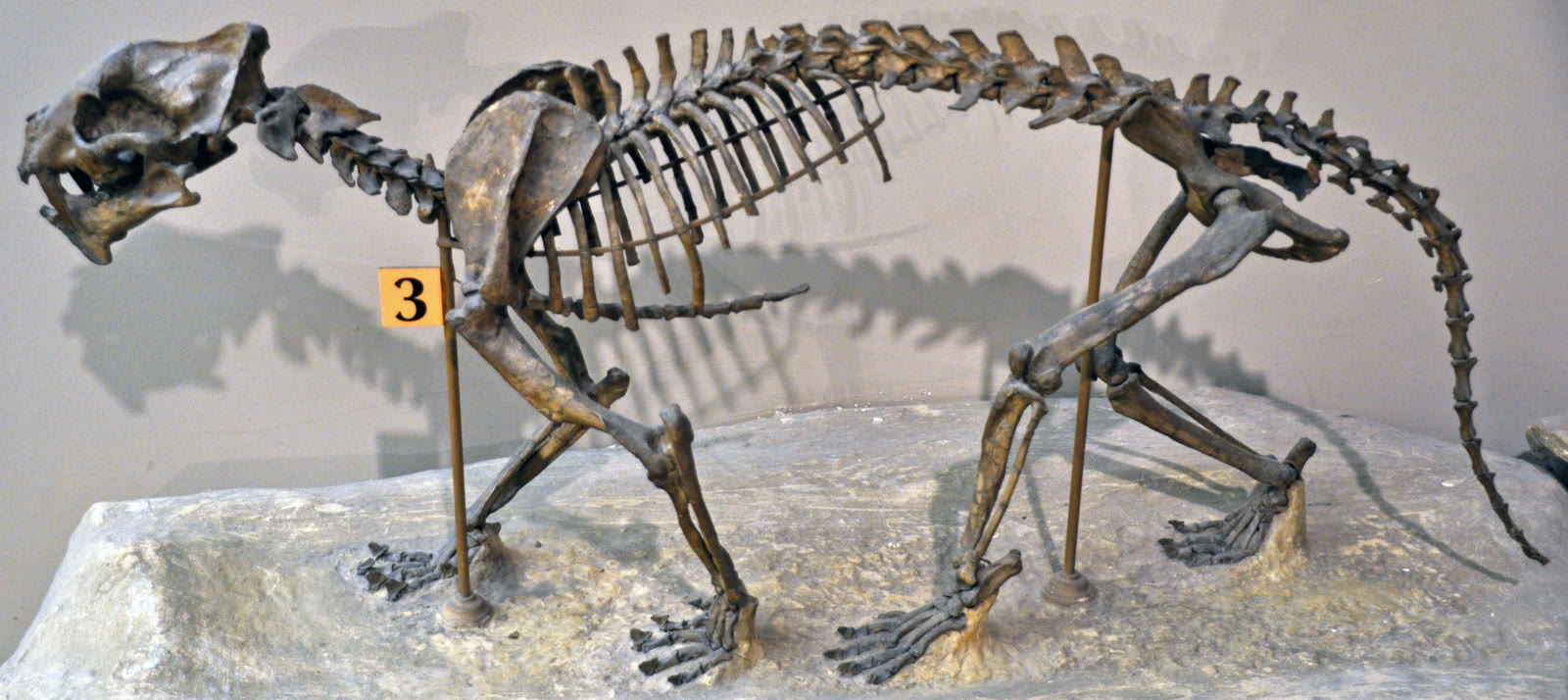
Image context: the lead image is a Wikimedia Commons photograph of a mounted Hoplophoneus primaevus skeleton at the Carnegie Museum of Natural History.[6] It is the right kind of image for this piece because the mount keeps the article's claim visible: the saber teeth matter, but the posture, feet, neck, and whole skeleton keep the animal out of a lazy true-cat comparison.
The sabers came from a different lineage
The word "cat" has to be handled carefully. Nimravids are often called false saber-toothed cats because the skull profile looks familiar: large canines, carnassial blades, a compact predator body, and a face that invites comparison with later felids.[2][3] But the family sits outside Felidae. Cambridge's Eocene-Oligocene transition chapter describes nimravids as cat-like, predominately saber-toothed carnivorans known across the late Eocene to late Miocene, while also separating their radiation from true cats.[2] Barrett's 2016 systematic revision keeps the same taxonomic caution in a more technical frame, treating Nimravidae as an extinct carnivore family whose valid species and relationships have been hard to sort because old genus names and convergent anatomy often pulled in different directions.[3]
That matters for Hoplophoneus because a saber tooth is not a family tree. The long canine is an evolutionary solution that more than one carnivore lineage explored. Later machairodont cats, nimravids, and other saber-toothed predators all converged on versions of enlarged killing teeth, but they did not inherit one identical body plan from a single saber-toothed ancestor.[2][3] The safe reading is therefore narrower and stronger: Hoplophoneus shows that the saber-tooth package was available early to cat-like carnivorans, but each lineage assembled that package with different constraints.
The taxonomy is not just a label exercise. Barrett's revision found twelve valid North American nimravid species across six monophyletic genera, and treated Hoplophoneus mentalis as a junior synonym of H. primaevus while reinstating H. oharrai.[3] That kind of revision changes the shape of the animal's history. If a genus absorbs or loses species, its apparent diversity, geographic range, and evolutionary role change with it. A species profile must therefore keep Hoplophoneus as a taxonomic question as well as a skull in a case.
The body refuses the small-cat script
Hough's 1950 USGS study is old, but the central warning remains useful: Hoplophoneus was not simply a modern cat with antique teeth.[1] Hough argued from the skeleton that the animal's head was large, the neck long, the back more highly arched, and the feet plantigrade rather than digitigrade in the clean modern-felid sense.[1] In plain terms, the animal did not stand and move like a scaled-down leopard with sabers added.
That foot posture is especially important. A digitigrade animal walks on its toes, as living cats do. A plantigrade animal brings more of the foot to the ground. Fossil posture can be difficult to infer from a mount, but Hough's point was comparative: the limb bones and feet did not support an agile, fully cat-like restoration.[1] The animal was probably powerful and dangerous, but power does not automatically mean the same hunting mechanics as a lion or puma.
The cheek teeth sharpen the profile. Hough treated the dentition as strongly specialized for shearing flesh, which is a secure claim because the teeth themselves preserve cutting surfaces more directly than behavior.[1] The leap from cutting teeth to exact hunting style is less secure. The skeleton suggests a carnivore adapted for close contact, head-and-neck driven force, and ambush or grappling more than open pursuit, but the fossil record cannot replay the kill. The honest profile separates the hard evidence from the behavioral inference: saber canines and shearing cheek teeth are anatomical facts; the exact strike sequence is reconstruction.
The Badlands make the predator ecological
Badlands National Park gives Hoplophoneus a more concrete setting than the phrase "Oligocene predator." The National Park Service describes H. primaevus as a nimravid from the park's fossil record, and the park's public fossil story includes the 2010 discovery of a skull by seven-year-old Kylie Ferguson near the Ben Reifel Visitor Center.[4] That specimen matters because it turns the taxon from a museum label into a mapped fossil event: a skull, lower jaw, and vertebrae found in place, prepared, examined, and folded into the park's public paleontology work.[4]
The Oligocene setting also prevents a single-predator fantasy. Cambridge places nimravids within the broader Eocene-to-Oligocene turnover, a time when central North America was moving toward more open habitats while cat-like carnivorans diversified and later declined.[2] The important ecological point is not that Hoplophoneus "ruled" the Badlands. It lived in a changing carnivore guild with other predators and prey, in a landscape where habitat structure, body size, and hunting method mattered together.[2][4]
That is why the false-cat label should not be thrown away entirely. It tells readers what visual family of adaptations they are looking at. But it must be followed immediately by the correction: Hoplophoneus was one early experiment in cat-like hypercarnivory, not a direct preview of the later saber-toothed cats.[2][3] The Badlands record gives the animal its local body. The taxonomic literature gives it its lineage boundary.
Bite marks make violence specific
The most vivid Hoplophoneus evidence is not the saber itself, but what sabers did to other skulls. Smithsonian Magazine's report on Dakota Badlands nimravids describes bite marks on the 2010 Hoplophoneus skull and connects them to a broader pattern of nimravids injuring one another.[5] The NPS page makes the same point for public interpretation: the spacing of bite marks on the skull matched the animal's own saber teeth closely enough to suggest another Hoplophoneus as the attacker.[4]
This is stronger than a generic statement that saber-toothed predators were violent. Of course they were predators. The more interesting claim is that some Hoplophoneus skulls may preserve face-to-face or head-targeted conflict between members of the same or closely comparable nimravid predators.[4][5] Bone healing, puncture spacing, and bite placement turn behavior into a testable trace. A skeleton with clean teeth tells us capacity. A bitten skull tells us contact.
There is still a boundary. Bite marks do not reveal motive. They cannot tell us whether the encounter was territorial, mating-related, food-related, or a failed predation event. They do show that the saber apparatus had consequences beyond prey capture, and they keep the animal socially and behaviorally dangerous without inventing a full drama. For a fossil predator, that is already a rare kind of intimacy.
The animal is clearest when the comparison stays limited
The disciplined way to read Hoplophoneus is to use resemblance without surrendering to it. It resembled true cats in the ways that made nimravids successful: a carnivorous skull, shearing dentition, retractile-claw-like predatory signals in the broader family, and saber-tooth emphasis.[1][2] It differed in lineage, body mechanics, and probably in hunting style.[1][2][3] The profile gets worse when either side is exaggerated.
Make it too cat-like, and Hoplophoneus becomes a junior version of Smilodon, waiting for the later animal to define it. Make it too alien, and the useful convergence disappears. The best middle ground is anatomical. The sabers show repeated evolutionary pressure toward deep stabbing or slicing canines. The plantigrade feet and long neck remind us that the rest of the body had to deliver those teeth in its own way.[1]
That is why Hoplophoneus is still worth a dedicated profile. It makes saber-toothed predation less linear. The fossil record did not move from "ordinary carnivore" to "true saber cat" in one clean line. It tested similar weapons in different bodies, under different ecological regimes, with different taxonomic outcomes.[2][3] Hoplophoneus sits in that experimental zone: familiar enough to mislead, distinct enough to teach, and preserved well enough in the Badlands record that its violence can be read from bone rather than imagined from teeth alone.[4][5]
Sources
- Jean Hough, "The Habits and Adaptation of the Oligocene Saber Tooth Carnivore, Hoplophoneus," U.S. Geological Survey Professional Paper 221-H (1950) - anatomical comparison of skull, limbs, posture, dentition, and inferred adaptation.
- H. N. Bryant, "Nimravidae," in The Terrestrial Eocene-Oligocene Transition in North America, Cambridge University Press (1996) - chapter page summarizing nimravid range, cat-like convergence, taxonomy, and Eocene-Oligocene ecological context.
- Paul Z. Barrett, "Taxonomic and systematic revisions to the North American Nimravidae (Mammalia, Carnivora)," PeerJ 4:e1658 (2016) - PubMed record for the revision of North American nimravid species and relationships.
- U.S. National Park Service, "Nimravid: Saber-toothed Hunter of the Badlands" - Badlands National Park page on Hoplophoneus primaevus, the 2010 skull discovery, and bite-mark interpretation.
- Riley Black, "The Dakota Badlands Used to Host Sabertoothed Pseudo-Cat Battles," Smithsonian Magazine (2016) - reported account of bite-marked nimravid skulls and intra-nimravid conflict evidence.
- Wikimedia Commons, "File:Hoplophoneus primaevus (fossil false sabertooth cat) (Middle Oligocene; Nebraska, USA) 2 (32904296476).jpg" - source page for the Carnegie Museum skeleton photograph used as the lead image.