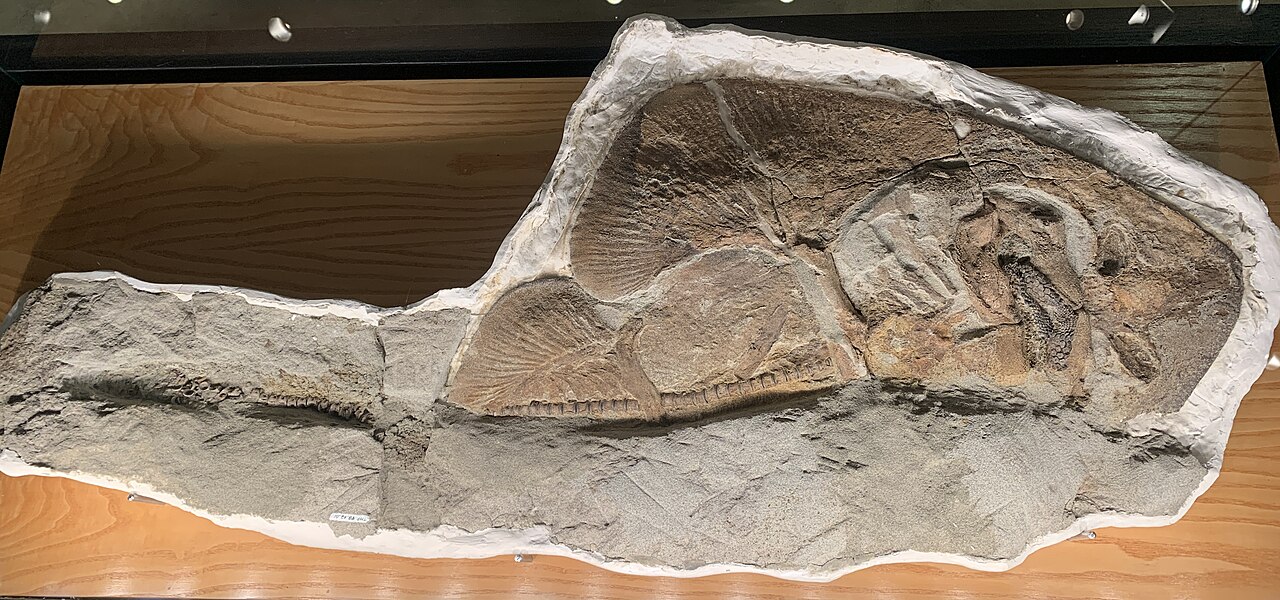
The ray above is not a cast. Across a pale slab at the Royal Tyrrell Museum, its body reads from right to left: blunt head, dark pavement of closely packed teeth, wing-like pectoral fins, a beaded vertebral column, then a tail that fades into missing rock. The museum photograph identifies it as TMP 1998.062.0001, the most complete known skeleton of Myledaphus bipartitus.[5] It is a spectacular fossil precisely because most Myledaphus fossils are not bodies at all.
For more than a century, this Late Cretaceous ray was principally a name attached to durable pieces. Its small crushing teeth are common in western North American deposits, and its calcified vertebral centra occur often enough that a 2013 study could section and compare 117 of them. Cartilage—the material that builds most of a ray's skeleton—usually left a much thinner archive. Teeth could reveal diet and distribution; centra could retain growth increments; neither, by itself, supplied the connected head, fin, and trunk characters needed to settle the animal's family address.[4]
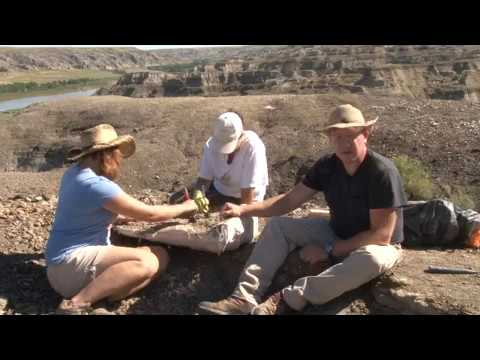
That imbalance is what makes the Royal Tyrrell Museum's 2-minute, 24-second Fossil Ray Discovery worth watching. Originally published on August 26, 2011, the field clip announces what its description calls only the second associated Myledaphus specimen then known.[1] The fossil in the clip is a partial find, not the more complete display specimen photographed above. Keep the two separate. Together, however, they show why “associated” can be a more consequential word than “large.”
The quarry withholds the familiar silhouette
The video opens in the striped badlands of Dinosaur Provincial Park. Three people sit close to the ground around a modest patch of rock. There is no clean ray outline, no theatrical skeleton rising from a trench, and no instant resemblance to an aquarium animal.[1] That visual modesty is the first annotation: field evidence rarely arrives in the same form as a museum mount.
An isolated tooth can travel, sort, and weather free of the animal that made it. A row of vertebrae beside cartilage and dermal denticles is different. Their proximity constrains which structures belonged together before erosion separated more of the carcass. Association does not guarantee an undisturbed burial or a complete animal, but it reduces the taxonomic guesswork required when every element comes from a separate screen-washed sample.
Around the midpoint, the camera cuts from the broad landscape to small dark fragments resting in a hand.[1] The scale change is the video's most useful moment. A ray's evolutionary story is being recovered through pieces that could disappear into gravel at a glance. The scientific value lies not in their visual drama but in the relationship among them—and in the field record that preserves that relationship.
Teeth made the taxon before they made the animal
Myledaphus bipartitus was named in 1876, long before an articulated body made its proportions visible. Its teeth are compact, polygonal crushing units rather than the blade-like teeth that dominate the popular image of fossil sharks. Their abundance made Myledaphus a recognizable component of Late Cretaceous freshwater assemblages, but tooth form alone produced an unstable classification. The animal was once treated as closer to stingrays; later dental and skeletal comparisons pulled it toward guitarfish-like rays.[4]
This is not a failure of teeth. Different fossil parts answer different questions. A tooth can be excellent evidence for the presence of a taxon at a locality, for wear, or for how a feeding surface worked. Vertebral centra can preserve growth bands: the 2013 analysis used them to reconstruct a life history from specimens scattered through the Oldman and Dinosaur Park formations.[4] But a phylogenetic dataset needs characters distributed across the skull, jaws, shoulder region, fins, and axial skeleton. When those regions are disconnected, a tooth-heavy record risks making one durable structure stand in for an entire body.
The photographed slab changes the scale of comparison. Its pectoral fins form a broad angular disc without swallowing the entire head; its pelvic fins sit behind and partly beneath that disc; calcified cartilage preserves a long axis through the trunk.[5] Those are observations of the fossil's anatomy, not a complete reconstruction of its swimming behavior. They are also the kind of linked characters that isolated teeth cannot supply.
A 2026 revision lets the whole body vote
In 2026, Julia Türtscher, Patrick L. Jambura, and Jürgen Kriwet published the first comprehensive skeletal description of M. bipartitus. Their study centers on an exceptionally preserved, roughly 101-centimeter specimen from the Campanian Dinosaur Park Formation. High-resolution photography and ultraviolet light helped expose fine structures; the researchers then coded a broader morphological dataset and tested it in phylogenetic analyses.[2][3]
The result places Myledaphus within Rhinopristiformes, the order that includes living guitarfishes and sawfishes. The authors describe a mixture of ancestral and more derived characters rather than one decisive “guitarfish feature.” That distinction matters. A family tree is not built by matching a fossil's outline to the nearest living silhouette; it is built by asking how many independent anatomical characters support competing placements, then testing how those characters behave across the comparison set.[2]
Nor does the revision turn Myledaphus into a direct ancestor of a modern guitarfish or sawfish. It identifies an early branch within a larger order. The exact relationships inside that order remain sensitive to the available fossils and character sampling, particularly because many Cretaceous rays are still known mainly from teeth. The new body narrows the answer. It does not close the archive.[2][3]
“Freshwater ray” describes a tolerance, not a sealed habitat
The revision also calls M. bipartitus the oldest known freshwater-tolerant rhinopristiform.[2][3] The careful word is tolerant. The Dinosaur Park Formation records river channels, floodplains, coastal wetlands, and varying marine influence as the nearby Western Interior Seaway shifted. Myledaphus remains occur in freshwater and brackish settings. That pattern supports euryhalinity—the ability to handle changing salinity—more securely than it supports an animal confined to one kind of water.[3]
Ecology here comes from joining anatomy to geology and distribution. The skeleton establishes what kind of ray this was. The sediments and repeated occurrences establish the waters it entered. Living rhinopristiforms offer useful comparisons because some move through estuaries or into fresh water, but analogy is not direct evidence of the Cretaceous animal's daily route. “Freshwater-tolerant” is therefore a bounded evolutionary claim, not a scene reconstruction of Myledaphus spending its whole life in one river.
That boundary makes the fossil more interesting. More than 70 million years ago, a ray lineage usually associated today with marine coasts had already tested inland and brackish habitats.[3] Freshwater invasion was not one late innovation that happened once. It was an ecological experiment attempted on different branches of the ray tree.
The short film ends before the scientific afterlife begins
The Royal Tyrrell clip records a recovery moment: people, locality, matrix, and a partial set of associated structures.[1] The 2013 growth study turns numerous isolated centra into a population-scale sample.[4] The 2026 revision uses a rare articulated skeleton to test the body plan and family tree.[2] None of these sources makes the others obsolete. They operate at different resolutions.
This is the deeper reason to watch a small field video beside a large museum fossil. The clip resists the idea that paleontology begins with a recognizable creature and merely fills in facts. In the quarry, the unit of discovery may be a few connected vertebrae. In a collection, a slab preserves anatomical relationships. Years later, new imaging, expanded comparative datasets, and revised classifications make those relationships answer questions that the excavators could not yet frame.
Watch the midpoint once more: dark fragments in a palm, badlands out of focus behind them.[1] The image does not look like a family tree. It shows the condition that makes one possible. Teeth made Myledaphus common in the record; associated bodies made it anatomically testable. The fossil ray found its family only when enough of one animal stayed together.
Sources
- Royal Tyrrell Museum of Palaeontology, “Fossil Ray Discovery,” official YouTube field video, originally published August 26, 2011.
- Julia Türtscher, Patrick L. Jambura, and Jürgen Kriwet, “Skeletal morphology and phylogenetic relationships of the Late Cretaceous freshwater ray Myledaphus bipartitus,” Journal of Systematic Palaeontology 24(2), 2026, DOI 10.1080/14772019.2026.2679622; University of Vienna research record and abstract.
- University of Vienna, “Cretaceous freshwater ray sheds new light on the evolution of modern rays,” research release, June 27, 2026.
- Alycia E. Wilson, Michael G. Newbrey, Donald B. Brinkman, Todd D. Cook, and Andrew G. Neuman, “Age and growth in Myledaphus bipartitus, a Late Cretaceous freshwater guitarfish from Alberta, Canada,” Canadian Journal of Earth Sciences 50(9), 2013, DOI 10.1139/cjes-2013-0001; Penn State research record and abstract.
- Bloopityboop, “File:Myledaphus bipartatus (guitarfish).jpg,” Wikimedia Commons source page and museum-image metadata for TMP 1998.062.0001, photographed at the Royal Tyrrell Museum in 2020.