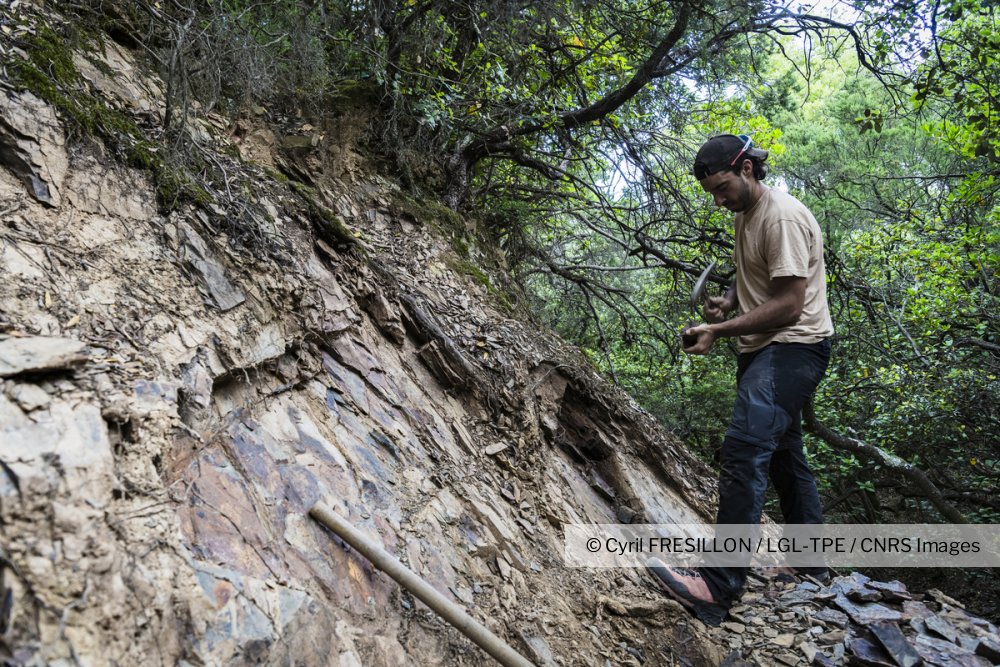
The cover photograph catches Cabrières at the moment deep time becomes loose stone. A researcher stands beneath oak branches, hammer raised toward thin shale beds that tilt out of a wooded slope. The exposure looks fresh only in the archaeological sense: before a piece reaches his hand, it has already passed through burial, mineral replacement, tectonic heating, uplift, rain, and roots.[6]
That long afterlife is the point. Many Cabrières fossils now appear as orange, red, brown, or black stains. A 2026 study argues that these colors are not a surviving palette from an Ordovician animal or alga. They are the visible end of a chemical relay in which decaying tissue was copied by pyrite, sometimes joined by silica or residual carbon, and then rewritten when pyrite weathered into iron oxides.[2]
The site carries a second transformation too. Since its first major description in 2024, several of its simplest shapes have moved back and forth across the boundary between body fossil and trace fossil—between the remains of an organism and the record of something an organism did. That disagreement matters because Cabrières has been presented as an exceptionally preserved window onto a high-latitude marine community near the Ordovician South Pole. If some supposed sponges, algae, and worms are instead burrows or pellet-filled trails, the window contains a different census.[1][3][4]
Cabrières is therefore best read as a field site with two linked questions. What sequence of minerals preserved each mark? And what kind of biological event did that mark originally record? The new chemistry sharpens the first question. It cannot answer the second by itself.
A polar shelf survives beside a French village
The fossiliferous outcrops lie within roughly one kilometre of Cabrières in the southern Montagne Noire, Hérault. Their rocks correlate with the mudstone-rich Landeyran Formation and sit in the late Floian part of the Early Ordovician, about 470 million years ago. At that time the region occupied a high southern latitude on Gondwana's margin. Sediment accumulated on an open marine shelf, much of it below the normal reach of storm waves.[1][5]
The discovery did not begin with a large institutional quarry. Amateur palaeontologists Eric and Sylvie Monceret found the first possible soft tissues in 2018, then continued collecting as specialists joined the work. By the 2024 description, more than 400 fossils had been registered in the Monceret collection at Université Claude Bernard Lyon 1. The assemblage combined familiar hard parts—trilobites, brachiopods, molluscs, hyoliths, conulariids, and sparse echinoderms—with non-biomineralized arthropod fragments and a much more contentious set of sponge-like, algal, tubular, and vermiform forms.[1]
That mixture gave the site its larger evolutionary promise. The Floian falls within the long transition from the Cambrian diversification of animal body plans to the Great Ordovician Biodiversification Event, when marine diversity and ecological structure expanded dramatically. Cabrières' original authors interpreted its mix of Cambrian-looking and more characteristically Ordovician groups as a polar community living through that transition. They went further, proposing that cooler high-latitude water may have offered refuge from unusually warm tropical seas.[1]
The geography is relatively secure; the refuge is an inference. A palaeogeographic model can place the shelf near the pole, but it cannot show migration. That claim depends on which fossils are genuine bodies, how completely the assemblage samples the community, how Cabrières compares with lower-latitude sites, and whether temperature rather than preservation or collecting explains the contrast. At this site, taxonomy and taphonomy are not background details. They determine how large an ecological story the rocks can carry.
The red stain began as pyrite
The 2026 preservation study began with an April 2024 field campaign. Researchers collected hundreds of specimens from surface outcrops, screened them under an optical microscope, and chose 12 examples spanning different colors and proposed organism types for scanning electron microscopy. More than 300 energy-dispersive X-ray spectra mapped how carbon, silicon, iron, and other elements varied between the visible fossils and the surrounding mudstone.[2]
The result was not one universal fossilization recipe. In filamentous forms identified by the authors as algae, carbon is concentrated especially near some margins, silicon occurs in other regions, and iron dominates elsewhere. Proposed sponge spicules no longer contain their original biogenic silica; iron-rich minerals occupy their place. Vermiform specimens carry small euhedral and framboid-like iron-oxide forms, including empty impressions where crystals have dissolved. Some fossils show almost no color contrast to the matrix yet retain a distinctive microscopic arrangement of minerals.[2]
From that mosaic, the authors reconstruct a sequence. Decay in buried marine sediment created reducing conditions. Microbes reducing seawater sulphate produced sulphide, which reacted with available iron and precipitated pyrite in and around decaying tissues. The dissolution of silica-rich sponge spicules may then have supplied some of the silicon that mineralized other organic surfaces. Where neither pyrite nor silica took over completely, carbonaceous material could persist.[2]
The sequence did not stop at early burial. Later heating, fluid movement, and surface weathering stripped sulphur from the pyrite. Some crystals dissolved; iron moved and reprecipitated as poorly crystalline oxides, while some carbon was leached away. Orange and red specimens are thus associated with oxidized iron. Black regions can retain more carbon. The palest ghosts may expose matrix beneath material that has almost entirely vanished.[2]
This makes the visible fossil an afterimage, not a direct coating of the original organism. A red outline can occupy a place once held by pyrite, and that pyrite may itself have replicated only part of a decaying body. Conversely, a feature invisible to the naked eye may still survive as texture at micron scale. Color is useful evidence about the last preservation phase, but it is not a legend that labels anatomy.
The study also states an important limit: all of its material came from surface outcrops; no fresh drill core was recovered. Cabrières' modern forest and fluid-rich geological history are not scenery around a sealed archive. They are active parts of the archive's alteration. The proposed relay—pyrite, silica or carbon, then weathering—fits the observed chemistry, but its distribution across tissue types and burial depths still needs broader, less weathered sampling.[2]
The same mud records bodies and behavior
A companion 2026 study looked not at body chemistry but at the Landeyran Formation's trace fossils. It identified shallow horizontal trails, open and actively filled burrows, rare vertical burrows, isolated faecal pellets, and tiny structures attributed to meiofaunal activity. Across much of the shelf mudstone, trace diversity and the intensity of sediment mixing remain low. The authors interpret that pattern as fluctuation between oxygen-poor and oxygen-starved conditions in the sediment.[5]
Low oxygen creates a productive paradox. It suppresses the animals that churn sediment and accelerate the destruction of carcasses, improving the odds that delicate material survives. Yet the presence of trails and burrows proves that the bottom was not permanently empty. Cabrières records intervals or microenvironments in which animals moved through the substrate alongside intervals in which limited mixing helped bodies escape rapid decay.[5]
That overlap makes misidentification possible. A compressed burrow on a bedding plane can resemble a worm. A branching trail can resemble an alga. A row of faecal pellets can be mistaken for repeated anatomy. Meanwhile, a genuinely soft body can lose relief, carbon, and crisp edges until it resembles little more than a stain. The rock does not sort these objects into separate drawers.
A fossil category has to be earned specimen by specimen
In October 2024, Lucy Muir and Joseph Botting challenged the original description directly. They argued that the specimens called sponges, algae, a worm, a hemichordate tube, and a lobopodian were better read as trace fossils, many of them burrows containing faecal pellets. On that interpretation, the contested non-arthropod forms would not establish exceptional soft-body preservation, and the most ambitious reconstruction of a diverse polar refuge would lose much of its support.[3]
The original team replied that the critique treated resemblance as identification. Their defense invoked repeated morphology, branching and tapering patterns, preserved structural details, the distinction between bodies lying on a surface and burrows occupying sediment, and differences in texture and composition. They retained both the Lagerstätte designation and the high-latitude-refuge interpretation.[4]
The 2026 ichnology paper turns that exchange into a practical five-part test. Investigators should ask whether an object retains three-dimensional relief; whether its width stays constant like a passage made by one animal; whether its length greatly exceeds any plausible body; whether weathering leaves a coherent burrow cast or delicate fragments; and whether bending, twisting, or tapering behaves like flexible tissue rather than an excavated tunnel. No cue is absolute. Mudstone compaction can flatten a cylindrical burrow by 50 to 80 percent, oblique exposure can change its apparent width, and weathering can erase relief. The criteria gain force as a package and across multiple preservational variants.[5]
This is also the boundary of the new chemical work. Iron, silica, and carbon can show that a structure followed a particular fossilization path. They can distinguish the object from its matrix even after its color fades. They do not, alone, say whether the decaying organic matter belonged to an alga, lined a burrow, or accumulated inside a feeding trace. A chemical map becomes taxonomic evidence only when it is registered to morphology and compared with explicit predictions from rival interpretations.[2][3][4][5]
What remains after the headline narrows
The dispute does not reduce Cabrières to nothing. Its age, shelf setting, high palaeolatitude, abundant biomineralized fauna, non-biomineralized arthropod material, and genuine trace-fossil assemblage remain substantial lines of evidence.[1][3][5] The 2026 analyses add a rare taphonomic lesson: even within one fossil, preservation can be partitioned among pyrite, silica, and carbon, then altered again by oxidation and leaching.[2]
What must remain provisional is the full biological census and everything built on it. Calling Cabrières a polar refuge requires more than locating it near the ancient pole. Researchers must show that the forms used to calculate diversity are bodies rather than behaviors, that their identities survive independent examination, and that ecological differences from other sites exceed the biases introduced by oxygen, burial chemistry, outcrop weathering, and collection.
The next decisive work is therefore less glamorous than naming another strange form. Fresh subsurface material could separate original mineralization from surface alteration. The same morphology followed across differently weathered specimens could reveal whether a structure keeps body-like features or burrow-like relief. Registered optical images, three-dimensional sections, elemental maps, and blind classifications by body-fossil and trace-fossil specialists could force competing explanations to make different predictions.
Return to the hammer in the photograph. It is not opening a time capsule with a single seal. It is taking one surface from the last stage of a long sequence.[6] Cabrières did not preserve a still image of a polar sea. It preserved substitutions: tissue into minerals, minerals into other minerals, and sometimes an organism's action into a shape that resembles the organism itself. The site's importance lies not in pretending those substitutions are transparent, but in learning how to read through each one.
Sources
- Farid Saleh et al., “The Cabrières Biota (France) provides insights into Ordovician polar ecosystems,” Nature Ecology & Evolution 8 (2024)—original description, locality, collection, stratigraphy, fossil census, and polar-refuge interpretation.
- Farid Saleh et al., “Preservation modes of exceptionally preserved fossils from the Early Ordovician Cabrières Biota, France,” Lethaia 59 (2026)—SEM and EDS evidence for pyritization, silicification, carbon preservation, and later weathering.
- Lucy A. Muir and Joseph P. Botting, “The Cabrières Biota is not a Konservat-Lagerstätte,” Nature Ecology & Evolution 8 (2024)—the trace-fossil reinterpretation and its consequences for the site's ecological claims.
- Farid Saleh et al., “Reply to: The Cabrières Biota is not a Konservat-Lagerstätte,” Nature Ecology & Evolution 8 (2024)—the original team's morphological and taphonomic defense of body-fossil identifications.
- Romain Gougeon et al., “Ichnology of the Lower Ordovician Landeyran Formation, Montagne Noire, France and criteria for distinguishing simple trace fossils from body fossils,” Lethaia 59 (2026)—trace assemblage, oxygen interpretation, compaction limits, and five-part identification framework.
- CNRS Images, “Extraction de fossiles au marteau, site de Cabrières, Hérault,” photograph 20240063_0037 by Cyril Frésillon (2024)—official source and field context for the cover photograph.