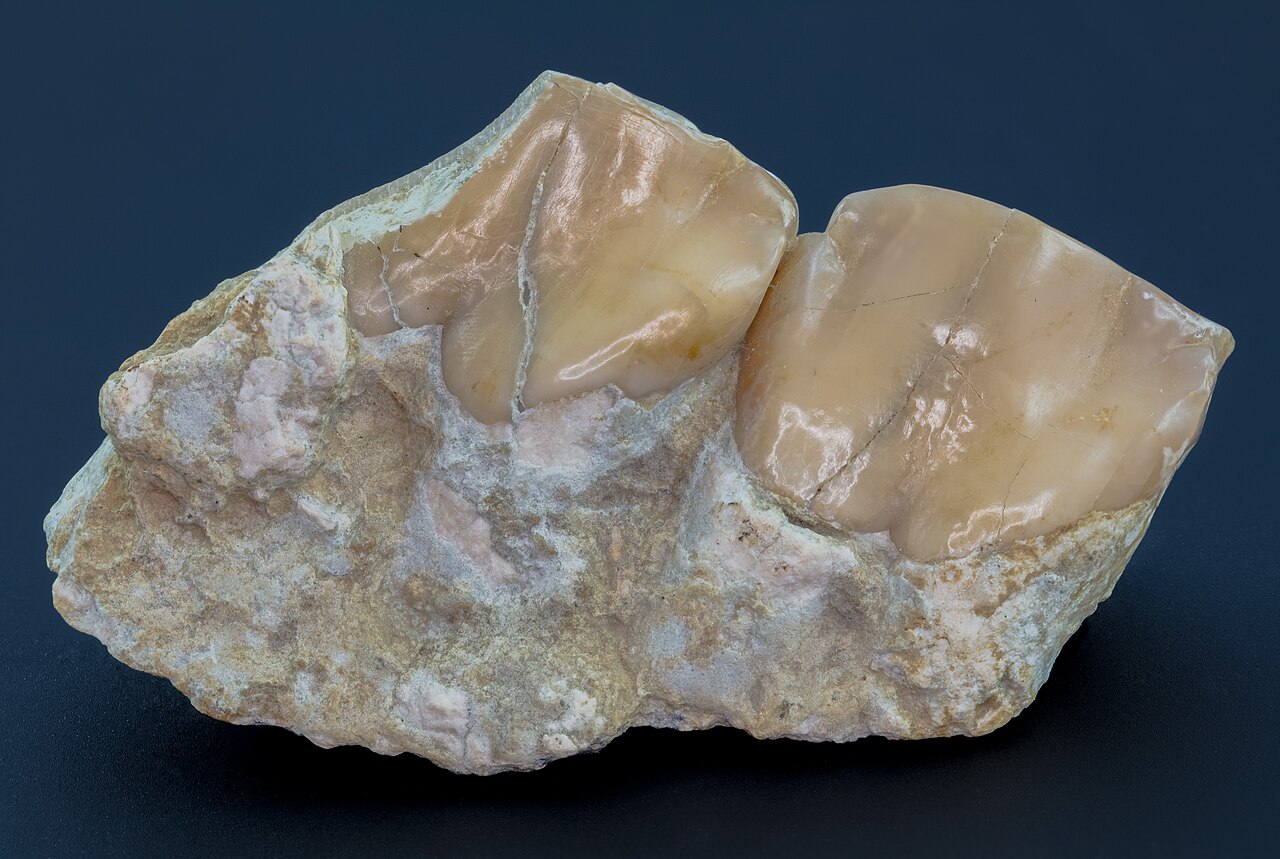
Two broad teeth rise from a broken jaw, their smooth brown enamel contrasting with the pale, chalky bone beneath them. This fragment belongs to Merycoidodon, one of the oreodonts: extinct hoofed mammals whose abundance makes them central characters in the ancient Badlands. The National Park Service identifies Merycoidodon as the park's most commonly found oreodont genus.[1][2]
Abundance can make a fossil seem familiar before its owner has been understood. An animal encountered repeatedly in the rocks can become a generic herbivore in a reconstructed landscape. Merycoidodon rewards a closer look. Its mouth combines an unexpected arrangement of pointed teeth with evidence of browsing, while enamel chemistry helps place that feeding within a landscape shared with early horses, camels and rhinoceroses.[4][5][6]
An animal before the buttes
Oreodonts belonged to the even-toed hoofed mammals, the broad group that includes living sheep and camels. Their four-toed feet and unfamiliar combination of features resist a neat modern equivalent. The comparison with pigs, sheep and camels can suggest an appearance, but no single living animal supplies a complete portrait. Nor does “oreodont” name one species: the Badlands preserve several genera, including Miniochoerus and Leptauchenia alongside Merycoidodon.[1]
Their remains occur especially frequently in the Brule Formation. In the park, these deposits accumulated roughly 34–30 million years ago, around the beginning and early part of the Oligocene. Rivers crossed a region becoming cooler and drier than the wetter floodplains recorded in the underlying Chadron Formation.[1][3]
The serrated buttes visible today came much later, as erosion cut into those deposits. Putting the animal among the present bare slopes would confuse its burial ground with its living habitat. The sediment preserves an earlier landscape; the modern relief exposes it.[3]
The fang with a different identity
A complete mouth adds a surprise that the photographed cheek teeth cannot show. In Merycoidodon and its relatives, the conspicuous lower tooth meeting the upper canine is a premolar. The actual lower canine is small and resembles an incisor, joining the teeth at the front of the jaw.[4]
Wighart von Koenigswald, Thomas Lehmann and Torsten Wappler discussed this arrangement in a 2025 study of the Eocene mammal Masillabune, comparing it with oreodont specimens. Their illustrated Merycoidodon skull shows how the upper canine meets the enlarged first lower premolar. Opposing wear surfaces help establish the contact.[4]
The distinction matters because a tooth's dramatic outline does not tell us its identity. Here, different positions in the tooth row have taken on a familiar-looking partnership. The authors also found comparable arrangements in separate mammalian groups, making resemblance alone an unreliable guide to close relationship.[4]
For the animal's diet, the rest of the mouth remains essential. A pair of pointed teeth cannot outweigh the evidence from the chewing surfaces behind them.
Leaves with an abrasive accompaniment
In their 2019 study of North American hoofed mammals, Gina Semprebon, Florent Rivals and Christine Janis examined tooth-crown height together with two scales of wear: the rounding of larger tooth features and microscopic scratches and pits. Their oreodont sample included several named species of Merycoidodon.[5]
The early oreodonts showed relatively low overall abrasion, comparable with living browsers. Across the family's longer history, microscopic wear indicated predominantly browsing diets, although some relatives had mixed feeding habits. Crucially, many teeth carried more pronounced pitting and coarser scratches than typical modern leaf browsers.[5]
The researchers interpreted much of that extra damage as the effect of external grit. Dust or soil swallowed with vegetation can abrade enamel without grass becoming the main food. This makes a leafy meal less gentle than it sounds: the animal consumes both its chosen plant and whatever adheres to it. Wear therefore records feeding conditions as well as food choice.[5]
Finding room among the neighbours
An independent approach places Merycoidodon within its community. Alessandro Zanazzi and Matthew Kohn's 2008 study measured carbon and oxygen isotopes in tooth enamel from six common White River mammal genera. Their carbon results suggested that Merycoidodon and the small horse Mesohippus preferred woodland settings, while the rhinoceros Subhyracodon and camel Poebrotherium favoured more open habitats.[6]
These were comparative inferences, dependent on assumptions about ancient atmospheric carbon and how habitat affected the plants eaten. They do not identify a particular leaf or locate an individual beneath a particular tree. They do suggest that animals preserved in the same regional record used different parts of their surroundings.[6]
The oxygen results also left digestion open to question. The authors suggested that foregut fermentation could have been absent or incompletely developed in the sampled oreodonts. Familiar comparisons with sheep should therefore stop short of confidently assigning Merycoidodon a sheep's digestive system.[6]
Together, the findings suggest an animal selecting vegetation, encountering abrasive particles and occupying its own part of a shared environment. The photograph alone cannot establish its owner's diet, but it makes the surviving evidence tangible. Abundance makes this ordinary work consequential: a landscape's history includes the repeated meals of its most numerous inhabitants.
Sources
- National Park Service, “Oreodont: Ancient Grazer of the Badlands” (2020) — abundance, diversity, anatomy and occurrence in the Brule Formation.
- Diego Delso, “Jaw and teeth of an Oreodon (Merycoidodon culbertsoni), South Dakota, United States,” Wikimedia Commons (2021) — photograph and specimen provenance supplied by the photographer.
- National Park Service, “Geologic Formations: How Badlands Buttes Came to Be” (2020) — depositional ages, ancient environments and later erosion.
- Wighart von Koenigswald, Thomas Lehmann and Torsten Wappler, “Extraordinary occlusion of caniniforms in the Eocene Masillabune martini from Messel,” Palaeobiodiversity and Palaeoenvironments 105 (2025), 939–947 — oreodont comparison and the Merycoidodon specimen in Figure 5.
- Gina M. Semprebon, Florent Rivals and Christine M. Janis, “The Role of Grass vs. Exogenous Abrasives in the Paleodietary Patterns of North American Ungulates,” Frontiers in Ecology and Evolution 7 (2019), article 65 — tooth wear, browsing and external grit, especially the Merycoidodontidae results.
- Alessandro Zanazzi and Matthew J. Kohn, “Ecology and Physiology of White River Mammals Based on Stable Isotope Ratios of Teeth,” Palaeogeography, Palaeoclimatology, Palaeoecology 257 (2008), 22–37 — institutional abstract reporting habitat and physiological inferences.