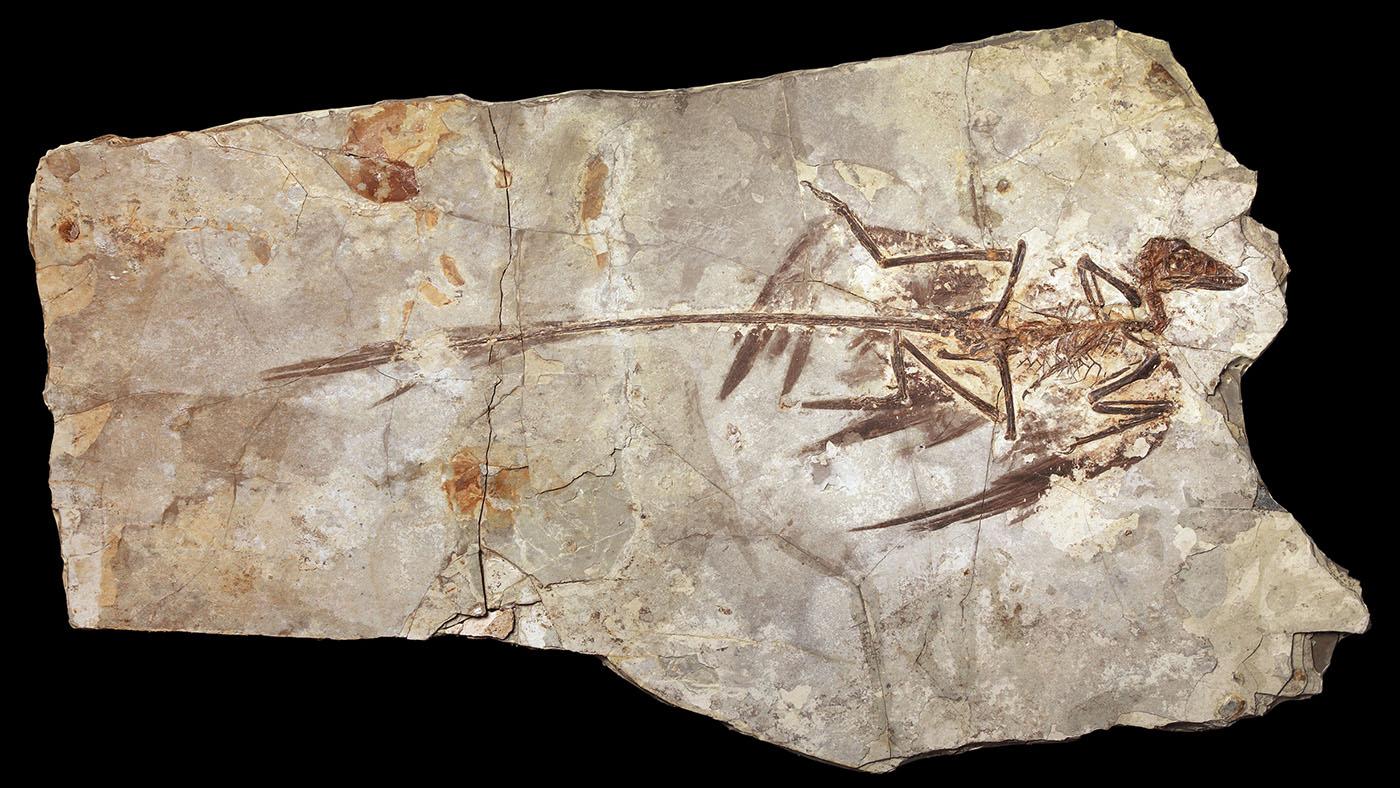

A mouse-sized dinosaur ought to be easy to imagine. Lizards, shrews, frogs, and birds all fit inside that envelope, and dinosaurs occupied terrestrial ecosystems for roughly 180 million years. Yet the smallest securely adult non-bird dinosaurs known from fossils weigh about 400–450 grams: closer to a large rabbit than a mouse. Paleontology has plenty of tiny dinosaur bones. What it lacks is convincing evidence that those bones belonged to a species whose adults stayed tiny.[2][3]
That distinction drives the American Museum of Natural History's six-and-a-half-minute film Where are All the Tiny Dinosaurs? Curator Roger Benson moves from giant bones in a storeroom to fossils that almost disappear against a fingertip, then asks whether the empty space below rabbit size reflects the way paleontologists collect, the way dinosaur bodies worked, or the ecology of Mesozoic communities.[1] The lead photograph makes the puzzle tangible: Microraptor is genuinely small, genuinely non-avian, and preserved with exquisite detail, but it still does not enter the body-mass range occupied by the smallest mammals, lizards, or birds.[3]
The video appeared in 2024 with the answer deliberately open. A 2026 study by Stephanie Lechki and Benson has since tested one of its central possibilities: perhaps the scaling of energy acquisition and reproduction imposed an intrinsic lower limit on non-bird dinosaurs. The result is valuable because the model fails. It cannot produce the observed small-size boundary, which moves the problem away from a simple physiological prohibition and toward ecological constraints that fossils record only indirectly.[2] Watch the film for its sequence of tests rather than for a missing miniature species; the annotations below show how each rejected explanation sharpens the question.
Opening sequence | A tiny bone is not yet a tiny species
The film opens with a useful visual trap. Museum halls and storerooms make dinosaur history look enormous because enormous bones are easy to notice, excavate, mount, and remember. Benson then holds a palm-sized rock containing much smaller remains and shows how CT scanning can digitally separate bone from matrix when physical preparation would be too risky.[1] This is not a decorative laboratory interlude. It establishes that the search method changes with scale: a fieldworker must get closer to the ground, and a preparator may need to leave the fossil inside the rock.
But better detection solves only one of two identification problems. A little skeleton may be the adult of a little species, or it may be a juvenile of a much larger species. The smallest body mass in an evolutionary dataset must be based on adult size, not on the smallest individual ever found. Growth stage can be assessed from several imperfect signals—bone microstructure, fusion, surface texture, proportions, and comparison with a growth series—but no single small-looking specimen earns the label “miniature adult” by appearance alone.
This is why the film's contrast between Microraptor, Fruitadens, and baby dinosaurs matters. Small adult taxa are real, and the 2026 analysis places the lower end of known non-avian dinosaur adult masses near 400 grams.[2] The claim is not that dinosaurs could never hatch below that mass. Eggs guarantee that many did. The pattern needing explanation is that known non-bird lineages did not remain in the 1–300-gram range as reproducing adults.
Around 3:40 | Birds do not dissolve the puzzle; they expose the transition
The video's cleverest turn is the hummingbird objection. Birds are dinosaurs, so any claim that “dinosaurs could not be tiny” is immediately false unless non-bird dinosaurs are specified. Early Cretaceous bird fossils enter the tens-of-grams range, and living birds extend down to less than two grams. Tiny dinosaurian bodies were biologically possible. They appeared on one branch of the dinosaur tree.[1][2]
That branch had already been shrinking before fully modern birds arrived. A broad 2014 analysis found sustained high rates of body-mass evolution along the avian stem and a long trend toward smaller bodies among successive bird-line theropods.[4] The 2026 study identifies an additional threshold: known non-avian adults bottom out near 400 grams, whereas birds have a modal mass around 30–33 grams. The important event is therefore not a magical instant when an animal became a bird. It is a lineage crossing into an ecological size regime that its close non-flying relatives did not occupy.[2][4]
Flight is a compelling part of the explanation, but the direction of causality remains open. Smaller bodies can assist aerial locomotion, while access to trees, airspace, dispersed food, and escape routes can reward further miniaturization. The new study proposes that flight coincided with release from constraints operating on the ground; it does not demonstrate that one wing stroke removed a fixed physiological barrier. The fossil pattern fixes the transition in deep time. The ecological mechanism is an inference built around it.[2]
Around 4:40 | Preservation bias is real, but it has a control group
The most obvious answer is taphonomy. Small skeletons contain slender elements that scatter, dissolve, break, or escape notice more readily than large bones. The global dinosaur record is therefore biased upward: the apparent abundance of tonne-scale species is partly a history of preservation and discovery, not a census of living communities.[2] The film acknowledges this directly as Benson searches close to the rock surface and opens collection drawers filled with minute remains.[1]
The stronger test is not to ask whether tiny dinosaur fossils are difficult to find; they are. It is to ask what else the same deposits preserve. The 2026 study examines the Jehol Group of northeastern China and Mongolia's Djadokhta Formation because both contain abundant small tetrapods, including mammals and squamates, alongside birds and non-bird dinosaurs. In other words, these rocks demonstrate that bodies in the missing size range could enter the local fossil record and be recovered by paleontologists.[2]
Those assemblages do correct part of the large-body distortion. The Djadokhta dinosaur sample has an observed modal mass around 0.76 kilograms, far below the global dinosaur dataset's heavily biased peak; Jehol also preserves far more small-bodied diversity than formations dominated by large isolated bones. Yet neither window contains an adult non-bird dinosaur below 300 grams, even though the energetic models predict dinosaurs in the 100–300-gram interval and neighboring vertebrate groups cross it.[2]
That is not mathematical proof that no mouse-sized dinosaur ever lived. Fossil absence never becomes omniscience. It is a controlled absence: the target remains missing where similarly fragile animals are present. Preservation can still hide many species around a few kilograms while becoming a weaker explanation for the complete sub-300-gram gap.
Around 5:25 | A failed energy model removes the simplest internal limit
The film ends by considering whether dinosaur physiology combined costly, elevated metabolism with a reptile-like way of acquiring food, making very small adult bodies energetically unworkable.[1] Lechki and Benson converted that intuition into a test. Their model balances two size-dependent processes: the rate at which an organism acquires surplus energy and the rate at which it converts that energy into offspring. Where those curves interact, the model predicts an energetically favored body size and a wider distribution around it.[2]
The framework approximates the observed body-size distributions of mammals, living birds, and turtles. It performs poorly for lizards, snakes, crocodylians, flightless birds, and non-avian dinosaurs, and it misses those groups in different directions. Most importantly, even after the researchers tried a wide range of physiological scaling values drawn from living animals, the model kept predicting non-bird dinosaurs in the 100–300-gram range. Intrinsic energetics did not forbid the very sizes the fossil record lacks.[2]
That failure does not prove the headline-friendly alternative that mammals “kept dinosaurs big.” It establishes a narrower conclusion: physiology alone is insufficient. Competition with small Mesozoic mammals is one candidate external constraint. Predation, the occupations of juvenile dinosaurs, habitat structure, and other forms of niche exclusion remain in the same explanatory basket. The paper's island comparisons show why ecology is plausible—body-size distributions can move closer to energetic predictions when predators or competitors are reduced—but analogy is not a direct observation of a Jurassic contest.[2]
The mammal hypothesis is attractive because it reverses a familiar story. Dinosaurs are often said to have restricted Mesozoic mammals to small bodies; small mammals may, in turn, have occupied enough ground-level niches to make extreme miniaturization less rewarding for non-bird dinosaurs. Birds could then cross the boundary as flight opened resources and spatial opportunities that ground-dwelling competitors did not control.[2][3] Each verb in that account matters: may, could, opened. The 2026 analysis supports ecological exclusion as a class of explanation, not one uniquely identified interaction.
The gap is now a result, not an empty drawer
Seen after the new study, the AMNH film offers a compact lesson in how paleontological explanations should be ranked. Tiny fossils are harder to recover, so sampling bias is real. Deposits that preserve tiny mammals and reptiles still lack comparable adult non-bird dinosaurs, so sampling bias does not erase the lower boundary. Energetic scaling does not reproduce that boundary, so a universal internal body-size rule is inadequate. Ecological exclusion and release fit the remaining pattern, but the identities and strengths of those interactions still need testing.[1][2]
A future mouse-sized adult dinosaur would be extraordinary because it would break a controlled pattern, not merely fill a neglected museum drawer. Until then, the most informative object is the interval itself: below the rabbit-sized Microraptor in the photograph, above the tiny mammals found in the same ancient worlds, and on the far side of a transition that early birds somehow crossed. The fossils define the gap. The failed model tells us where not to stop looking for its cause.
Sources
- American Museum of Natural History, “Where are All the Tiny Dinosaurs?”, official YouTube video, February 2024.
- Stephanie C. Lechki and Roger B. J. Benson, “The explanatory power of energetic fitness models across living amniotes and extinct non-avian dinosaurs,” Evolution, corrected proof published August 5, 2026.
- American Museum of Natural History, “New Study Asks: ‘Where Are the Tiny Dinosaurs?’”, research release and source page for the Mick Ellison Microraptor fossil photograph, August 5, 2026.
- Roger B. J. Benson et al., “Rates of Dinosaur Body Mass Evolution Indicate 170 Million Years of Sustained Ecological Innovation on the Avian Stem Lineage,” PLOS Biology 12 (2014).