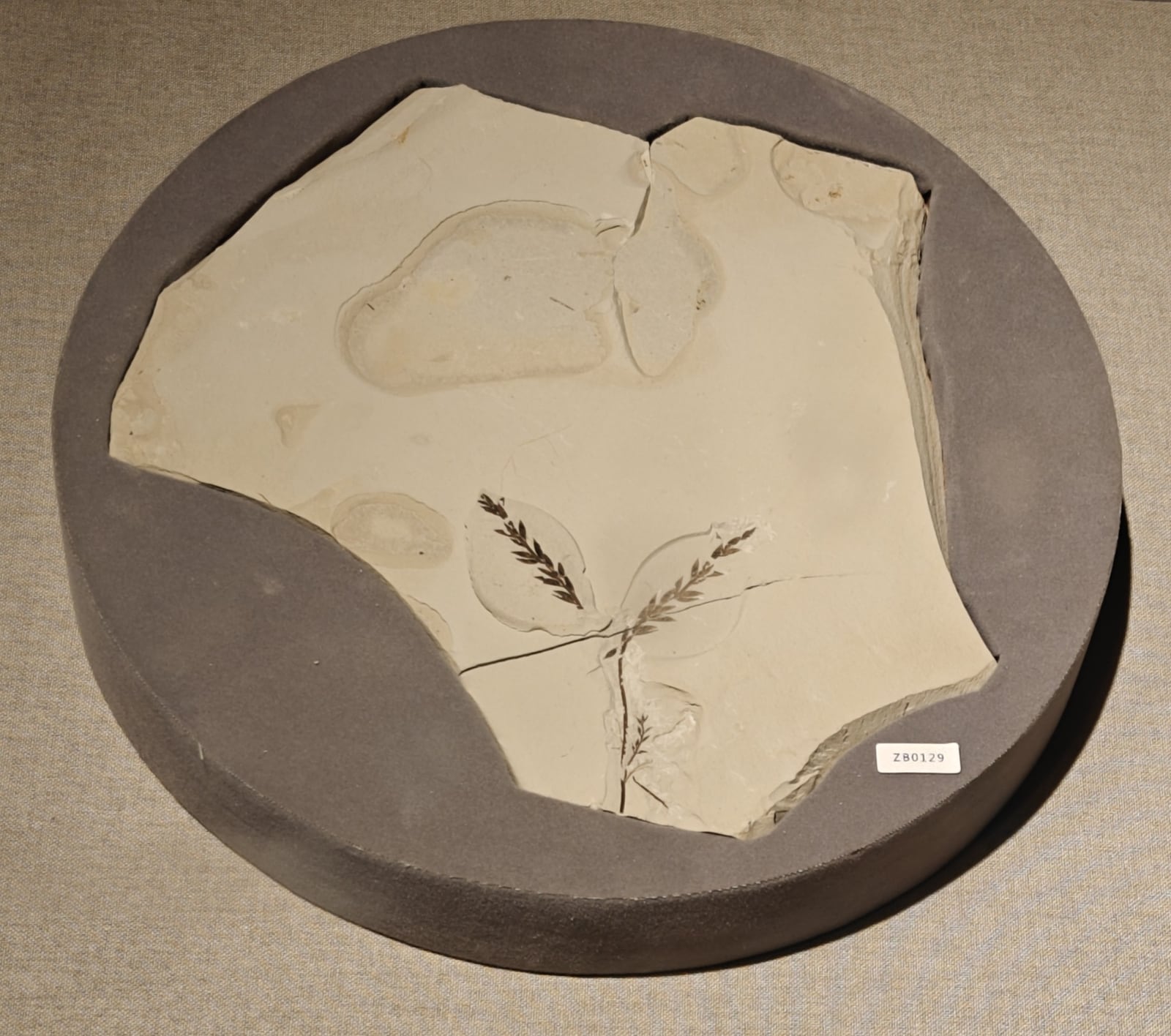
At first glance, Archaefructus does not look like a flower. A dark stem forks across pale stone. Fine leaves divide into narrow lobes. Along the upper axes sit ranks of small oval bodies, but no preserved petals gather them into a blossom that a modern observer would immediately recognize. The fossil looks less like a pressed bouquet than like pond weed caught mid-season.
That visual plainness once carried an enormous evolutionary claim. In 2002, researchers described complete plants of Archaefructus liaoningensis and A. sinensis from the Yixian Formation of northeastern China. They interpreted the long fertile axis as a simple, perianth-free reproductive structure and recovered the family as sister to all living flowering plants in their analysis.[1] The fossils quickly became candidates for something close to the ancestral flower.
The slab did not settle the matter. Other botanists soon proposed that the same axis was not one primitive flower at all, but an inflorescence—a shoot bearing multiple tiny flowers—whose apparent simplicity could reflect specialization for life in water.[2] Later material added a small bisexual unit between male and female zones, while a re-examination changed how fruits and seeds were read.[3][4] Each addition made the plant more informative and the slogan less secure.
This is the productive paradox of Archaefructus. It is unusually complete as a fossil plant, yet the evolutionary meaning of its most conspicuous structure remains unusually dependent on where one flower is thought to begin and end.
Begin at the roots, not the headline
The age is the firmest boundary. Archaefructus comes from the Yixian Formation and is Early Cretaceous, not Jurassic. The 2002 account gave a minimum age of 124.6 million years; high-precision dating published later brackets the Yixian Formation in the Jin–Yang Basin between about 125.8 and 124.1 million years ago.[1][6] “Roughly 125 million years old” is precise enough for this fossil. Calling it the first flower is not.
Its completeness is real. The original description reported plants known from roots to fertile shoots, rather than isolated pollen, a detached leaf or a single compressed organ.[1] A third species, Archaefructus eoflora, was described from a specimen retaining roots, a horizontal rhizome, leafy shoots and reproductive parts at several developmental stages. Its authors also noted sediment clinging around the roots and a complete fish on the slab, evidence they used to argue that the plant had not travelled far before burial.[3]
Those connections matter. A leaf found alone may be associated with a flower only by proximity. Here, vegetative and reproductive structures remain physically joined. That lets paleobotanists ask whether leaf form, rooting habit and fertile architecture belong to one organism. It also strengthens an aquatic interpretation. The fossils represent herbaceous plants with finely dissected leaves; the A. eoflora specimen preserves roots attached to a rhizome, and all were preserved in a lake system.[1][3]
But “aquatic” is already an ecological reconstruction assembled from several clues. The fossil does not preserve a waterline. The 2002 team pictured an emergent herb with fertile shoots above the surface, while critics considered the possibility of a more fully submerged plant.[1][2] Roots, rock and form make water a strong inference; they do not photograph the plant's posture in the lake.
The bare axis looked like ancestral simplicity
Read the fertile shoot according to the original model. Paired stamens occupy its lower portion. Above them are carpels, the ovule-bearing units that mature into fruits. No petals or sepals—the sterile organs collectively called a perianth—were recognized between those reproductive parts.[1] In that reading, the entire elongated structure behaves like one unusually stretched bisexual reproductive axis.
The appeal is easy to see. If the earliest flowering plants had simpler flowers, then an axis with stamens below, carpels above and no elaborate perianth can look like an evolutionary starting point. The 2002 analysis placed Archaefructus outside the common ancestor of all living angiosperms, as their sister lineage.[1] Its physical age and its branch position then seemed to tell the same story: an old plant with a simple flower stood near the base of flowering-plant history.
Yet those are three separate propositions. The fossil is old. Its organs were coded in a particular way. An analysis placed that coded combination on a particular branch. Geological age does not certify primitiveness, and a phylogenetic result is not a photograph hidden in the rock. The fossil supplied morphological observations; the branching result came from comparing scored characters with those of other plants.[1][5]
The missing perianth is especially delicate evidence. No petals or sepals are recognized on the specimens, but non-preservation, genuine ancestral absence and evolutionary loss can produce the same score. Aquatic flowering plants can simplify or reduce structures that their ancestors possessed.[2] A bare axis therefore cannot, by itself, tell whether it predates the evolution of a perianth or belongs to a lineage that discarded one.
Move the flower boundary and the story changes
In 2003, Else Marie Friis and colleagues challenged both the organ interpretation and the basal placement. Their alternative began by redrawing the boundary around the flower. Rather than treating the long axis as one multipart flower, they read it as an inflorescence with small male flowers below and female flowers above. On that model, the plant could be a specialized member of the angiosperm crown rather than a precursor outside it.[2]
Nothing needs to move on the slab for this change to happen. The oval bodies remain in their rows; the leaves remain finely divided. What changes is their botanical unit. If a stamen cluster or carpel cluster represents a flower, the larger axis is a system of flowers. The absence of a conspicuous perianth then becomes compatible with reduced, unisexual aquatic flowers rather than evidence for one archaic naked bloom.
This is more than a dispute over terminology. Phylogenetic matrices compare characters assigned to organisms and organs. A character such as “flower bisexual” cannot be scored until the analyst has decided which structure counts as a flower. Nor can “perianth absent” mean the same thing under every evolutionary scenario. The anatomical boundary feeds the character score, and the score helps determine the branch.[2][5]
The critics also observed that finely divided submerged leaves and reduced reproductive structures occur among derived water plants.[2] Resemblance to an expected ancestor is therefore not enough. Evolution can arrive at sparseness from two directions: before elaboration has evolved, or after elaboration has been reduced.
A new species supplied a hinge, not a verdict
The 2004 description of A. eoflora seemed designed to arbitrate the dispute because it preserved reproductive organs at different stages. Most importantly, the authors identified a small cluster of two carpels and one stamen between the lower stamen-bearing and upper carpel-bearing sections. They called that cluster a true bisexual flower.[3]
At first this sounds like confirmation that the entire axis is one flower. Structurally, it points the other way. If one localized cluster can be a bisexual flower, the long shoot surrounding it can be understood as an inflorescence bearing floral units. The authors themselves described the reproductive system as a mixture of flower-like and inflorescence-like organization. They also reported a cymose pattern in branches of the main shoot rather than reducing the whole fossil to a single uncomplicated bloom.[3]
The new fossil therefore supplied a hinge between male and female regions, not a universal key. It showed that Archaefructus could combine stamens and carpels within a small unit. It did not make every repeated organ along every axis homologous with a petal, stamen or carpel in one modern-style flower.
Later re-examination showed why even apparently small details matter. Xin Wang and Xiao-Ting Zheng studied new material alongside the A. liaoningensis holotype and reported that fruits could occur in opposite or whorled pairs, rather than simply in a spiral. They also placed ovules or seeds along the midrib on the outer-facing side of the fruit, revising the earlier interpretation that they attached at the inward margins of a folded carpel.[4] That does not remove Archaefructus from angiosperm history. It changes the character package used to compare it with living and fossil groups.
A complete organism can still yield an incomplete character set
The debate exposes two different meanings of completeness. A fossil may be complete in the everyday sense because root, stem, leaf and fertile shoot are attached. It can still be incomplete for phylogeny because critical characters are hidden, compressed, absent at the preserved stage or inseparable from interpretation.
No securely identified perianth parts surround the reproductive organs. That is direct observation. Whether a perianth was genuinely absent in life is a stronger inference. The order of stamens and carpels along the axis is observable; whether those organs belong to one flower or many is a homology argument. The plant's occurrence in lake deposits is geological context; its exact position relative to the water surface is reconstruction. Keeping those levels apart does not weaken the fossil. It shows exactly where its evidential force lies.
Later formal studies of Early Cretaceous angiosperms have emphasized that fossil placements can shift when researchers alter uncertain scores or use different backbone relationships among living plants.[5] For Archaefructus, affinities with aquatic lineages have remained plausible, but no single address near water lilies, Ceratophyllum, eudicots or the base of the angiosperm tree has become an uncontested resting place.[2][5] The responsible label is an Early Cretaceous flowering plant with an unresolved exact position—not the direct ancestor of today's flowers, and not a frozen prototype of the first bloom.
That conclusion is less cinematic than a lily opening in a dinosaur lake. It is also more faithful to the rock. Archaefructus gives paleobotany something rarer than a perfect ancestor: an attached organism on which rival evolutionary stories must use the same leaves, the same roots and the same ranks of reproductive organs. The argument turns on a boundary no chisel can expose—the point at which one flower ends and another begins.
Sources
- Ge Sun et al., “Archaefructaceae, a new basal angiosperm family,” Science 296 (2002)—original description of complete plants, their age, anatomy and initial phylogenetic placement.
- Else Marie Friis et al., “Archaefructus—angiosperm precursor or specialized early angiosperm?” Trends in Plant Science 8 (2003)—critique of the single-flower interpretation and proposal of a specialized aquatic crown angiosperm.
- Qiang Ji et al., “Early Cretaceous Archaefructus eoflora sp. nov. with Bisexual Flowers from Beipiao, Western Liaoning, China,” Acta Geologica Sinica 78 (2004)—description of the whole plant, developmental series and disputed bisexual floral unit.
- Xin Wang and Xiao-Ting Zheng, “Reconsiderations on two characters of early angiosperm Archaefructus,” Palaeoworld 21 (2012)—re-examination of fruit arrangement and seed attachment.
- James A. Doyle and Peter K. Endress, “Integrating Early Cretaceous Fossils into the Phylogeny of Living Angiosperms: ANITA Lines and Relatives of Chloranthaceae,” International Journal of Plant Sciences 175 (2014)—formal treatment of fossil character scoring under molecular backbone constraints.
- Yuting Zhong et al., “High-precision geochronological constraints on the duration of ‘Dinosaur Pompeii’ and the Yixian Formation,” National Science Review 8 (2021)—U–Pb age bracket for the formation.
- Wikimedia Commons, “Archaefructus liaoningensis (Shanghai Natural History Museum 2025) (cropped)”—provenance, authorship and CC BY-SA 4.0 license for the archival specimen photograph used above.