Mosasaurus hoffmannii still arrives in popular memory as an overgrown sea snake with too many teeth: long mouth, long body, and one simple command to terrorize the Late Cretaceous ocean. The more defensible picture is narrower and better. Mosasaurus matters because three anatomical stories reinforce one another. The skull and teeth are built for seizing and processing large prey, the dentition is not static but continuously renewed along a distinctive replacement path, and the tail and trunk no longer read like a tapering serpent once soft-tissue evidence is taken seriously.[1][2][3][4][5][6]
That integrated view also fixes a classification mistake that popular media keeps repeating. Mosasaurs were not dinosaurs. They were fully marine squamates, closer to the lizard-and-snake side of reptile evolution, and by the Late Cretaceous they had become open-water predators with flipper-like limbs and tail-driven propulsion.[4][5][6] The animal stops looking like a generic monster the moment those layers stay together: skull, tooth conveyor, and tail fluke in one body.
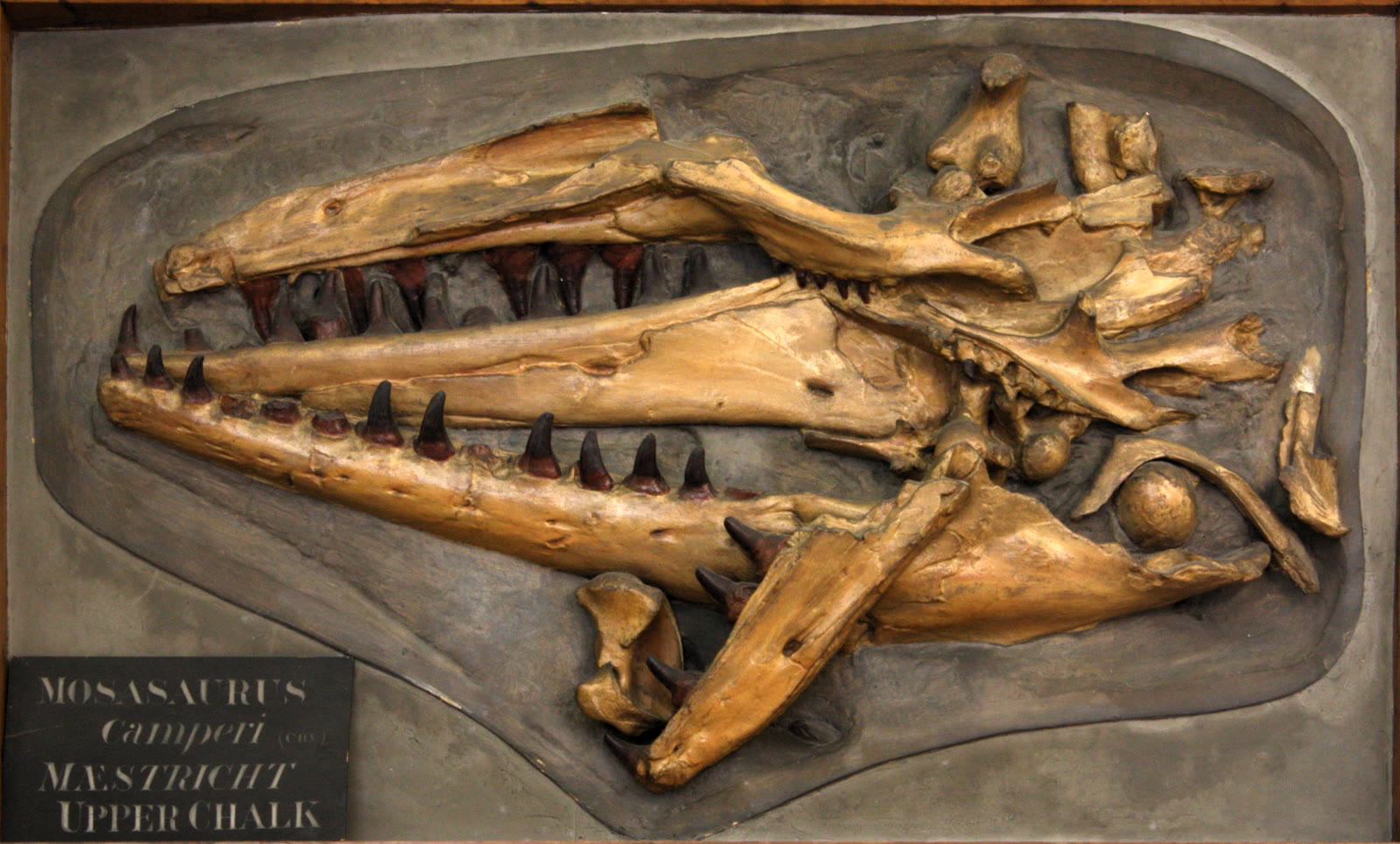
Image context: the cover uses a real photograph of a mounted Mosasaurus skeleton in the Sedgwick Museum of Earth Sciences from Wikimedia Commons. That choice matters because this article depends on whole-body proportions. The jaws are long, but the deep trunk, paddle limbs, and strong tail are just as important to the argument as the teeth.[7]
1) The head was not a simple snake analogue. It was a large-prey handling system.
The species is still known disproportionately from skull material, and that bias can actually help if it is used carefully.[1] Street and Caldwell's 2017 redescription tightened the diagnosis of M. hoffmannii and kept attention on the animal's cranial architecture rather than on inherited legend.[1] North American material referred to M. hoffmannii and discussed alongside it shows the teeth as among the most robust in the genus: exceptionally long, strongly recurved, and suited to a forceful grip rather than to some delicate fish-snatching specialization.[2]
That is the first useful correction. Mosasaurus is often drawn as if length by itself did the work, as if the body was just a long tube ending in a mouth. The skull evidence points toward something more organized. Robust marginal teeth, a broad prey-facing jaw apparatus, and palatal dentition visible on the roof of the mouth add up to a predator designed to keep hold of struggling food once it was seized.[1][2][6] The extra teeth do not decorate the mouth. They turn the whole head into a multi-surface capture device.
The American Museum of Natural History's mosasaur research video compresses that anatomy into one sharp public phrase: flipper-like limbs, a shark-like tail, and an extra row of teeth on the roof of the mouth.[6] The phrase works because it keeps the skull from being isolated. The mouth of Mosasaurus was already formidable, but it only becomes scientifically legible when it is treated as the front end of a fully marine reptile rather than as a sea-serpent caricature.
2) The teeth were a renewable conveyor, not a fixed set of giant knives.
The most revealing source here is Caldwell's 2007 study of mosasaur dentition.[3] The paper describes replacement crowns forming posterolingual to attached teeth, or posterolabial in the pterygoid series, then moving along a zig-zag path: along the dental groove, down into the alveolus, and back up into position before eruption.[3] That is a more dynamic system than the old picture of a few giant permanent teeth lodged in the jaw forever.
This matters because Mosasaurus was not working with one irreplaceable edge. It carried a bite apparatus that expected wear and replacement.[3] That applies to both the jaws and the palatal tooth rows. If the head is read as a prey-retention system, continual dental renewal becomes part of the same logic. A large marine predator that grips hard, processes resistant prey, and keeps prey inside the mouth needs its dentition to be sustainable, not merely impressive.
Caldwell's conclusion also sharpens a second common mistake.[3] Mosasaur teeth were thecodont in both geometry and histology, not just loosely attached lizard pegs.[3] In practical terms, the bite system was more structured than the phrase "big sea lizard" suggests. That does not make Mosasaurus a crocodile analogue or a shark analogue. It makes it a squamate that evolved its own tightly organized dental solution for marine predation.
3) The tail reset the whole animal.
For a long time, derived mosasaurs were reconstructed too close to sea snakes with paddles: long bodies, generalized tapering tails, and propulsion spread vaguely along the trunk. Lindgren and colleagues' 2013 Nature Communications paper is the clean break from that picture.[4] Working from exceptional soft-tissue preservation, they showed a bilobed tail fin and a body outline that narrows toward the tail stock before expanding into the fluke.[4] That is not decorative anatomy. It is a locomotor redesign.
Once that evidence is in place, the silhouette changes. The front half of the body remains deep, the limbs are fully transformed into flippers, and the main propulsive emphasis shifts decisively toward the tail.[4][5][6] The Natural History Museum's mosasaur overview makes the broader evolutionary frame clear: early relatives still looked more amphibious, but later forms acquired flipper-like limbs and fully marine habits.[5] AMNH's transcript says the same in simpler language: mosasaurs were fully marine and did not return to land.[6]
That is the hinge of the article. The tail is not a secondary flourish added to a giant jaw. It is the structure that stops Mosasaurus from being imagined as a generalized reptile drifting through water. The shark-like fluke does not mean mosasaurs became sharks. It means hydrodynamic performance had become important enough to reshape the rear of the animal through convergence.[4][6]
4) The best reading is integrated, and the boundaries still matter.
Put the evidence together and Mosasaurus hoffmannii becomes much sharper. It was a fully marine mosasaurine squamate whose skull and robust teeth were built to seize and retain large prey, whose dental apparatus was continuously renewed through a structured replacement system, and whose tail-driven swimming anatomy is now visible enough to retire older sea-serpent reconstructions.[1][2][3][4][5][6]
The limits matter just as much. This article does not claim an exact top speed, does not reduce every mosasaur species to the same body plan, and does not turn a skull-heavy fossil record into a complete life-history film. M. hoffmannii is still better known from some regions of the skeleton than others.[1] But the core reset holds. The animal should be read as an integrated marine predator, not as three separate icons stitched together by popular art: giant jaws, random lizard body, generic tail.
That is why Mosasaurus still rewards close reading. The head gets the posters. The tooth replacement system and the tail fluke explain how the poster animal actually worked.
Sources
- Hallie P. Street and Michael W. Caldwell, "Rediagnosis and redescription of Mosasaurus hoffmannii (Squamata: Mosasauridae) and an assessment of species assigned to the genus Mosasaurus" (2017), Geological Magazine.
- Michael J. Everhart, Johan Lindgren, and Cindy L. Palmer, "A mosasaur from the Maastrichtian Fox Hills Formation of the northern Western Interior Seaway of the United States and the synonymy of Mosasaurus maximus with Mosasaurus hoffmanni" (2015), Netherlands Journal of Geosciences.
- M. W. Caldwell, "Ontogeny, anatomy and attachment of the dentition in mosasaurs (Mosasauridae: Squamata)" (2007), Zoological Journal of the Linnean Society.
- Johan Lindgren, Michael J. Polcyn, Bruce A. Young, Eric A. S. Siu-Ting, Jan Kear, and Lars Schmitz, "Soft tissue preservation in a fossil marine lizard with a bilobed tail fin" (2013), Nature Communications.
- Natural History Museum, "What is a mosasaur? Facts about Mosasaurus and its relatives."
- American Museum of Natural History, "Mosasaurus: Lizard King of the Ancient Ocean" (video transcript and research overview).
- Wikimedia Commons file page for the Sedgwick Museum Mosasaurus skeleton photograph used as the article image.