Conodonts were famous long before they were understood.[1][2] For most of their research history, they appeared in the rock record as tiny phosphatic elements, usually just 0.3 to 3 millimetres long, scattered through marine limestones, shales, and cherts in numbers large enough to date whole intervals of Paleozoic and Triassic time.[1] That abundance made them geologically useful and biologically frustrating. A paleontologist could sort the elements, name their shapes, and correlate strata across continents without being able to say with confidence what kind of animal had carried them.[1][2]
That is why conodonts are more interesting as a lineage problem than as a bag of "first teeth."[2][5][6] The important shift was not one dramatic claim by itself. It was the gradual locking together of three kinds of evidence: apparatus reconstruction from disjunct elements, rare soft-bodied fossils that restored the animal, and wear plus tissue studies that clarified function.[2][3][4][5][6] Once those layers stayed in frame at the same time, conodonts stopped looking like orphan microfossils and started looking like a long-lived vertebrate experiment in mineralized feeding.[1][2]
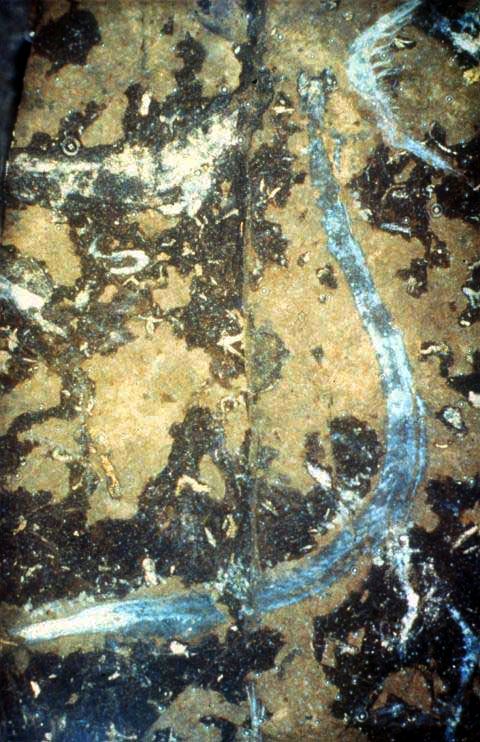
Image context: the cover now uses a real Granton conodont animal fossil image from the Scottish Geology Trust / Hunterian context rather than the earlier analytical SEM plate. That choice matters because this article turns on the moment when rare soft-bodied fossils put the tooth-like elements back inside an eel-like animal, changing the question from isolated microfossils to an integrated feeding apparatus.[3]
The original problem was not rarity. It was disassembly.
The most useful overview may still be the simplest one. Sweet and Donoghue note that conodonts were soft-bodied animals whose fossil record is dominated by a set of phosphatic elements that formed a feeding apparatus.[2] Once the animal died, that apparatus usually dissociated and its parts were jumbled on the sea floor.[2] From 1856 to about 1966, that post-mortem break-up encouraged an artificial taxonomy built around isolated element shapes rather than biological animals.[2] In other words, conodont history begins with a sorting problem before it becomes an evolutionary one.
That helps explain the old confusion recorded by the Australian Museum. Conodonts were assigned at different times to worms, arthropods, molluscs, fish teeth, and even plants.[1] None of those guesses was irrational in a world where the hard parts were common and the body was missing. The elements are genuinely tooth-like. They can be coniform, bar-like, or platform-like; they can look like individual tools rather than one integrated machine.[1] A dissociated apparatus encourages over-reading of each piece.
This is also why conodonts became so important to stratigraphy. Their elements are durable, numerous, and evolutionarily responsive over a time range from the Late Cambrian, around 500 million years ago, to the Late Triassic, about 200 million years ago.[1] Geologists could use them even while zoologists were still arguing about what they were.[1][2] That double life is part of the fascination. The same fossils that became some of the best time markers in marine rocks also remained among the most controversial microfossils in paleontology.[1][2]
Body fossils changed the question from "what are these pieces?" to "how does this apparatus sit inside an animal?"
The Scottish conodont discoveries are still the clearest turning point in public view. The Scottish Geology Trust summarizes the Granton material from Edinburgh as 11 near-complete conodont animals, preserved in Lower Carboniferous shrimp beds and measuring roughly 21 to 55 millimetres in length.[3] Those fossils supplied large eyes, a tail fin, and a head bearing several kinds of elements rather than one repetitive row of simple denticles.[3] That was the moment conodonts stopped behaving like anonymous debris and became attachable to a soft-bodied, eel-like vertebrate-grade animal.[2][3]
The South African material made the picture less local and more anatomical. Aldridge and Theron described giant Ordovician conodont apparatuses associated with preserved soft tissue, including lobate structures in front of the apparatus that they interpreted as eye cartilages, plus a possible trunk trace in one specimen.[4] This matters because the Edinburgh fossils did not remain a one-site miracle. Soft-tissue preservation from another Lagerstätte made the animal harder to dismiss and pushed the apparatus deeper into a real head-body context.[3][4]
Once those fossils existed, the older loose-element record had to be reread. The apparatus was not a random pile of comparable teeth. It was a bilaterally symmetrical set of different elements occupying different positions in the head region.[1][2] That distinction is the real upgrade. A conodont element by itself tells you only the durable end of the story. The animal fossils show that the biologically meaningful unit is the apparatus.
Microwear proved that the elements were doing tooth-like work, not just sitting there
Even with the animal restored, function still needed discipline. The decisive improvement came from microscopic wear. Purnell's 1995 Nature paper argued that conodont elements preserve wear patterns produced when opposed elements came into bilateral occlusion and crushed or sheared food.[5] The paper presented that as the first unequivocal evidence that conodont elements functioned as teeth and tied that function to macrophagy in very early vertebrates.[5]
That result matters because it narrows the claim in exactly the right way. "Tooth-like" can mean shape alone. Wear says use.[5] It shifts the interpretation from resemblance to mechanics. Conodont elements were not being admired by paleontologists for looking vaguely dental. They were entering contact, leaving patterned surfaces, and participating in food processing inside a working feeding apparatus.[1][2][5]
This is the point at which conodonts become more than a classification story. They become an ecological one. If the apparatus was capable of real shearing and crushing, then at least some conodonts belonged to a feeding world more active and predatory than a passive microfossil label would suggest.[5] The old mystery of affinity and the newer question of diet begin to reinforce each other.
They still should not be flattened into the simple ancestor of vertebrate teeth
That temptation remains, and it is where the best recent work adds restraint. The 2022 Scientific Reports paper on conodont nanomechanics describes conodonts as the earliest example of a mineralized feeding apparatus in vertebrates, but it also argues that conodont hard tissues are best read as an independent evolutionary experiment rather than as tissues directly homologous with later vertebrate dentition.[6] The paper's summary of prior work matters here: conodont elements occupied an oral or pharyngeal feeding array, yet their tissue story does not collapse neatly into the history of jawed-vertebrate teeth.[6]
That makes conodonts stronger, not weaker. They matter because they preserve an early vertebrate solution to feeding with mineralized elements, while still refusing to become a simple prototype for our own teeth.[5][6] The lineage gives paleontology something better than a first draft of the familiar. It gives a side branch that converged on sharp, durable, occluding structures under its own constraints.[6]
Read that way, conodonts recover their full scale. They were not just index fossils, not just mystery teeth, and not just a discarded candidate for the first dentition story.[1][2][6] They were a successful marine lineage that lasted roughly 300 million years, diversified widely, and solved feeding with an apparatus that only became legible once isolated elements, body fossils, and microwear all stopped being read in isolation.[1][2][3][4][5][6] The deeper lesson is methodological. Paleontology advances here not by one sensational fossil alone, but by refusing to let any one layer of evidence speak for the whole animal.
Sources
- Australian Museum, "What are conodonts?" - overview of conodont age range, element sizes, apparatus positions, ecology, and stratigraphic importance.
- Walter C. Sweet and Philip C. J. Donoghue, "Conodonts: Past, present, future," Journal of Paleontology 75(6) - abstract summarizing dissociated-element taxonomy, multielement apparatus reconstruction, and conodont significance as vertebrate fossils.
- Scottish Geology Trust, "Conodont Animals from Granton, Edinburgh" - public summary of the Granton body fossils, specimen count, size range, eyes, tail fin, and preserved head apparatus.
- Richard J. Aldridge and Johannes N. Theron, "Conodonts with preserved soft tissue from a new Ordovician Konservat-Lagerstätte," Journal of Micropalaeontology 12 (1993) - open-access soft-tissue evidence from South Africa, including eye-cartilage interpretation and a possible trunk trace.
- Mark A. Purnell, "Microwear on conodont elements and macrophagy in the first vertebrates," Nature 374 (1995) - occlusion wear evidence showing that conodont elements functioned as teeth.
- Mohammad Shohel et al., "Nanomechanical variability in the early evolution of vertebrate dentition," Scientific Reports 12 (2022) - conodont hard tissues as an early mineralized feeding apparatus and an independent evolutionary experiment relative to vertebrate dentition.