Monte San Giorgio is easy to misread as a mountain that simply yielded spectacular marine reptiles. That version is not false, but it is too small. The better field report starts with the whole setting: a pyramid-shaped wooded mountain beside Lake Lugano, on the Swiss-Italian border, preserving one of the clearest records of Triassic marine life from roughly 245 to 230 million years ago.[1] The World Heritage Outlook account frames the sequence as a tropical lagoon, sheltered and partly separated from the open sea by an offshore reef, with reptiles, fish, bivalves, ammonites, echinoderms, crustaceans, and even some land-derived fossils entering the archive.[1]
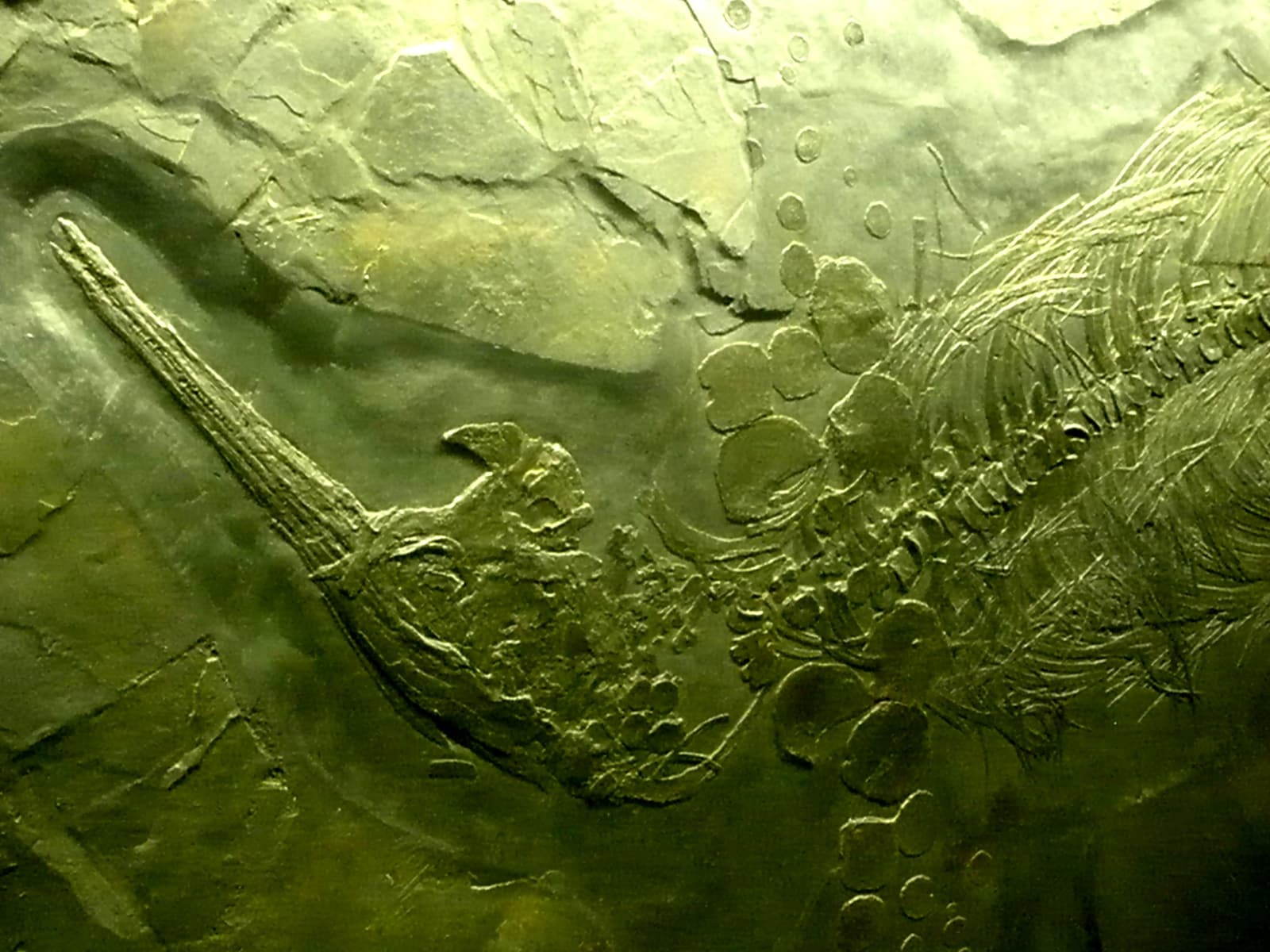
That matters because a lagoon is a filter, not a neutral backdrop. It decides what can live nearby, what can drift in, what sinks, what rots, what survives burial, and what later researchers can reasonably infer. The image above gives the fossil record its specimen-scale drama: a Besanosaurus leptorhynchus slab, close enough to see long-snouted anatomy and rib texture in the dark rock. But the article should not stop at the animal. The animal is one readable sentence in a much larger sedimentary text.
A Site Made From Repeated Windows
Monte San Giorgio is not one magic bed. Klug, Spiekman, Bastiaans, Scheffold, and Scheyer's 2024 review treats the famous Besano Formation, formerly the Grenzbitumenzone and including the Anisian-Ladinian boundary, together with successively younger fossil-bearing units such as the Cava inferiore, Cava superiore, Cassina beds, and Kalkschieferzone.[2] That list is the field-report key. The site's strength is repetition through stratigraphy: several fossil windows, several preservation settings, and a research history long enough to compare them.
The same review argues that Monte San Giorgio has a prototype role among Triassic black-shale Lagerstatten, in the way Burgess Shale anchors early Paleozoic black-shale thinking or Solnhofen anchors platy-limestone preservation.[2] The claim is not that every Triassic fossil site should be forced into one template. It is that Monte San Giorgio gives researchers a reference case for how black-shale marine conservation deposits can preserve whole faunas after the end-Permian crisis reshaped marine ecosystems.
That is why the phrase "tropical lagoon" should not be softened into scenery. A partly restricted basin near land can preserve marine animals, shoreline signals, washed-in terrestrial material, and low-oxygen bottom conditions in the same broad system. It also creates interpretive danger. A slab with an articulated reptile can look like a clear life scene, when it is really a death, decay, transport, sinking, and burial result. Monte San Giorgio is powerful because enough fossils survived to make those filters testable, not because the filters disappear.
Reptiles Are The Door, Not The Whole Room
The marine reptiles made Monte San Giorgio famous for good reason. Tanystropheus, ichthyosaurs, pachypleurosaurs, nothosaurs, placodonts, and other Triassic forms give the site its public face, and many are preserved with the kind of completeness that makes a museum visitor stop walking.[2][3] Furrer's 2024 research history notes that the region's first fossils were found during black-shale mining near Besano in the nineteenth century, while major formal excavations followed on both sides of the border, especially from 1924 to 1968, with systematic work continuing into the present.[3] Reptiles helped turn mining spoil and bituminous beds into an international paleontological project.
But a reptile-only reading wastes the site. The World Heritage Outlook summary explicitly keeps fish, bivalves, ammonites, echinoderms, crustaceans, insects, plants, and land-based reptiles in the frame.[1] The 2024 conservation-deposit review does the same by comparing faunal composition and preservation mode across fossil-bearing units rather than treating one charismatic clade as the archive.[2] That wider frame changes the question from "Which spectacular reptile lived here?" to "What kind of post-extinction marine ecosystem can be reconstructed from repeated black-shale windows?"
Fishes are especially important because they stop the lagoon from becoming a reptile stage set. Predatory fishes, small ray-finned forms, coelacanths, and other aquatic animals make the food web feel less like a parade of famous skeletons and more like an inhabited basin. Invertebrates do similar work. Bivalves and ammonites help place the water column and bottom conditions; crustaceans and echinoderms complicate the idea of a uniformly dead floor; land plants and insects remind the reader that the lagoon was close enough to shore for terrestrial signals to enter the marine record.[1][2]
Besanosaurus Shows What Detail Can And Cannot Do
Besanosaurus leptorhynchus is a good lead image because it has both drama and restraint. The fossil is not a painting of a living animal. It is a slab record of a long-snouted ichthyosaur from the Middle Triassic Besano Formation, one of the marine reptiles that made the Monte San Giorgio region a reference point.[4][5] Bindellini and colleagues' cranial-anatomy study treats the taxon as a taxonomic and paleobiological problem, using skull detail to revise how specimens from the formation should be understood.[4]
That is exactly the right scale for interpretation. A skull can show snout construction, tooth arrangement, eye-region anatomy, jaw-muscle attachment surfaces, and the boundaries between one taxon and another. It cannot, by itself, replay a chase through the lagoon. A flattened skeleton can preserve enough geometry to argue about swimming, feeding, and relationships, but every life reconstruction has to pass through compression, preparation, comparison, and uncertainty.
This is where the Monte San Giorgio field report becomes more useful than a species profile. Besanosaurus matters here less as a single animal than as a demonstration of the site's specimen quality. The slab lets a reader see why old black shales became scientific infrastructure. Reptile bones are present not as isolated trophies but as repeated, prepared, catalogued objects connected to formations, beds, museums, and decades of revisions.[3][4]
The Century Of Work Is Part Of The Fossil Record
Monte San Giorgio also teaches that a famous fossil site is made by institutions as well as rock. Furrer traces a long path from nineteenth-century black-shale mining and early fossil finds to formal excavations, museum storage, laboratory work, and continuing international collaboration.[3] The most extensive early excavations occurred between 1924 and 1968, but the research did not end with those campaigns.[3] Fossils kept moving through preparation rooms, monographs, taxonomic revisions, and new technical questions.
That history is not background trivia. It affects what the site can tell us. A single lucky fossil may change a headline. A century of disciplined recovery can change the comparison set. Monte San Giorgio became valuable because specimens were not merely collected; they were documented, prepared, housed in institutions, reexamined, and linked to stratigraphic context. The World Heritage Outlook outstanding-value summary makes the same point in heritage language: the long study history and resource management created a well-catalogued body of exceptional specimens and a rich geological literature.[1]
The Italian extension matters in the same way. The field area is not bounded by a modern political line in the way fossils are bounded by sediment. The Swiss side, the adjoining Monte Pravello-Monte Orsa area in Italy, the Besano Formation, and overlying Meride Limestone beds all belong to one research problem: how a Middle Triassic restricted marine basin recorded life near the northwestern Tethys after the largest mass extinction in Earth history.[2][3]
Why The Lagoon Reading Holds
The strongest version of Monte San Giorgio is therefore not a gallery of sea dragons. It is a lagoon archive with a reptile gallery inside it. The distinction matters. A gallery emphasizes specimens as finished objects. An archive emphasizes the conditions that made those objects possible and the limits those conditions impose.
Read as an archive, the site holds several scales together. At basin scale, a reef-sheltered lagoon near land shaped what entered the record.[1] At stratigraphic scale, multiple fossil-bearing units preserve repeated windows rather than one sealed moment.[2][3] At ecological scale, reptiles sit among fishes, invertebrates, and terrestrial signals, so the fauna cannot be reduced to a few dramatic skeletons.[1][2] At specimen scale, Besanosaurus shows how fine anatomical detail can survive while still demanding careful interpretation.[4][5]
That is why Monte San Giorgio remains a useful paleontology field report in 2026. It does not merely add Triassic animals to a list. It gives readers a way to think about recovery after catastrophe, restricted-basin preservation, museum labor, and the difference between fossil completeness and narrative certainty. The lagoon did not preserve a simple underwater world. It preserved enough fragments, often with extraordinary detail, for a century of work to keep rebuilding the world without pretending the filter is gone.
Sources
- IUCN World Heritage Outlook, "Monte San Giorgio" - heritage assessment summarizing the age range, lagoon setting, fossil groups, and outstanding universal value.
- Christian Klug, Stephan N. F. Spiekman, Dylan Bastiaans, Beat Scheffold, and Torsten M. Scheyer, "The marine conservation deposits of Monte San Giorgio (Switzerland, Italy): the prototype of Triassic black shale Lagerstatten," Swiss Journal of Palaeontology 143, article 11 (2024).
- Heinz Furrer, "The history of palaeontological research and excavations at Monte San Giorgio," Swiss Journal of Palaeontology 143, article 18 (2024).
- Gabriele Bindellini, Andrzej S. Wolniewicz, Feiko Miedema, Torsten M. Scheyer, and Cristiano Dal Sasso, "Cranial anatomy of Besanosaurus leptorhynchus Dal Sasso & Pinna, 1996 (Reptilia: Ichthyosauria) from the Middle Triassic Besano Formation of Monte San Giorgio, Italy/Switzerland," PeerJ 9:e11179 (2021), PubMed record.
- Wikimedia Commons, "File:Besanosaurus.JPG" - source page for the real fossil photograph used as the article image.