For a long time, dinosaur color lived mostly in paleoart. That changed when paleontologists stopped treating fossil feathers as silhouettes and started treating them as microstructural evidence. Melanosomes, the pigment-bearing organelles associated with melanin, made it possible to argue from preserved anatomy toward constrained color claims.[1][2][3]
That did not turn extinct plumage into an open-and-shut paint chart. What it did was better: it created a method with visible strengths, visible limits, and a clear evidence ladder. In 2026, the most useful way to read any dinosaur color headline is to ask where on that ladder the claim sits.
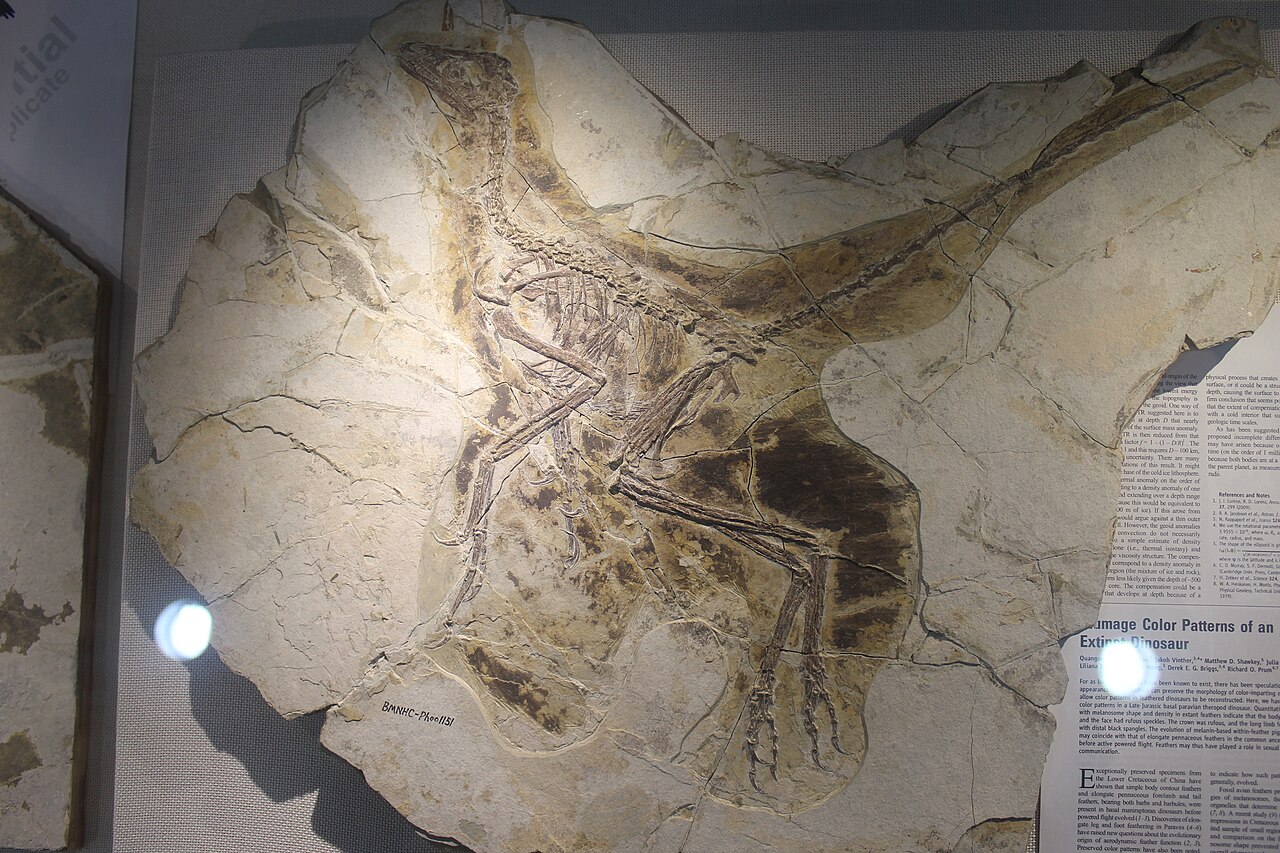
Image context: the cover image shows an Anchiornis specimen at the Beijing Museum of Natural History, used here because Anchiornis became one of the clearest early demonstrations of how fossil melanosomes can support a whole-body plumage reconstruction when preservation and sampling density are unusually strong.[3][7]
1) The method began with fossil feathers, not with full-body fantasy
The first real shift came when Vinther and colleagues showed in 2008 that fossil feathers could preserve melanosomes with recognizable morphology.[1] That mattered because color work no longer had to begin from artistic preference. It could begin from structures with extant analogs.
Zhang and colleagues extended that logic in 2010 by identifying fossilized melanosomes in Cretaceous birds and non-avian dinosaurs, arguing that these microbodies were informative enough to constrain color in deep time.[2] The key intellectual move was simple but powerful: if melanosome shape and arrangement correlate with color classes in living feathers, then comparable fossil structures can carry limited but real chromatic information.[1][2]
That is the foundation. Without preserved feather microstructure, a vivid dinosaur reconstruction remains an illustration. With preserved feather microstructure, some parts of that reconstruction become a testable anatomical claim.
2) Why Anchiornis became the showcase case
Not every feathered fossil can bear the same interpretive load. Anchiornis huxleyi became central because the specimen base preserved extensive plumage across multiple body regions, giving researchers a rare chance to sample melanosomes from the head, wings, body, and legs rather than from one isolated feather.[3]
Li and colleagues used that sampling density in 2010 to reconstruct a black-and-white body pattern with a rufous crest in Anchiornis.[3] The result became famous because it looked vivid, but the real methodological value was upstream. The study showed what has to go right before a reconstruction becomes more than a guess:
- the fossil must preserve the relevant tissues clearly,
- the anatomical regions must be sampled densely enough to avoid overgeneralizing from one patch,
- and the extant comparison set must be good enough to keep morphology-to-color mapping disciplined.[1][2][3]
In other words, Anchiornis was persuasive not because the claim was colorful, but because the evidence density was unusually high.
3) What melanosomes can anchor, and what they cannot
Melanosomes are powerful because they move color discussion into anatomy and chemistry. They are not magical because they do not preserve every visual property equally well.
At their strongest, melanosome-based studies can support bounded claims about broad color classes or patterning in preserved feather regions.[1][2][3] Black, gray, reddish-brown, and patterned distribution can become scientifically discussable in ways that older dinosaur art never allowed.
But Colleary and colleagues showed in 2015 why the method needs restraint.[4] Their experimental, chemical, and morphological work argued that fossil melanin can survive diagenesis while still being altered by burial history and time. That means fossil pigment evidence is not a literal untouched color swatch. It is preserved evidence filtered through chemistry, compression, and mineral context.[4]
This is the boundary that keeps the method honest. When readers hear “scientists discovered a dinosaur’s true colors,” the better translation is narrower: scientists recovered evidence that constrains some color properties more tightly than before.
4) Structural color makes the method richer and harder
The method becomes more demanding when the claim moves from pigment-based color to visual effects such as iridescence. In 2012, Li and colleagues argued that Microraptor preserved melanosome geometries consistent with iridescent plumage.[5]
That paper is important because it expanded the ambition of paleocolor studies. Researchers were no longer asking only whether a feathered dinosaur was dark or banded. They were asking whether nanoscale arrangement could support gloss, sheen, and display-related optics.[5]
At the same time, this is where overclaiming becomes easier. Structural color depends on geometry, packing, and optical interaction, not just the presence of melanin-bearing organelles. A specimen with dark feather traces is not automatically an iridescent animal. The argument has to pass through preserved organization, extant comparisons, and a defensible optical model.[5]
So the method’s growth did not erase uncertainty. It redistributed it into more explicit technical checkpoints.
5) Ecology requires another layer beyond color naming
Once color reconstruction became plausible, the next temptation was to jump directly from color to lifestyle. That move can work, but only with extra assumptions made visible.
Vinther and colleagues did exactly that in 2016 with Psittacosaurus, using preserved pigmentation patterns plus a three-dimensional model to test countershading under different light environments.[6] The paper mattered because it showed that fossil color could support ecological inference, not just visual description. Yet it also showed how much additional structure such an inference requires: body geometry, illumination regime, and habitat framing all become part of the reasoning chain.[6]
That is an important escalation in claim type. Saying a tail was dark is one level of argument. Saying countershading implies a woodland-style lighting environment is a stronger and more assumption-loaded level. Both can be evidence-based; they are not evidence-based in the same way.
6) How to read fossil-color claims in 2026
By now, paleontology has moved well past the era when extinct color was pure decoration. It has also moved past the stage where one dramatic reconstruction should be read as final.
Three questions usually sort strong claims from weak ones:
- What tissue is actually preserved: isolated feather traces, multiple feather regions, skin, or something more fragmentary?[1][2][3]
- Is the study arguing for broad pigment classes, for structural effects like iridescence, or for ecology-level interpretation such as camouflage?[4][5][6]
- How much of the conclusion comes from direct fossil evidence, and how much comes from comparison models layered on top?[3][4][6]
That is why melanosomes matter so much. They did not hand paleontology omniscience about prehistoric color. They changed the field from imaginative coloring to constrained inference. The best work in this area still follows that rule: the brighter the reconstruction, the more carefully the evidence stack has to be shown.
Sources
- Vinther et al. (2008), Biology Letters: "The colour of fossil feathers."
- Zhang et al. (2010), Nature: "Fossilized melanosomes and the colour of Cretaceous dinosaurs and birds."
- Li et al. (2010), Science: "Plumage color patterns of an extinct dinosaur."
- Colleary et al. (2015), PNAS: "Chemical, experimental, and morphological evidence for diagenetically altered melanin in exceptionally preserved fossils."
- Li et al. (2012), Science: "Reconstruction of Microraptor and the evolution of iridescent plumage."
- Vinther et al. (2016), Current Biology: "3D Camouflage in an Ornithischian Dinosaur."
- Wikimedia Commons file page for the Anchiornis museum photograph used as the article image.