Metriorhynchids are easiest to misunderstand if the word "crocodile" arrives first. The living crocodile image brings armor, riverbanks, belly-crawling, basking, and sudden lunges from the edge of water. Metriorhynchids belonged to Crocodylomorpha, but their best fossils point in another direction. By the Late Jurassic, this lineage had moved far enough into the sea that the old shoreline template starts to fail: armor was gone, skin became smooth, limbs acted more like hydrofoils, the tail carried a fluke, and salt glands solved a physiological problem no river crocodile faces at full ocean scale.[1][2][3]
That is why metriorhynchids deserve an evolution-and-lineage context rather than a simple taxon profile. The question is not "what was the weird marine crocodile?" The sharper question is how many systems had to change before a crocodylomorph could stop being a coastal animal and become a pelagic one. The answer is not one spectacular trait. It is a package: hydrodynamic skin, reduced or absent osteoderms, tail propulsion, altered limbs and pelvis, osmoregulation, and probably a reproductive strategy that did not require hauling the body onto land.[1][3][4]
The lineage crossed a real threshold
Thalattosuchians were marine crocodylomorphs, but they did not all cross the same boundary. Teleosauroids remained closer to the long-snouted, armored, shoreline-adjacent crocodile image. Metriorhynchids pushed farther. Spindler and colleagues describe Metriorhynchidae as the only archosaurs showing adaptations to a highly pelagic lifestyle, a claim that matters because archosaurs otherwise include crocodilians, pterosaurs, dinosaurs, and birds, not the classic cast of open-ocean reptiles.[1]
The distinction is visible in skin. In early thalattosuchians, the integument could remain crocodylian-like, with scutes and osteoderms preserving a familiar armor system.[1] In metriorhynchids, the evidence from multiple specimens and at least three genera instead shows a uniform skin type lacking scutes or scales, reinforced by folded surfaces and transverse fibers.[1] That is not a cosmetic difference. Armor, scutes, and scales interact with drag, flexibility, thermoregulation, and muscle support. Losing them means the animal's relationship with water changed at the body surface.
This is the first reason the "marine crocodile" shorthand is too blunt. A crocodile can swim well without becoming an oceanic animal. Metriorhynchids were not merely better swimmers. They crossed into a regime where the body surface itself became part of a streamlined marine solution.
Smooth skin was evidence, not decoration
The soft-tissue record is unusually important here because bones alone can make metriorhynchids look less transformed than they were. A long skull and tooth row still invite a reptile-predator reading. But skin changes the level of commitment. Spindler and colleagues' 2021 integument study reports smooth, flexible metriorhynchid skin without scutes, plus straight transverse fibers acting as reinforcement structures.[1] They also describe a hypocercal tail fluke comparable in broad functional role to tail-fluke arrangements in other marine reptiles.[1]
The comparison with ichthyosaurs and plesiosaurs is useful, but it should not be overextended. Metriorhynchids did not become ichthyosaurs by another name. They reached a similar hydrodynamic problem from a crocodylomorph starting point. That makes the convergence more interesting. If animals with different ancestry repeatedly reduce drag by smoothing the skin and reorganizing propulsive surfaces, then the fossil is recording a marine design pressure, not a one-off oddity.
The same study also keeps the limits visible. Some skin marks may represent epibiont scars, possible barnacle- or limpet-like attachment traces, or other healed marks, but the producers are not securely identified.[1] That uncertainty is part of the appeal. A pelagic reptile's skin was not only a surface for swimming. It was a living interface with water, parasites, wounds, and preservation. The fossils let us read that interface imperfectly, but directly.
The tail turned into a locomotor argument
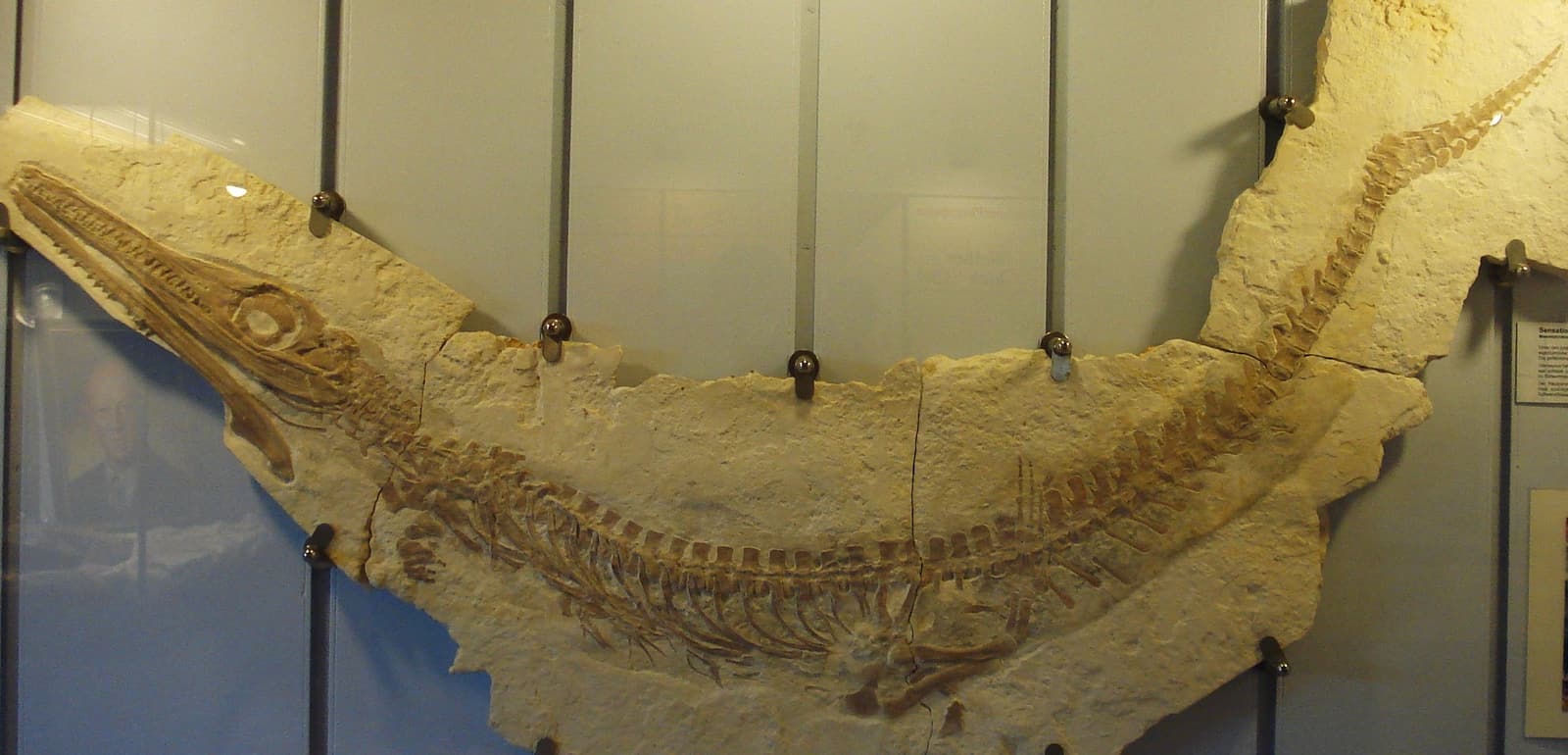
The newly described Cricosaurus albersdoerferi skeleton makes the tail problem especially concrete. Sachs and colleagues describe an articulated, soft-tissue-bearing specimen from the upper Kimmeridgian Torleite Formation at Painten in Bavaria, naming it as a new species and using it to explore previously under-studied variation in the metriorhynchid tail region.[2] The specimen matters because complete metriorhynchid skeletons are rare, and the tail was historically easier to idealize than to compare.
Their description emphasizes variation among southern German Cricosaurus species in skulls, dorsal neural spines, tail displacement units, and flukes.[2] That is a strong lineage-context clue. If tail architecture varies within a close cluster of species, then metriorhynchid swimming was not one finished template copied across the group. It was an active evolutionary field. Closely related animals could differ in locomotor ability and feeding ecology while occupying different northern Tethys lagoon settings.[2]
This also prevents a common flattening of marine reptiles. We often tell the story as land animal enters water, tail becomes fluke, job done. Cricosaurus makes that too simple. The tail fluke is a real marine adaptation, but the details of how the vertebrae bend, how neural spines and hemapophyses shape the fluke, and how soft tissue attaches all change the animal's swimming envelope.[2] The lineage did not only acquire a marine label. It tuned the propulsion system.
Salt glands made seawater livable
Open-sea life is not solved by swimming alone. A reptile eating marine prey and possibly taking in seawater has to handle salt. Fernandez and Gasparini's work on Geosaurus araucanensis is central because it moves osmoregulation from inference toward fossil anatomy. Their study identifies natural casts of salt-excreting glands in several individuals, including adult, sub-adult, and juvenile material, and argues that the glands were hypertrophied enough to imply high excretory capability.[3]
That matters for two reasons. First, salt glands make metriorhynchids more biologically marine. The animal was not simply visiting salty water from a freshwater baseline; its head carried hardware for maintaining internal chemistry in a marine setting.[3] Second, the juvenile evidence is important. If juvenile individuals already had large salt glands, then young metriorhynchids were not necessarily restricted to a sheltered non-marine nursery in the way a shoreline-crocodile analogy might suggest.[3]
The salt-gland evidence also helps order the transition. Fernandez and Gasparini frame marine adaptation in crocodyliforms as a physiological sequence from freshwater to coastal or estuarine habits and onward to pelagic life, with the fossil record indicating that the pelagic stage had been achieved by the Early Middle Jurassic.[3] That line is useful because it turns metriorhynchids into a long transition, not a sudden Jurassic gimmick. Their open-sea body was assembled through both skeletal and physiological change.
Reproduction is where the crocodile analogy strains hardest
The most difficult boundary is reproduction. Living crocodilians lay eggs on land. If metriorhynchids were simply aquatic crocodiles with better tails, they would still need a way to get out of the water, nest, and return. Herrera and colleagues attack that assumption by testing reproductive strategies through a counter-inductive approach: rather than claiming direct evidence of embryos, they ask which hypothesis is contradicted by the body plan.[4]
Their conclusion is deliberately unorthodox but important. They reject oviparity for metriorhynchids because the postcranial body contradicts effective terrestrial locomotion for egg laying. The reduced pelvic girdle, transformed limbs, long hypocercal tail, and bone microstructure all work against a turtle-like or crocodile-like haul-out model.[4] They also note that the pelvic region in Cricosaurus araucanensis resembles, in broad functional terms, patterns seen in other live-bearing Mesozoic marine reptiles.[4]
This does not mean paleontologists have found a pregnant metriorhynchid. They have not. The claim should stay bounded: live-bearing is inferred as the better-supported reproductive strategy once egg laying requires a terrestrial behavior the skeleton seems poorly built to perform.[4] But even that bounded conclusion is enough to change the lineage picture. A crocodylomorph that likely did not need land to reproduce is not a shoreline animal with marine accessories. It is a lineage that had moved the life cycle itself offshore.
What the package means
Metriorhynchids matter because they show that the crocodile branch of archosaur history had more marine potential than living crocodilians suggest. The group did not become fully pelagic by changing one part. The skin lost the scuted armor surface and gained a smoother, fiber-reinforced integument.[1] The tail became a fluke-bearing propulsive structure with species-level variation.[1][2] The skull carried salt-gland evidence strong enough to make ocean chemistry part of the fossil story.[3] The pelvis, limbs, and tail make land-based egg laying difficult enough that live birth becomes the more coherent inference.[4]
That package also explains why the fossil photograph is more than a visual. A mounted or slabbed metriorhynchid skeleton asks the reader to look past familiar crocodile vocabulary. The long body is not an old river predator stretched into a novelty. It is a record of systems being reassigned: surface, propulsion, salt balance, feeding, and reproduction. Each system has its own evidence and its own uncertainty, but together they point in the same direction.
The best way to read metriorhynchids, then, is not as "crocodiles at sea." It is as one of the strongest Mesozoic tests of how far a lineage can move when water stops being habitat and becomes the whole operating environment.
Sources
- Frederik Spindler, Rene Lauer, Helmut Tischlinger, and Matthias Mauser, "The integument of pelagic crocodylomorphs (Thalattosuchia: Metriorhynchidae)," Palaeontologia Electronica 24(2):a25 (2021).
- Sven Sachs, Mark T. Young, Pascal Abel, and Heinrich Mallison, "A new species of Cricosaurus (Thalattosuchia, Metriorhynchidae) based upon a remarkably well-preserved skeleton from the Upper Jurassic of Germany," Palaeontologia Electronica 24(2):a24 (2021).
- Marta Fernandez and Zulma Gasparini, "Salt glands in the Jurassic metriorhynchid Geosaurus: implications for the evolution of osmoregulation in Mesozoic marine crocodyliforms," The Science of Nature 95 (2008): 79-84.
- Yanina Herrera, Marta S. Fernandez, and Zulma Gasparini, "Morphology of the sacral region and reproductive strategies of Metriorhynchidae: a counter-inductive approach," Earth and Environmental Science Transactions of The Royal Society of Edinburgh 106(4) (2017).
- Ghedoghedo, "File:Cricosaurus albersdoerferi.jpg," Wikimedia Commons file page for the fossil photograph used in this article.