Lisowicia bojani is the kind of fossil that corrects a story by being too large to ignore. The familiar Late Triassic scene usually gives the big-bodied future to dinosaurs: archosaurs diversify, sauropodomorphs start stretching the herbivore envelope, and the old synapsid world fades into the background. Lisowicia does not overturn that broad transition, but it makes the handoff less tidy. In southern Poland, near the end of the Triassic, a dicynodont still became huge.
That matters because dicynodonts were not dinosaurs, not reptiles in the everyday sense, and not mammals either. They were non-mammalian therapsids, part of the synapsid side of amniote history: the broader branch that eventually includes mammals. By the Late Triassic, they are often treated as ecological remainders from an older Permian-Triassic world. Lisowicia resists that diminished role. It asks the reader to imagine a beaked, tusked herbivore lineage still experimenting at megaherbivore scale while dinosaurs were already part of the same landscape.[1][2]
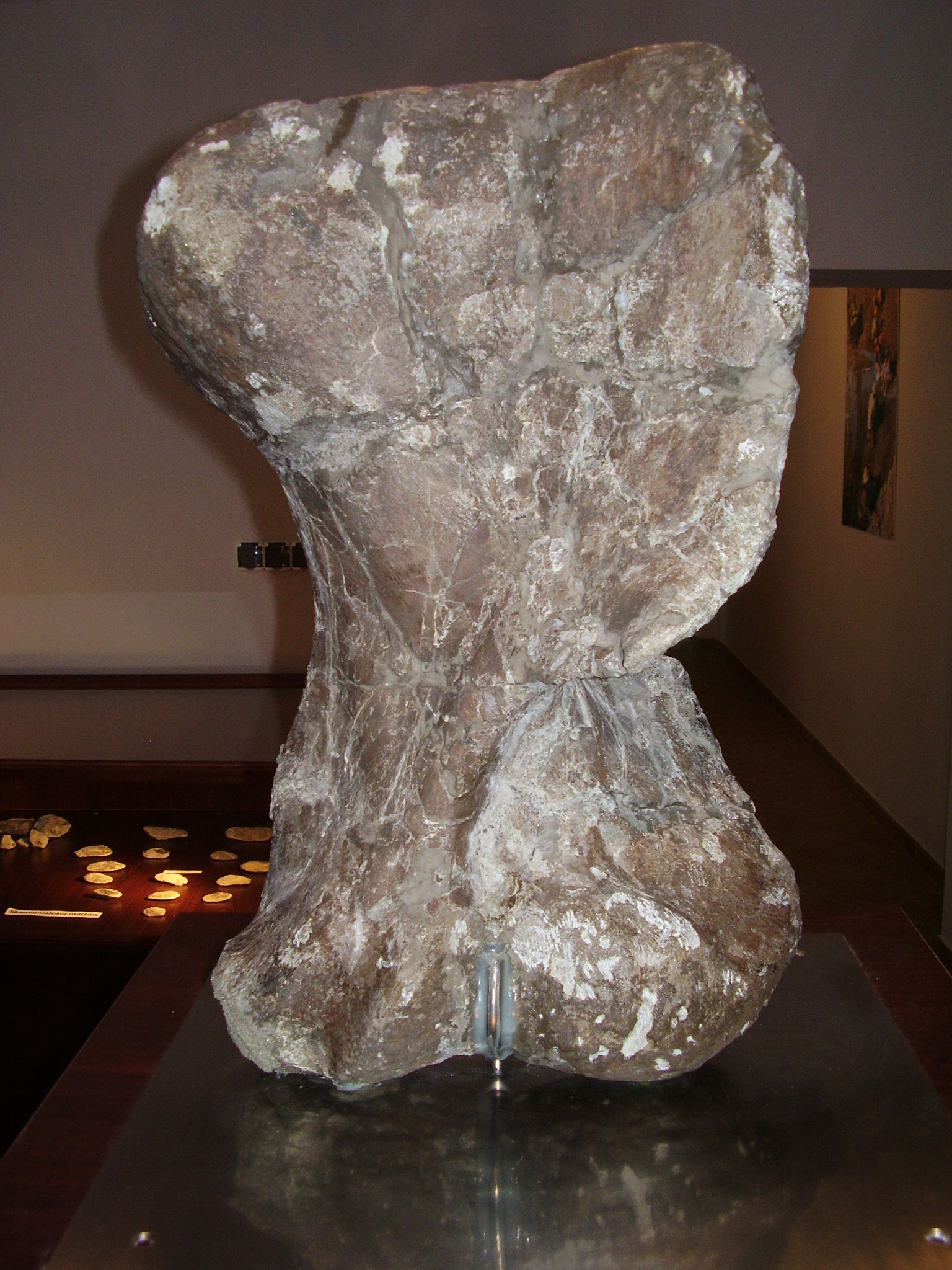
Image context: the cover photograph shows a giant dicynodont humerus from Lisowice, published on Wikimedia Commons as a real fossil-bone image rather than a life reconstruction.[5] It belongs in this article because the most disciplined way into Lisowicia is not an elephant analogy or a dinosaur comparison. It is the physical fact of an unusually massive limb bone.
The first surprise was place and timing
The 2008 locality report did not yet present Lisowicia under that name. It reported a giant rhino-size dicynodont from Upper Triassic fluvial sediments at the Lipie Slaskie clay pit near Lisowice in southern Poland.[1] That was already enough to disturb expectations. The authors noted that dicynodonts were thought to have vanished from the Late Triassic record of Europe, while the Lisowice material placed a giant form in an assemblage that also included carnivorous dinosaurs, pterosaurs, and temnospondyl amphibians.[1]
The setting is important because it keeps Lisowicia from becoming a museum monster detached from environment. The bones came from river-laid sediments, not from a clean evolutionary diagram. The 2008 paper framed the assemblage as evidence that Late Triassic tetrapod succession was strongly shaped by ecology and by the uneven preservation of different environments.[1] In other words, the apparent disappearance of dicynodont-dominated faunas may have been partly a fossil-record problem, not just a biological absence.
That is the first useful boundary. Lisowicia does not mean dicynodonts were secretly thriving everywhere at the end of the Triassic. It means one European locality preserved a late, large dicynodont presence strongly enough to complicate the usual narrative of decline.
The named animal turned size into the headline
The formal description in Science made the scale unavoidable. Sulej and Niedzwiedzki described Lisowicia bojani as a Late Triassic dicynodont from Poland, with an estimated length of more than 4.5 meters, shoulder height around 2.6 meters, and body mass near 9 tons.[2] Those numbers are why the animal immediately became newsworthy. A dicynodont had entered the size range readers associate with elephants and large dinosaurs.
But the species is not important simply because it was big. Large size in a late dicynodont changes the ecological reading of the Triassic. It suggests that at least some synapsid herbivores were still capable of occupying heavy browsing or grazing roles at the same time that dinosaur lineages were expanding. The point is not that Lisowicia beat dinosaurs at their own game. The point is that the "age of dinosaurs" did not instantly make every large non-dinosaur herbivore irrelevant.[1][2]
The name also fixed a specimen-level problem. Before Lisowicia was described, the Lisowice dicynodont material could be discussed as an extraordinary set of bones. After the description, those bones became a named taxon with a defined anatomical and phylogenetic argument. That shift matters in paleontology because a headline fossil becomes more useful when it can be compared, challenged, and revised within a named framework.
The posture claim is where the animal gets interesting
The Science paper's title emphasized erect limbs, and that is more than a visual detail.[2] Most dicynodonts are reconstructed with more sprawling or semi-sprawling limb postures than modern large mammals. A huge animal with more upright, column-like support would therefore raise a functional question: did body size push Lisowicia toward a different load-bearing solution?
The fossil bone in the image keeps that question honest. A large humerus is not a complete walking animation. It is a piece of a support system. The later 2024 osteological study returned to the skeleton in much greater anatomical detail, describing vertebrae, ribs, pectoral elements, limb bones, and pelvic material from Lisowice-Lipie Slaskie.[3] Its discussion of the shoulder region is especially useful because it treats posture as a problem of articulating surfaces, muscle attachments, and girdle construction rather than as a silhouette.[3]
That is the right way to read the animal. Lisowicia should not be turned into a mammal-like dicynodont simply because upright limbs are an attractive comparison. The stronger claim is narrower: its skeleton suggests unusual load-bearing architecture for a dicynodont, and that architecture may be tied to the demands of great size.[2][3]
The weight estimate got smaller, not less important
The biggest number attached to Lisowicia did not stay untouched. Romano and Manucci later reassessed body mass using volumetric modeling and argued that the original long-bone-scaling estimate probably overshot the animal's mass.[4] Their adult estimates ranged from 4.87 to 7.02 tons, with an average around 5.88 tons, and they treated the roughly 9.33-ton original value as an overestimate by about 60%.[4]
That sounds like a deflation, but it actually makes the fossil more scientific. Size claims in paleontology are not trophies; they are estimates built from methods. Long-bone circumference can be powerful, especially for living mammals and well-sampled extinct groups, but an unusually robust extinct animal can strain the assumptions behind a regression. A volumetric model asks a different question: what body volume is plausible around the skeleton, and what mass follows from that volume?[4]
So the corrected reading is not "the giant was not giant." Even the conservative estimates leave Lisowicia as an enormous dicynodont. The better lesson is that the animal's significance does not depend on protecting the largest number. Its importance survives the revision because the ecological and anatomical problem remains: a late dicynodont in Europe still achieved multi-ton body size, robust limb construction, and a presence large enough to share the landscape with archosaurs.[1][2][4]
A late giant is not a survival myth
There is a tempting way to turn Lisowicia into a last-of-its-kind drama: the old synapsid herbivore standing nobly beside the rising dinosaurs. That story is too clean. The 2024 osteological paper places Lisowicia inside a broader Late Triassic dicynodont relationship problem, with possible links to other lineages in the Germanic Basin and beyond.[3] The animal is therefore not just an isolated relic. It is evidence that dicynodont history near the end of the Triassic had more geographic and anatomical structure than a simple fade-out implies.
This is also why the dinosaur comparison should be used carefully. The Lisowice assemblage included carnivorous dinosaurs and other vertebrates, but Lisowicia is not mainly interesting because it stood near dinosaurs.[1] It is interesting because its own lineage still had ecological room. A huge dicynodont in a fluvial Late Triassic ecosystem tells us that herbivore size, posture, and survival were distributed across more than one major amniote branch.
That wider reading keeps the fossil from becoming a novelty. Lisowicia is not a proto-rhino, not an elephant substitute, and not a dinosaur with the wrong ancestry. It was a giant beaked synapsid herbivore from the late Triassic of Poland, known from bones substantial enough to force fresh questions about dicynodont size, posture, and persistence.[1][2][3]
The cleanest profile is therefore this: Lisowicia bojani makes the Triassic transition look crowded. Dinosaurs were rising, but they did not have a monopoly on large herbivore experiments. Dicynodonts had an older body plan, a different evolutionary address, and, in this Polish clay pit, at least one last giant way to stay visible.
Sources
- Jerzy Dzik, Tomasz Sulej, and Grzegorz Niedzwiedzki, "A dicynodont-theropod association in the latest Triassic of Poland," Acta Palaeontologica Polonica 53, no. 4 (2008).
- Tomasz Sulej and Grzegorz Niedzwiedzki, "An elephant-sized Late Triassic synapsid with erect limbs," Science 363, no. 6422 (2019), PubMed record.
- Tomasz Sulej, "Osteology and relationships of the Late Triassic giant dicynodont Lisowicia," Zoological Journal of the Linnean Society 202, no. 1 (2024), author-hosted PDF.
- Marco Romano and Fabio Manucci, "Resizing Lisowicia bojani: volumetric body mass estimate and 3D reconstruction of the giant Late Triassic dicynodont," Historical Biology 33, no. 4 (2021), EBSCO DOI record.
- Wikimedia Commons, "File:Fosilni kost dicynodonta.jpg" - photographed humerus of a giant Triassic dicynodont from Lisowice, southern Poland.