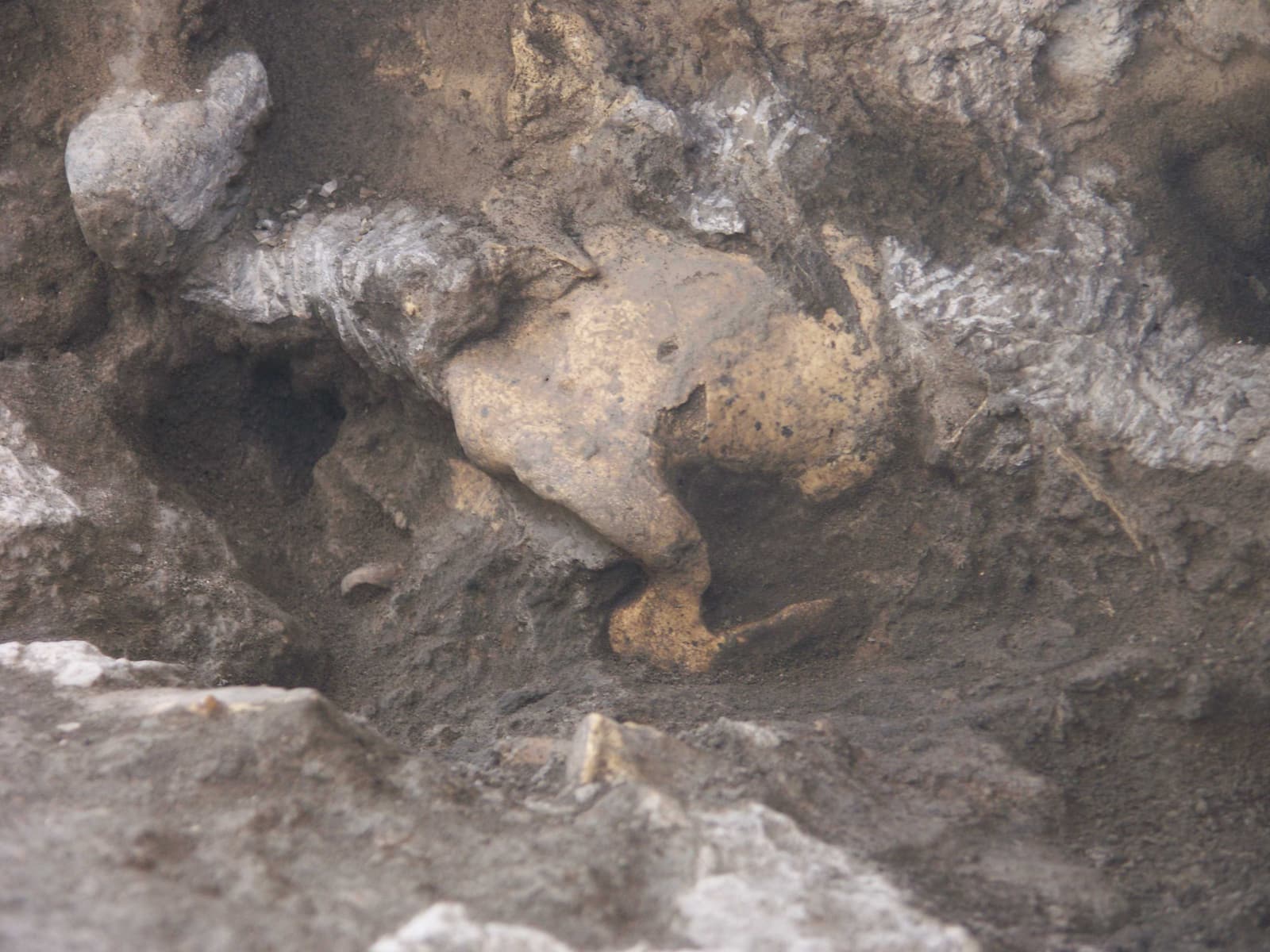
Dmanisi Skull 5 became famous as a taxonomic provocation, but that framing can make the fossil look too much like a slogan.[1][5] Its real force is slower and more mechanical. The specimen matters because one adult skull from Dmanisi, Georgia, dated to about 1.8 million years ago, locks together traits that many researchers had become used to distributing across different early Homo labels: a very small 546 cm3 braincase, a long projecting face, and the massive D2600 mandible attached to the same individual.[1] Once those pieces sit in one body from one site that also preserves other crania, variation stops being a background nuisance and becomes the fossil's main message.[1][2]
That is why a close reading still helps in 2026. The cleanest current framing is not that Skull 5 definitively erased every named early Homo species outside Asia, and not that it proved Dmanisi must contain multiple species.[2][3][4][5] A more defensible reading is narrower. Most broad syntheses and museum treatments still place the Dmanisi hominins within early Homo erectus or an early Homo erectus grade, while acknowledging that the exact taxonomic boundaries remain contested.[2][4] Skull 5 matters because it made those boundaries expensive. Any attempt to split or lump early Homo now has to explain why one Dmanisi population appears to contain such a wide morphological spread.[1][2][3]
Image context: the lead image uses a real archival excavation photograph from Wikimedia Commons showing Skull 5 in the ground at Dmanisi. It belongs here because the article is about association and context. Before Skull 5 became a debate object in journals, it was a cranium recovered from the same site that had already produced other hominin skulls, fauna, and stone tools. The visual anchor keeps the argument tied to one place, one deposit, and one unusually revealing field sample.[6]
The completeness of the specimen changed the argument
The 2013 Science paper is still the starting point because it states the problem with unusual bluntness.[1] D4500, together with the previously known D2600 mandible, gave researchers what the authors called the first completely preserved adult hominid skull from the early Pleistocene.[1] That matters because completeness changes the burden of proof. When braincase and face come from different fossils, size mismatch and orientation can always be negotiated through reconstruction habits and taxonomic expectation. When the same individual carries a tiny vault and a large, strongly prognathic face, the range of plausible early Homo bodies widens in a way that no partial cranium can force by itself.[1][2]
This is the first reason Skull 5 is more important than a generic "complete skull" headline. Completeness here is not a museum luxury. It is what makes the contradiction in the specimen difficult to soften. The small cranial capacity does not come from one animal while the large face and robust chewing apparatus come from another. The fossil fuses them.[1]
The skull did not just expand the sample. It stretched it
The Dmanisi sample had already been important before Skull 5, because the site preserved several early hominin individuals outside Africa at an unexpectedly early date.[4] Skull 5 changed the internal geometry of that sample. The 2017 Journal of Human Evolution monograph on Skull 5 treats the specimen as both anatomically distinctive and central to the whole Dmanisi problem: massively built, with a large face and very small brain, yet clearly part of the same broader assemblage whose relationship to other early Homo fossils remains the key issue.[2]
That phrase matters: the key issue is relationship, not spectacle.[2] The fossil does not just add another point to a chart. It pulls the cloud of points wider. If the five Dmanisi crania came from isolated African and Eurasian localities, many researchers would have felt greater permission to sort them into different species bins.[1][5] Because they come from one site, roughly the same narrow window of deep time, that reflex becomes harder to defend. The question changes from "Which named species does this resemble?" to "How much variability can one paleodeme, one regional population, actually hold?"[1][2]
The attached mandible is why the fossil remains contentious
The D2600 mandible is part of what keeps Skull 5 from settling into comfortable consensus. The 2014 PLOS ONE study on Dmanisi mandibles was explicit that D4500 reopened the variability debate because D2600 had long looked unusually big and anatomically awkward relative to the smaller Dmanisi mandibles.[3] Bermudez de Castro and colleagues argued that some of these differences were established early in development and were not easily dismissed as simple size effects, sexual dimorphism, or late-life wear remodeling.[3] They even allowed that the Dmanisi accumulation might represent more than one paleodeme over a span that was short geologically but not necessarily synchronous in a behavioral sense.[3]
This is exactly the boundary a responsible article has to keep visible. Skull 5 did not end the debate by fiat. It intensified it. Lordkipanidze and colleagues used the specimen to argue for a single evolving lineage of early Homo with wide morphological variation across continents.[1] Later critics and re-readings did not erase the fossil; they questioned whether the D2600-D4500 combination should really be absorbed that smoothly.[2][3][5] The most durable outcome is therefore methodological rather than doctrinal. Skull 5 forced everyone to state their variation threshold out loud.
Why current consensus stays careful
The Smithsonian's Human Origins overview still places Dmanisi within Homo erectus and treats the Georgian fossils as part of the earliest known expansion of that broader lineage beyond Africa.[4] That is probably the most practical consensus framing for a general reader in 2026: early Homo erectus, or early Homo very close to that grade.[2][4] But the qualifier matters. The same fossil record that makes Dmanisi foundational also makes it hard to pretend that early Homo taxonomy is cleanly settled.[1][2][3]
Nature's 2013 coverage captured why the specimen landed so loudly: the authors' interpretation implied that fossils often split into Homo habilis, Homo rudolfensis, and Homo ergaster might instead belong within a single variable lineage, commonly folded into Homo erectus.[5] That was and remains controversial.[5] Skull 5 is strongest when read one step below that headline. It does not require a reader to endorse every taxonomic compression claim to see its value. It only requires accepting that early Homo cannot be read as a tidy ladder of discreet skull types once Dmanisi is on the table.[1][2][3][5]
The fossil therefore remains powerful for a very precise reason. It makes variation itself observable. Skull 5 is not merely an extra specimen from a famous site. It is the point at which face, braincase, mandible, locality, and sample structure all collide. That is why the find still matters: not because it closed the argument, but because it made simplistic arguments much harder to keep.
Sources
- David Lordkipanidze and others, "A Complete Skull from Dmanisi, Georgia, and the Evolutionary Biology of Early Homo," Science 342 (2013).
- Jos M. Bermudez de Castro and others, "Skull 5 from Dmanisi: Descriptive anatomy, comparative studies, and evolutionary significance," Journal of Human Evolution 104 (2017).
- Jose Maria Bermudez de Castro and others, "On the variability of the Dmanisi mandibles," PLOS ONE 9, no. 2 (2014).
- Smithsonian Institution Human Origins Program, "Homo erectus."
- Sid Perkins, "Skull suggests three early human species were one," Nature News (2013).
- Wikimedia Commons file page for the archival excavation photograph of Dmanisi Skull 5 used as the article image.