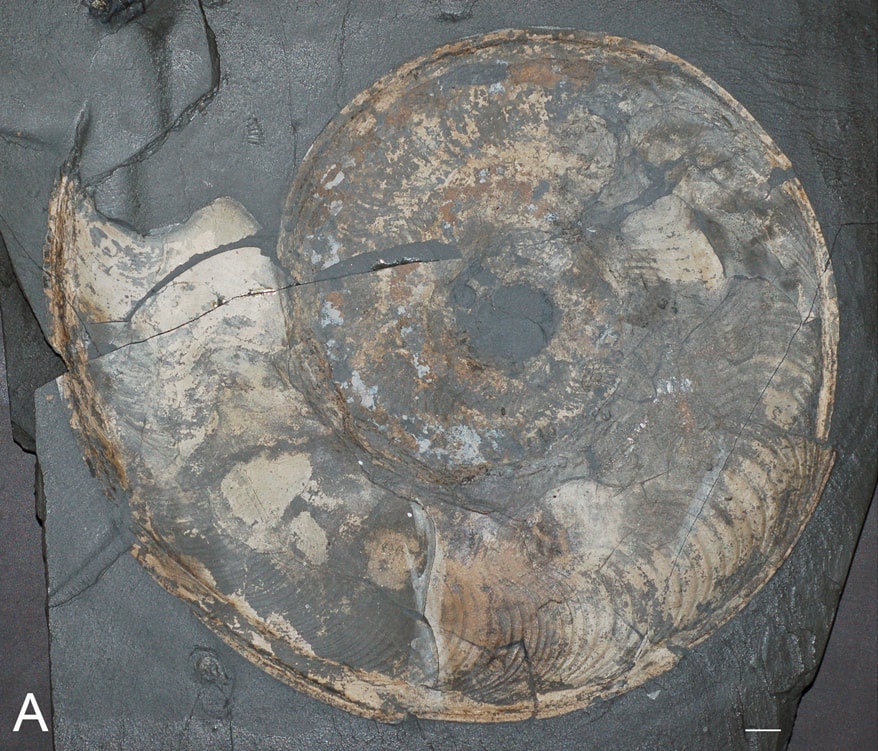
Three small lobsters lie inside the outer coil of an ammonite from Dotternhausen, southwestern Germany. Their tails point toward one another. The shell, flattened into the dark rock of the Early Jurassic Posidonia Shale, belonged to Harpoceras falciferum. The animals tucked inside it were later arrivals.[1]
It is an unexpectedly domestic arrangement: a large animal's abandoned skeleton containing smaller animals. A fossil shell usually draws attention toward the creature that built it—its growth, its swimming, its disappearance. These occupants turn the question outward. What happened when that carefully constructed space became available to everyone else?
A room on the sea floor
Adiel Klompmaker and René Fraaije's 2012 study identified the occupants as eryonid lobsters, although preservation prevented a genus or species assignment. Their near-completeness, close grouping and orientation argued against either stomach contents or bodies swept casually into the shell. The authors favored sheltering, perhaps before molting or to escape predators. Feeding on residual ammonite tissue and longer residence remained alternatives.[1]
The arrangement therefore gives us an encounter with a space, while leaving the duration of the visit unresolved. A refuge used for an afternoon and a home occupied repeatedly can end in a similar-looking fossil.
This is part of a broader ecological role for shells. In a 2003 synthesis, Jorge Gutiérrez and colleagues described mollusks as ecosystem engineers: their shells provide attachment surfaces and refuges, and alter the movement of particles and dissolved substances around the bottom. The opportunities depend on shell shape, distribution and the resources already available nearby.[2]
That perspective changes the scale of the scene. An empty shell can be a substantial feature in the world of a small animal. Its opening governs access; its walls create protected surfaces. The original builder does not need to remain alive for those physical effects to continue. Shell production leaves an ecological inheritance.[2]
A house with a different doorway
The familiar modern image of a hermit crab suggests a snail shell being carried across sand. Fossils widen that picture. René Fraaije's 2003 description of an Early Cretaceous hermit crab from Speeton, Yorkshire, documented an animal preserved inside an ammonite. The specimen belongs to the Hauterivian stage, substantially later than the Dotternhausen lobsters.[3]
This is a different kind of occupation. A lobster can enter a cavity for protection without adopting the shell as portable armor. The Speeton association directly connects a hermit crab with a kind of housing that has no living equivalent: ammonites are extinct.
Fraaije argued that attention to snail shells had obscured the importance of ammonites in early hermit-crab history. He also linked changes in housing to the shape of claws used to block shell openings.[3] A doorway matters to an animal whose exposed entrance must be defended. The shell supplies both an opportunity and a constraint.
One preserved association cannot establish what every early hermit crab preferred. It can, however, expand the set of homes that an evolutionary account must explain.
Residents can leave without erasing their address
Often the crab itself is missing. Sally Walker's 1992 study assembled ways to recognize former hermit-crab occupation from organisms that grew on or bored into snail shells. Some evidence takes the form of conspicuous encrusting growths; other clues are small borings and traces concentrated around the opening.[4]
These are records of relationships. A snail made the shell, another animal occupied it, and additional organisms exploited the resulting surfaces. Treating the specimen solely as a snail fossil would flatten that sequence into a single life.
The inference requires a pattern. A shell bearing an encruster is not, by itself, a diagnosis of hermit-crab occupation. Walker's approach asks which organisms are present and where their remains occur.[4] The position of a small trace can carry more information than an impressive crust.
A 2007 study by Silvio Casadio and colleagues applied this reasoning to Eocene shells from the La Meseta Formation on Seymour Island, Antarctica. On Antarctodarwinella ellioti, worms and bryozoans favored particular areas inside the opening, especially the central pillar, or columella. Statistical comparisons showed that this distribution was uneven.[5]
The authors interpreted the arrangement as evidence of hermit-crab occupation, comparing it with communities on shells inhabited by living crabs. Here the tenant is reconstructed through its associates. The shell preserves a small community's organization even without a crab body waiting inside.[5]
A fossil can become housing again
Occasionally the interval between builder and occupant becomes much longer. In 2001, David Barnes reported living Coenobita rugosus hermit crabs using fossil shells in southwestern Madagascar. Coastal erosion released the shells from limestone, making them available when suitable alternatives were scarce.[6]
The sequence is remarkable: a mollusk grows a shell, the shell enters the geological record, erosion exposes it, and a living animal puts it back to work. In Barnes's account, the coast supplies the material by releasing it from the rock.[6]
Those modern occupants offer a useful final adjustment to the Jurassic scene. An abandoned shell has several possible histories: brief refuge, portable protection, surface for a community, or housing recovered after burial. Calling it an ammonite or a snail identifies its maker. Looking into its opening can reveal who inherited the space.
Sources
- Adiel A. Klompmaker and René H. B. Fraaije, “Animal Behavior Frozen in Time: Gregarious Behavior of Early Jurassic Lobsters within an Ammonoid Body Chamber.” PLOS ONE (2012); specimen interpretation and figure 3A.
- Jorge L. Gutiérrez, Clive G. Jones, David L. Strayer and Oscar O. Iribarne, “Mollusks as ecosystem engineers: the role of shell production in aquatic habitats.” Oikos (2003).
- René H. B. Fraaije, “The oldest in situ hermit crab from the Lower Cretaceous of Speeton, UK.” Palaeontology (2003); ammonite occupation and claw morphology.
- S. E. Walker, “Criteria for recognizing marine hermit crabs in the fossil record using gastropod shells.” Journal of Paleontology (1992).
- Silvio Casadio, Ana Parras, Miguel Griffin and Sergio Marenssi, “Borers and encrusters as indicators of the presence of hermit crabs in Antarctic Eocene gastropods shells.” Antarctic Science (2007).
- David K. A. Barnes, “Ancient homes for hard-up hermit crabs.” Nature (2001); living crabs occupying fossil shells released by coastal erosion.