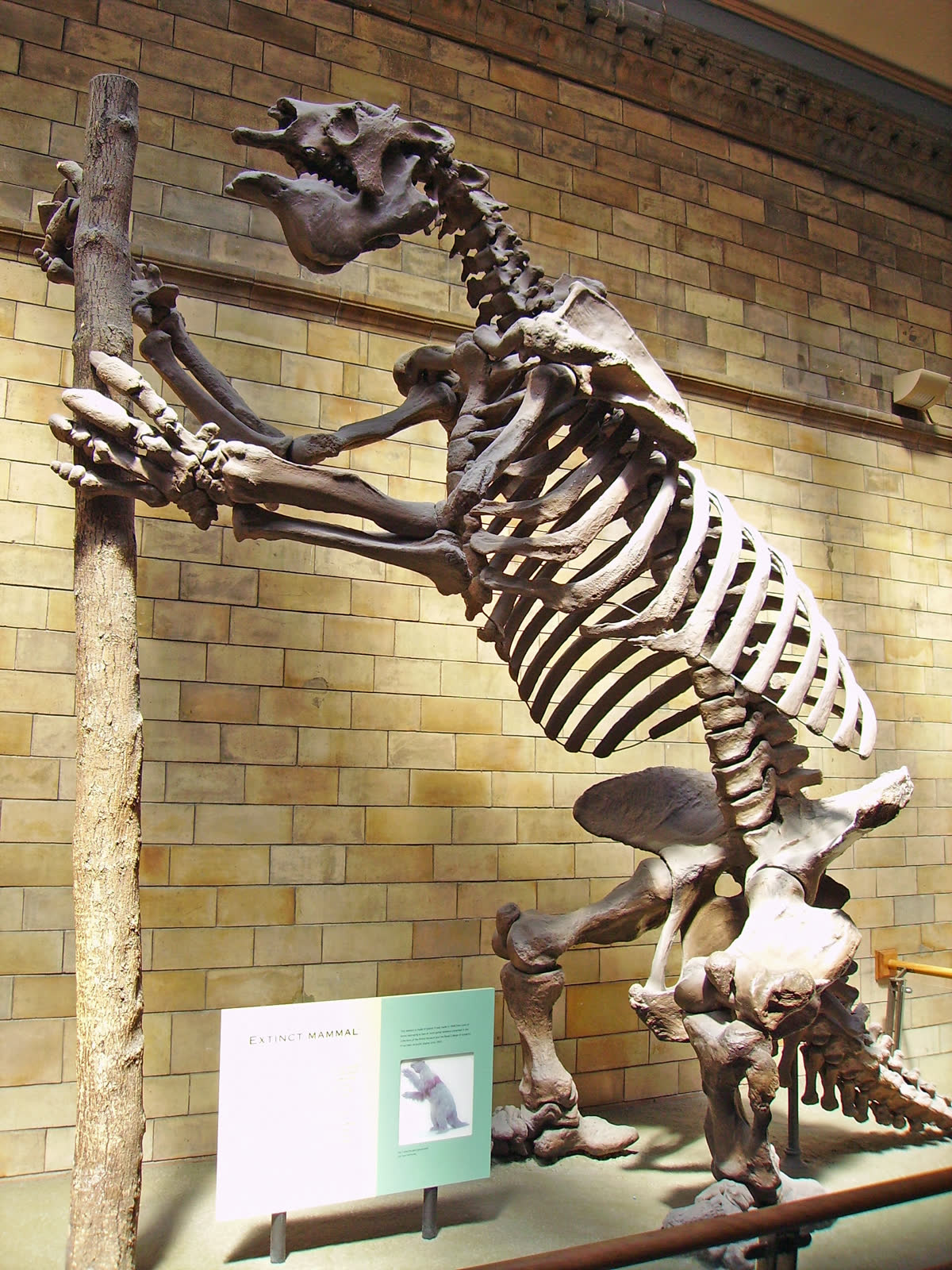
Megatherium americanum is easy to shrink into a phrase: giant ground sloth. The phrase is true, but it is not very helpful. A living sloth prepares the wrong expectations: hanging, small-bodied, slow in the canopy. Megatherium asks for a different animal entirely, one built around mass, reach, bracing, and selective feeding on a Pleistocene South American landscape. The Natural History Museum gives the scale cleanly: up to about four tonnes, with an upright height around 3.5 metres, and fossils known from Argentina, Uruguay, and Bolivia across Middle Pleistocene to early Holocene deposits.[1]
The better profile starts with the mounted skeleton in the photograph above. It is not a snapshot of one certain posture. It is a useful anatomical proposal. The pelvis is enormous, the hind limbs are columns, the tail is not decorative, and the forelimbs end in claws that look too large until the whole body is treated as a feeding platform. Megatherium was not simply a sloth made bigger. It was a browsing machine whose size only makes sense when the body is allowed to work as a tripod.
That tripod idea needs discipline. It is tempting to picture the animal strolling around permanently upright like a mammalian parody of a theropod. The safer claim is narrower. The skeleton makes rearing plausible, and NHM's account describes M. americanum as able to stand and walk on its hind legs.[1] But the most biologically useful part of upright posture was probably not theatrical walking. It was access: rising on hind limbs, using the tail as a third support, pulling vegetation inward with the forelimbs, and bringing the mouth to higher or selected plant parts. In other words, the posture belongs first to feeding, not to spectacle.
The Head Narrows The Menu
The skull keeps the animal out of monster territory. M. Susana Bargo's 2001 analysis of Megatherium americanum did not treat diet as a cartoon choice between harmless herbivore and clawed menace. It reconstructed the masticatory apparatus, estimated muscle moment arms, and asked what the teeth and jaw mechanics could actually do.[2] The result was a strong but bounded inference: M. americanum was adapted for strong, mainly vertical biting, with high-crowned, bilophodont teeth whose sharp crests suited cutting more than grinding.[2]
That matters because the giant-sloth image often overweights the claws. The mouth says at least as much. Bargo's paper argues that hard, fibrous food was probably not the main dietary component; the animal fits best as a browser in open habitats, capable of processing moderate to soft tough vegetation.[2] A browser is not a gentle mascot. A four-tonne browser changes trees and shrubs by force. But it changes them through cropping, tearing, and selective intake, not through the generalized grazing routine of a low-headed grass processor.
The muzzle evidence tightens the point. Bargo, Toledo, and Vizcaino's later work on South American Pleistocene ground sloth muzzles reconstructed soft-tissue feeding anatomy from skull landmarks across several species.[3] That comparison is important because Megatherium did not live alone in a world of one sloth. The late Pleistocene had multiple ground sloth body plans, and muzzle shape helps separate selective browsers from bulk feeders. The narrow-muzzled profile of Megatherium fits the idea of choosing plant parts rather than sweeping up low-quality vegetation indiscriminately.[2][3]
This is where the living-rhino analogy sometimes used for selective lips becomes helpful only if it stays an analogy. The fossil does not preserve a lip. It preserves skull surfaces, tooth form, jaw mechanics, and comparative anatomy that make a selective, browsing muzzle reasonable.[2][3] Skin, fur, exact lip texture, and day-to-day feeding gestures remain reconstructed layers. The evidence is strong enough to move beyond "big vegetarian." It is not strong enough to film the animal's mouth in action.
The Claws Were Tools Before They Were Weapons
The claws are the feature that makes Megatherium look dangerous. They probably were dangerous. A large animal with powerful forelimbs and long claws would have been difficult for predators to attack casually, and defensive use is a reasonable inference. But the profile is weaker if the claws become the whole animal. In a browser, the forelimbs also belong to food acquisition: hooking, pulling, bracing, breaking, and positioning vegetation within reach of the head.
That is why the skeleton should be read from back to front. The hindquarters support the rise. The tail expands the base. The forelimbs reach into the plant. The skull and teeth do the cutting. No single part explains the animal alone. A tooth-only Megatherium becomes an abstract diet model. A claw-only Megatherium becomes a monster. A posture-only Megatherium becomes a circus trick. The useful animal is the whole system, with feeding mechanics and body mechanics pulling in the same direction.[1][2][3]
The same caution applies to speed and behavior. Very large mammals often get described through extremes: unstoppable, lumbering, slow, armored, stupid, invincible. Fossils rarely support that kind of certainty. Megatherium was massive and probably not built for athletic sprinting, but the skeleton does not need speed to be ecologically serious. A high-reach browser can shape vegetation while moving deliberately. A defensive adult can be formidable without being fast. A feeding system can dominate a local plant resource without behaving like a predator.
The Pampas Endgame Is Not A Single-Cause Story
The animal's disappearance is another place where the profile benefits from restraint. NHM notes that Megatherium overlapped with humans and that cut-marked fossils suggest these giant sloths were sometimes used as food.[1] The Campo Laborde evidence makes that interaction much harder to dismiss: Politis, Messineo, Stafford, and Lindsey reported a late Pleistocene giant ground sloth kill and butchering site in the Argentine Pampas, with new dating placing the event around 12,600 calibrated years before present.[4]
That is strong evidence for human use of Megatherium. It is not, by itself, a complete extinction theory. One kill site does not prove that people alone removed every population across South America, and late Pleistocene ecosystems were also changing under climate and habitat pressures. What Campo Laborde does is set a hard boundary against a clean, human-free ending. At least some people encountered Megatherium as meat, tool material, and risk at the end of its history.[4]
This endgame also sharpens how the living animal should be imagined. It was not a museum oddity waiting for science. It was part of a working landscape: vegetation, other large herbivores, predators, water margins, mud, and people. A four-tonne browser could have been both ecologically important and vulnerable. Its size protected it from many ordinary dangers, but size also made it slow to reproduce, costly to feed, and valuable when humans could exploit one carcass.
The best Megatherium profile therefore refuses both available shortcuts. It was not a cuddly sloth scaled up into absurdity. It was not a horror creature with claws first and ecology second. It was a late Pleistocene xenarthran browser whose body made sense as an integrated feeding platform: narrow muzzle, shearing teeth, powerful forelimbs, hind-limb support, and a tail that turned rearing from a stunt into a practical posture.[1][2][3]
That is why the skeleton still works. The upright mount is dramatic, but the drama comes from anatomy rather than fantasy. Once the animal is read as a tripod browser, the huge pelvis, deep rib cage, raised arms, and long claws stop looking like random exaggerations. They become parts of a coherent browsing solution, written at mammoth scale into the bones of a sloth.
Sources
- Natural History Museum, "What was Megatherium?" (2018) - discovery, Darwin specimens, size, distribution, time range, bipedal posture, and diet overview.
- M. Susana Bargo, "The ground sloth Megatherium americanum: Skull shape, bite forces, and diet," Acta Palaeontologica Polonica 46 (2001) - jaw mechanics, tooth form, and browsing interpretation.
- M. Susana Bargo, Nestor Toledo, and Sergio F. Vizcaino, "Muzzle of South American Pleistocene ground sloths (Xenarthra, Tardigrada)," Journal of Morphology 267 (2006), PubMed record.
- Gustavo G. Politis, Pablo G. Messineo, Thomas W. Stafford Jr., and Emily L. Lindsey, "Campo Laborde: A Late Pleistocene giant ground sloth kill and butchering site in the Pampas," Science Advances 5 (2019), repository record.
- Wikimedia Commons, "File:Megatherium americanum Skeleton NHM.JPG" - photographed Natural History Museum skeleton used as the article image.