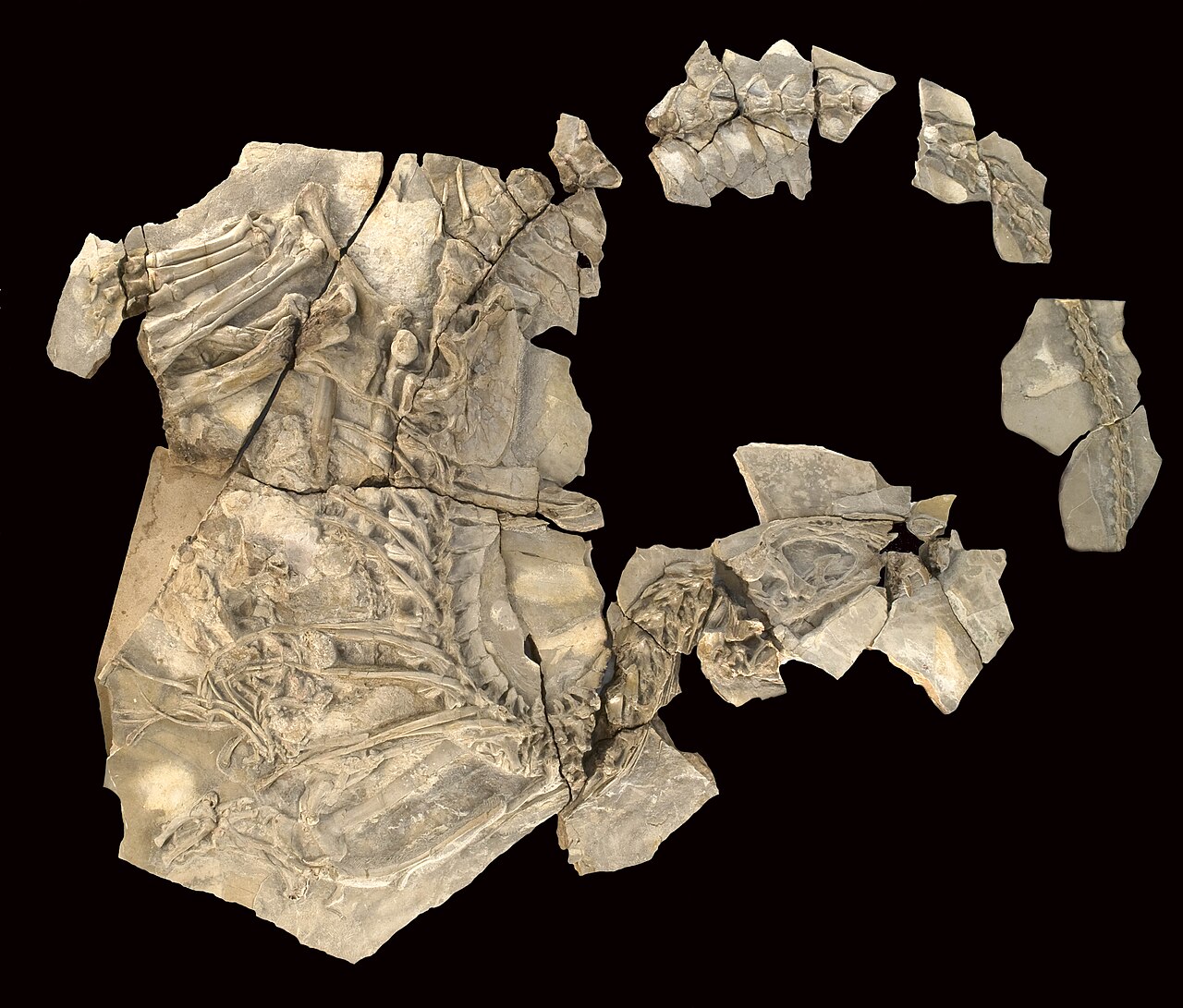
Concavenator corcovatus is a dinosaur built to attract bad shortcuts. The name invites the hump. The forearm bumps invite the feather headline. The fact that it was a carnivorous theropod from Spain invites comparisons with better-known giant predators. Read closely, though, the Las Hoyas specimen is more useful when it slows all of those reflexes down. It matters because one near-complete fossil keeps several kinds of evidence in one place: backbone, skull, limbs, foot and tail skin traces, and a few tiny scars on the ulna whose meaning still has to be argued.[1][2][5]
That makes Concavenator a fossil-find problem rather than a simple species card. The original 2010 Nature description introduced an almost complete, exquisitely preserved, roughly six-meter theropod from the Barremian-age Las Hoyas Konservat-Lagerstätte in Cuenca, Spain.[1] It placed the animal as a primitive member of Carcharodontosauria, the broader "shark-toothed" theropod lineage better known from later, larger predators.[1][5] But the scientific pressure of the fossil comes from two stranger details: two elongated presacral neural spines that form a pointed pre-hip crest, and a row of small bumps on the ulna that the describing authors interpreted as comparable to quill knobs in birds.[1]
The photograph above is useful because it keeps those claims attached to the object. Concavenator is not best understood from a polished hunting scene. The fossil is an articulated body in limestone, remarkable enough that the skeleton can be discussed region by region, yet incomplete or ambiguous enough that the most dramatic features remain bounded. That is the article's central lesson: the slab supports real oddity, not unlimited certainty.
The Hump Is A Scaffold Before It Is A Story
The back crest is the feature almost everyone notices first. The Natural History Museum summarizes the preserved anatomy plainly: two tall bones in the spine created an unusual crest near the hips.[5] The original paper described the underlying structure more technically, as elongation of the neurapophyses of two presacral vertebrae forming a pointed, hump-like structure.[1] That distinction matters. Bone proves the raised scaffold. It does not, by itself, prove the living surface.
In life, the crest might have supported a fleshy hump, a thin sail, or some other soft-tissue arrangement. The Natural History Museum is careful on exactly this point: experts do not know how it looked in life, and the function remains uncertain.[5] Species recognition, display, fat storage, and temperature-related hypotheses are all easier to imagine than to prove. The fossil therefore gives a strong anatomical fact and a weaker biological question. The spines were there. The living tissue around them is still reconstructed.
That is why Concavenator should not be flattened into a small Spinosaurus analogy. The museum account makes the taxonomic boundary explicit: despite a superficial back-spine resemblance, Concavenator was not a spinosaur; it belongs with carcharodontosaurs.[5] The comparison is useful only as a warning. Similar silhouettes can come from different lineages, different body regions, and different biological pressures. In Concavenator, the crest sits just before the hips and is built from a very localized pair of vertebral changes, not from an extended sail running along much of the back.[1][5]
The best reading, then, is not "humpbacked predator" as a finished answer. It is a preserved axial oddity that asks what a short, pointed soft-tissue-backed crest was doing on an early carcharodontosaurian body. The fossil keeps the question honest by making the support visible and the surface missing.
The Arm Bumps Are Even More Dangerous
The ulnar bumps are smaller than the crest and arguably more consequential. Ortega, Escaso, and Sanz proposed that the bumps were homologous to quill knobs in modern birds, attachment areas for follicular ligaments that anchor feather roots.[1] If that interpretation holds, it extends feather-related, non-scale skin appendages deeper into theropod history than a narrow coelurosaur-only picture would suggest.[1]
That is a major claim, but the fossil does not become stronger if the uncertainty is hidden. The Natural History Museum's public summary states the current boundary well: scientists disagree about whether the arm marks indicate feathers; some see evidence for quill knobs, while others regard the bumps as possible muscle attachment scars, and distortion makes certainty difficult.[5] This is exactly where Concavenator becomes interesting. The specimen does not simply prove a feathered allosauroid. It creates a test case for what bone scars can and cannot say about skin appendages.
The distinction is not pedantic. Quill knobs in living birds are tied to feather attachment. Muscle scars, tendon attachments, or preservation artifacts would mean something quite different. Because the fossil preserves no feather impressions around the arm itself, the ulnar row has to carry the argument indirectly.[1][5] That makes the claim powerful if correct, but fragile if overstated.
Later appendicular work helps explain why the specimen keeps being revisited. Cuesta, Ortega, and Sanz described the limb skeleton in detail and treated Concavenator as the most complete appendicular skeleton then available for Carcharodontosauridae, with only a few regions absent.[2] Completeness matters because one disputed row of bumps should be read in relation to the whole forelimb, not lifted out as a freestanding headline. The question is not only "are these quill knobs?" It is "where do these structures sit on an anatomically described arm, and what alternatives can the rest of the limb exclude?"[2][5]
That is the disciplined version of the feather question. Concavenator may preserve a signal with broad implications for the origin and distribution of feather-like structures. Or it may preserve a more ordinary attachment pattern misread through a bird-centered analogy. The fossil's value is that the answer has to be earned from anatomy.
Las Hoyas Makes Surfaces Matter
The broader site context is part of why these questions are possible. Las Hoyas is not an ordinary bone patch. IUGS describes it as a Barremian wetland fossil site with an unusually complete biota, including soft-bodied organisms, plants, and animals, deposited in lacustrine and palustrine environments.[6] The Natural History Museum gives the public version of the same scene: an inland lake setting with plants, fishes, worms, prehistoric crocodiles, and other European dinosaurs.[5]
That matters because Concavenator is not only a skeleton. The original description and later public summaries note scale evidence on parts of the body, including skin evidence from the feet and other regions.[1][5] Those surfaces complicate the common image of the animal. It is not safe to paint the whole dinosaur as fully feathered just because the ulna has disputed bumps. It is also not safe to declare it uniformly scaly everywhere, because preserved scales in one region do not automatically describe every part of the body.[5]
This is one of the useful lessons from exceptional preservation. A Lagerstätte can tempt readers to assume that whatever is missing was absent in life. That is too simple. Las Hoyas can preserve remarkable detail, but preservation is still selective. Skin around the foot, tail, or body does not guarantee identical preservation around the forearm. Absence of a feather impression near the ulna weakens overconfident restoration, but it does not by itself settle what the bumps were.[1][5][6]
The site therefore makes Concavenator sharper, not easier. It gives the fossil enough surface evidence to stop the article from being only about bones, while still leaving the most dramatic surface claim partly unresolved.
The Skull And Body Keep The Animal From Becoming A Gimmick
The danger in writing about Concavenator is that the hump and arm bumps swallow the rest of the animal. The later osteology papers push against that. The cranial description by Cuesta, Vidal, Ortega, and Sanz returned to the skull as a serious anatomical object, while the axial study treated the vertebral column beyond the famous raised spines.[3][4] Together with the appendicular description, those papers show that the holotype did not finish its scientific work in the announcement year.[2][3][4]
That afterlife matters. A weaker fossil would remain a curiosity: one odd crest, one disputed row of bumps, one memorable nickname. Concavenator remains useful because the specimen is complete enough to sustain normal anatomical paleontology after the headlines fade. The skull can be compared. The limbs can be measured. The vertebral column can be described. The taxonomic placement can be tested against other theropods. The spectacular features are not separate from that work; they are constrained by it.[2][3][4]
This is also why the carcharodontosaurian placement matters. Concavenator is not just a strange Spanish carnivore. It sits near the early history of a predatory lineage whose later members became some of the largest land carnivores.[1][5] A medium-sized Barremian member from Europe helps show that the group's early diversification was geographically and anatomically more complex than a simple late-Gondwanan giant-predator story.[1] The hump and arm bumps are local oddities, but the fossil's placement gives them evolutionary reach.
A Better Way To Remember Concavenator
The strongest version of Concavenator is narrower than the public image and better because of it. The animal was a real Early Cretaceous carcharodontosaurian from the Las Hoyas wetland record, preserved as a near-complete skeleton with a short, pointed pre-hip crest and disputed ulnar bumps.[1][5][6] It probably did not look like a generic big theropod with a novelty sail glued on. It also should not be used as casual proof that large allosauroid-grade predators definitely had bird-like feather attachments on the arms.
What the fossil does support is more interesting. It shows that early carcharodontosaurians could carry unexpected vertebral specializations. It gives paleontologists a specimen-level test for feather-related structures outside the usual coelurosaur comfort zone. It preserves enough skin evidence elsewhere on the body to make the integument problem regional rather than all-or-nothing. And it keeps reminding readers that spectacular fossils are most valuable when their uncertainty remains visible.[1][2][5]
That is why Concavenator still holds attention. The hump is real, but the living surface is not settled. The arm bumps are real, but their biological meaning remains contested. The skeleton is spectacular, but its best lesson is restraint. The Las Hoyas slab does not ask us to choose between dull certainty and wild reconstruction. It asks us to keep the evidence on the bone until the bone can bear the story.
Sources
- Francisco Ortega, Fernando Escaso, and José L. Sanz, "A bizarre, humped Carcharodontosauria (Theropoda) from the lower cretaceous of Spain," Nature 467 (2010), PubMed record and DOI.
- Elena Cuesta, Francisco Ortega, and José L. Sanz, "Appendicular osteology of Concavenator corcovatus (Theropoda; Carcharodontosauridae; Early Cretaceous; Spain)," Journal of Vertebrate Paleontology 38 (2018), BioOne record.
- Elena Cuesta, Daniel Calés Vidal, Francisco Ortega, and José L. Sanz, "The cranial osteology of Concavenator corcovatus (Theropoda; Carcharodontosauria) from the Lower Cretaceous of Spain," Cretaceous Research 91 (2018), UNED record and DOI.
- Elena Cuesta, Francisco Ortega, and José L. Sanz, "Axial osteology of Concavenator corcovatus (Theropoda; Carcharodontosauria) from the Lower Cretaceous of Spain," Cretaceous Research 95 (2019), DOI summary.
- Natural History Museum, "Concavenator" dinosaur directory page - crest, feather-dispute boundary, taxonomy, age, and Las Hoyas context.
- International Union of Geological Sciences, "Early Cretaceous wetland of Las Hoyas" - geoheritage overview of the Barremian wetland biota and depositional setting.
- Wikimedia Commons, "File:Concavenator.jpg" - photographed fossil slab used as the article image.