Megaloceros giganteus is usually introduced from the wrong end. The popular name "Irish elk" pushes attention toward the antlers, the Irish bog finds, and the fantasy that the animal somehow evolved itself into extinction. The species is clearer when read as a deer first. Its antlers were immense, but they belonged to a particular body, a particular habitat, and a particular mating system.[1][2][3][5]
That shift matters because the old caricature is too neat. This was not an elk, and it was not confined to Ireland.[1][3][5] It was a giant deer spread across Eurasia whose males stood about two metres at the shoulder and could carry antlers up to roughly three and a half metres across.[1][5] The stronger species profile begins there: a very large cervid living in open or semi-open country, paying the costs of an extravagant display structure because the display itself made biological sense.[1][2][5]
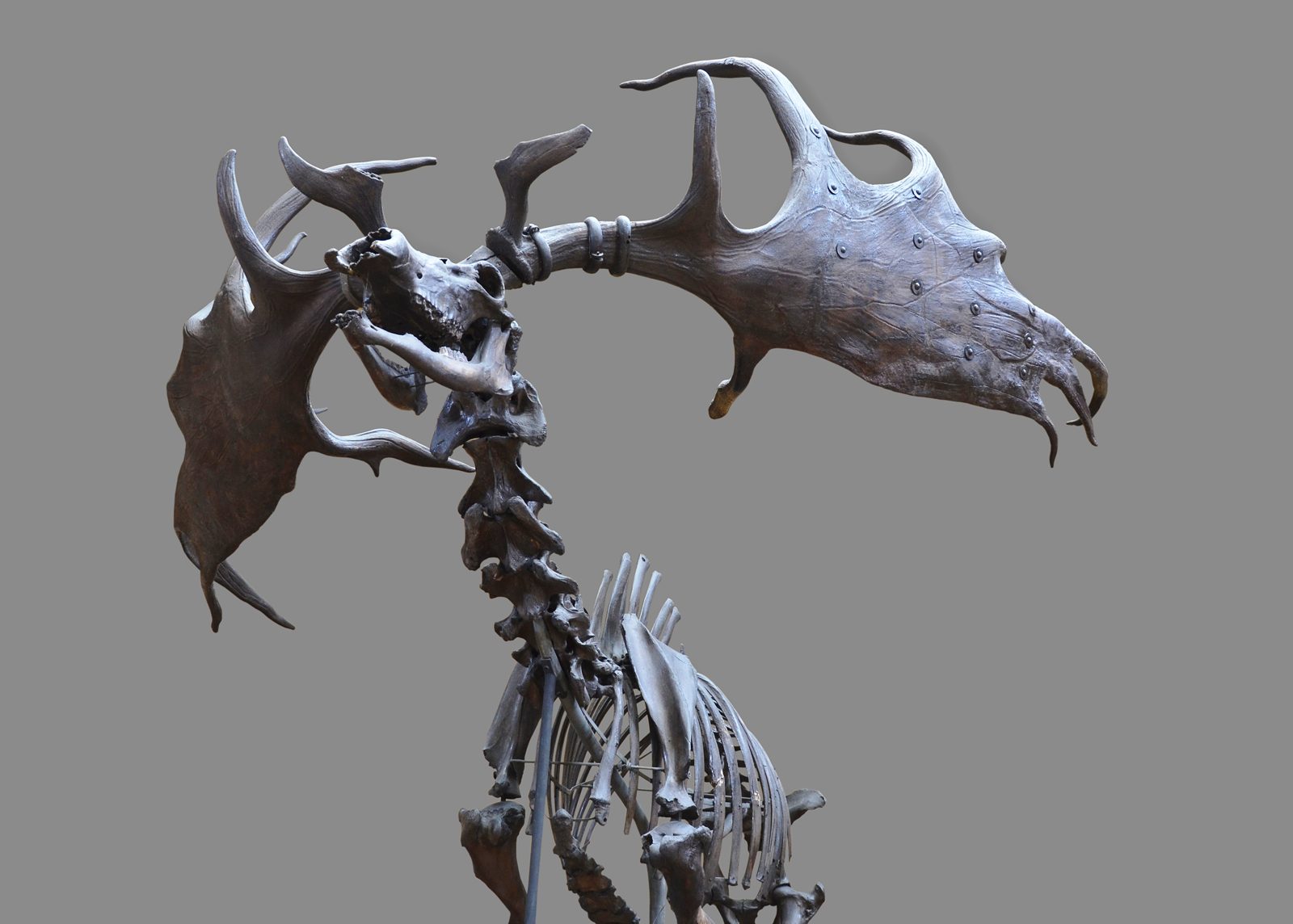
Image context: the cover uses a real photographed Megaloceros giganteus skeleton from the Galerie de Paleontologie et d'Anatomie comparee in Paris via Wikimedia Commons. It belongs here because the article's argument is structural. One look shows the mismatch that made the animal famous and the body plan that keeps the mismatch from being nonsense: a recognizably deer-like torso and limbs carrying the broadest antlers known in any deer.[6]
The species was a deer, not a broken experiment
The first correction is taxonomic. The antlers are so broad and flattened that earlier researchers often treated giant deer as close to moose or placed them ambiguously among living deer.[3] The 2005 Nature paper tightened that uncertainty with a combined morphological and ancient-DNA analysis, finding support for a sister-group relationship between giant deer and living fallow deer.[3] That does not turn Megaloceros into a simple oversized fallow deer. It does something better. It puts the species back inside deer evolution instead of leaving it stranded as a freakish side note.
Lister's longer 1994 review matters for the same reason.[1] The giant deer was not a one-locality wonder accidentally fossilized in Ireland. It had a long Pleistocene history across Europe and western Asia, with the Irish material becoming famous largely because preservation in bogs was so generous.[1] Once that broader range comes back into view, the species stops looking like a local curiosity and starts reading as a successful large cervid whose ecology worked across substantial parts of Eurasia.[1][4]
This is why the animal's silhouette needs discipline. The body was not merely a stand for antlers. It was a large, long-legged grazer-browser living in landscapes where visibility, movement, and mate competition could reward display at scale.[1][5] The antlers were the headline, but the body underneath had to support the headline every year.
Why the antlers made sense in open country
The best public summary from the Natural History Museum is still the simplest: a male carrying antlers that wide would have had a hard time moving through dense forest, which is one reason the species fits better in parkland, open woodland, and grassland than in closed forest.[5] That point sounds obvious once stated, but it changes the whole reading. Antlers are not just ornaments pasted onto a deer. They are ecological structures. Their usefulness depends on where the animal can move, display, and fight without constantly turning its own headgear into a handicap.[5]
The fallow-deer relationship sharpens that interpretation.[3][5] NHM's Adrian Lister notes that living fallow deer mate through lek-like display, with males roaring, parading, and locking antlers while females choose among them.[5] The fossil record cannot replay a full Megaloceros rut for us, but it does constrain the analogies that make sense. Very large antlers are easier to understand in a system of intimidation, visual display, and controlled pushing contests than in a fantasy of continual life-or-death combat.[2][5]
That is the species-profile lesson. The antlers were not simply "too big." They were big for a reason. Sexual selection can favor structures that are expensive as long as the reproductive payoff is real.[2][5] In Megaloceros, the payoff seems to have belonged to visibility, mate choice, and rivalry in landscapes open enough to let those signals work.[5]
Allometry explains part of the story, but not all of it
The famous scientific argument about giant deer antlers often ran through Stephen Jay Gould's allometry work: perhaps a very large deer was more or less bound to grow disproportionately large antlers.[2] The 2024 reassessment by Tsuboi and colleagues makes the picture more precise.[2] Using new morphometric data across 57 deer taxa, the authors found that Irish elk antlers are larger than predicted if one looks only within the true deer, Cervini, but are close to expectation when all deer are considered together.[2]
That is an important correction because it narrows what "allometry" can and cannot do for explanation. It does support the idea that giant deer antlers were not some impossible violation of deer scaling.[2] At the same time, the paper rejects a stronger claim that developmental allometric constraint by itself explains why the antlers became so large, emphasizing instead that antler evolution across deer includes substantial non-allometric change.[2]
For this species profile, that is exactly the right boundary. Megaloceros was not a mathematically doomed deer forced into absurdity by body size alone.[2] Nor was it a pure sexual-selection fairy tale floating free of anatomy. The best reading holds both levels together: deer scaling made very large antlers plausible, and ecology plus display biology made them worth carrying.[2][5]
Extinction is not a punchline about bad design
Once the antlers are put back into habitat and life history, the extinction story changes too. The old moralizing version said the species more or less bred itself into failure. The 2004 Nature paper by Stuart, Kosintsev, Higham, and Lister makes that view too crude.[4] Their radiocarbon evidence showed that giant deer survived in western Siberia until about 6,900 radiocarbon years before present, roughly 7,700 years ago, far later than the once-standard terminal date.[4] That alone weakens any simple story in which the antlers caused a uniform, inevitable collapse at the Pleistocene-Holocene boundary.
The same paper argues that giant deer and woolly mammoth both underwent dramatic distributional shifts driven largely by climatic and vegetational change, though their ecological responses differed.[4] That is the key framing. Extinction has to be read through changing landscapes, changing forage, and changing range structure, not through one theatrical body part isolated from everything else.[4]
The NHM summary lands in a similar place from a museum angle: giant deer were likely pushed by a combination of pressures, and the energetic burden of growing enormous antlers would have become harder to meet when climate turned harsher and food became scarcer.[5] Read carefully, that does not rehabilitate the old self-destruction myth. It does something more useful. It says the antlers were costly, but the decisive problem emerged when a costly display system met shifting vegetation and shrinking ecological room.[4][5]
That is why Megaloceros still deserves attention in 2026. The species keeps a famous Ice Age animal from collapsing into caricature. It was a real deer with the largest antlers any deer ever evolved, closely allied to fallow deer, shaped for display in open country, and ultimately caught inside a changing climatic and vegetational map.[1][2][3][4][5] The antlers were spectacular. The mistake is thinking spectacle is the whole explanation.
Sources
- Adrian M. Lister, "The evolution of the giant deer, Megaloceros giganteus (Blumenbach)" (1994), Zoological Journal of the Linnean Society - long-range species history, morphology, and geographic spread.
- Masahito Tsuboi et al., "Antler Allometry, the Irish Elk and Gould Revisited" (2024), Evolutionary Biology - open-access reassessment of antler scaling and the limits of the allometric-constraint argument.
- A. M. Lister et al., "The phylogenetic position of the 'giant deer' Megaloceros giganteus" (2005), Nature - combined morphology and DNA evidence supporting a sister-group relationship with fallow deer.
- A. J. Stuart, P. A. Kosintsev, T. F. G. Higham, and A. M. Lister, "Pleistocene to Holocene extinction dynamics in giant deer and woolly mammoth" (2004), Nature - late survival in western Siberia and climate-vegetation-driven range shifts.
- Natural History Museum, "The Irish elk: when and why did this giant deer go extinct and what did it look like?" - museum synthesis on body size, habitat, mating display, and extinction pressures.
- Wikimedia Commons file page for the Paris Megaloceros skeletal mount photograph used as the article image.