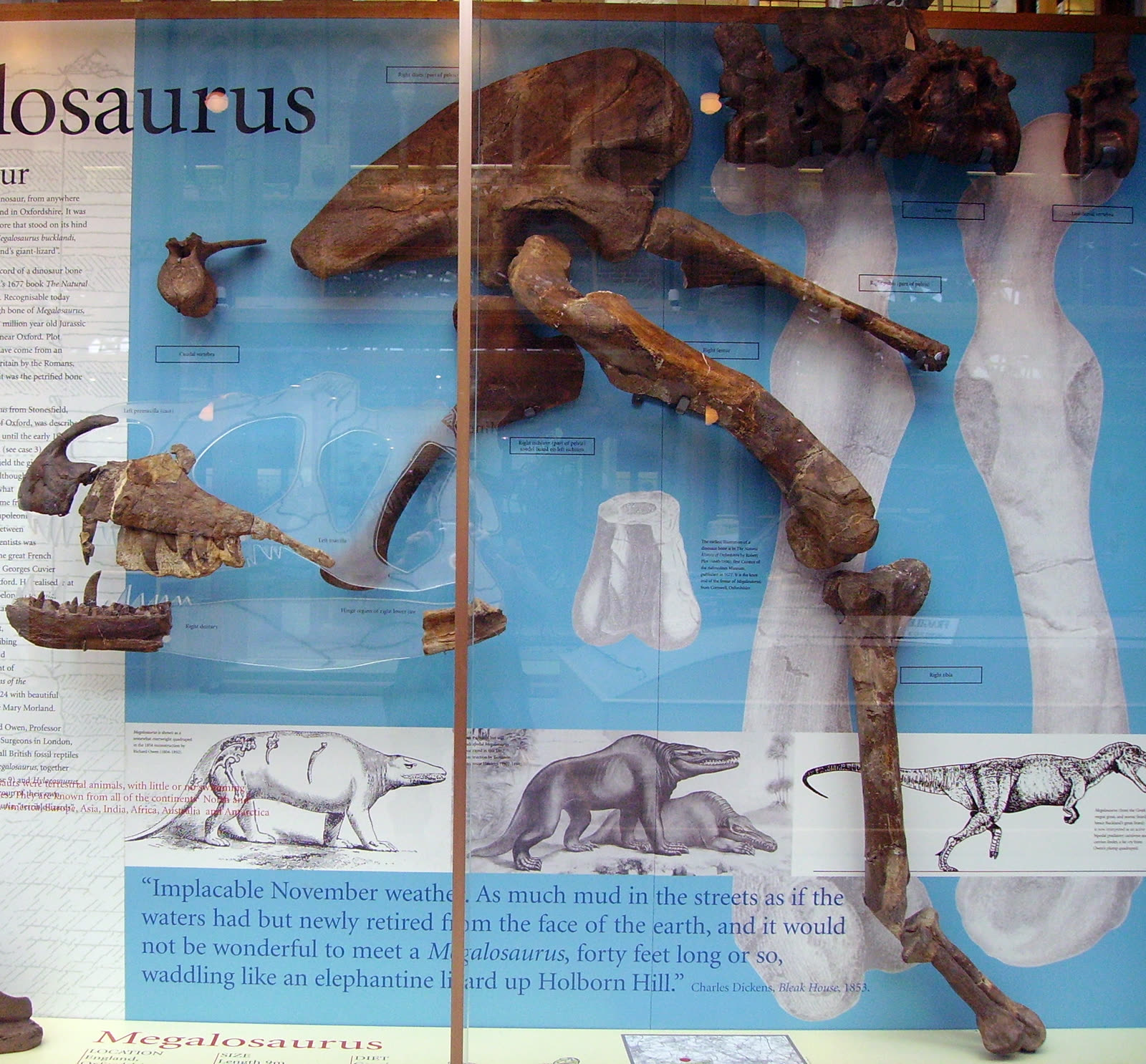
Megalosaurus bucklandii is famous because it became the first validly named dinosaur. That fact is true, but it is also a little too smooth. The animal did not enter science as a complete skeleton, a running silhouette, or a creature already understood as a dinosaur in the modern sense. It entered through pieces from Stonesfield: a lower jaw with teeth, vertebrae, pelvic and limb fragments, and the problem of what kind of extinct reptile could have left them behind.[1][2]
The jaw is the best place to slow down. It is not a decorative relic of a naming ceremony. It is the specimen that keeps the name from floating away into Victorian imagination. Oxford University Museum of Natural History now identifies its Megalosaurus jawbone and associated limestone as type material for M. bucklandii, and the jaw remains tied to the older Stonesfield Slate record that made Oxfordshire central to early dinosaur science.[2] A close reading of that dentary shows why the first dinosaur was never simply "found." It had to be assembled, named, repaired, re-examined, and bounded.
A name before a category
William Buckland's 1824 paper described the animal as the "great fossil lizard of Stonesfield," not as a dinosaur, because the word Dinosauria did not yet exist.[1] That gap matters. Buckland could compare bones and teeth, estimate scale, and argue for an enormous carnivorous reptile, but he was not placing the fossil inside a ready-made dinosaur tree. The category would come later, after Megalosaurus, Iguanodon, and Hylaeosaurus gave Richard Owen enough comparative material to propose a group.
That sequence changes how the fossil should be read. Megalosaurus is not important because Buckland saw a complete dinosaur and announced a modern concept early. It is important because a partial animal made the old categories strain. The teeth suggested predation. The bones suggested size. The quarry context placed the material in deep time rather than in a recent monster story. The name became durable because the specimen was specific enough to keep being tested after the vocabulary around it changed.[1][2]
The most useful mental image is therefore not a charging theropod. It is a jaw in a cabinet. The dentary is broken, partial, and historically handled, but it carries the argument better than a polished reconstruction would. A reconstruction must choose posture, skin, mass, gait, color, and behavior. The jaw asks a smaller and harder question: what can a named species legitimately rest on?
The dentary makes the predator concrete
The jaw mattered because teeth are not passive labels. In a carnivorous dinosaur, they record a feeding system: sockets, replacement, curvature, spacing, breakage, and wear. Buckland's original description used the jaw and teeth to argue for a large extinct reptile, and later work has kept returning to the same material because the dentary still contains anatomy rather than merely historical prestige.[1][3][4]
That is why Megalosaurus is a better fossil-find story than a first-dinosaur trivia answer. The specimen's fame depends on the fact that it is both iconic and diagnostic. Roger Benson's 2010 redescription treated M. bucklandii as a valid Middle Jurassic theropod taxon and emphasized the role of the lectotype dentary in diagnosing it among related theropods.[3] In plainer terms, the jaw is not just the oldest celebrity in the dinosaur cabinet. It is still part of the species' technical boundary.
The boundary is necessary because early dinosaur names often absorbed too much. For much of the nineteenth and twentieth centuries, large fragmentary theropod material from different places could be pulled toward familiar labels. A close reading resists that habit. The Stonesfield jaw supports Megalosaurus bucklandii; it does not give permission to turn every large Jurassic theropod scrap into the same animal. The fossil's value rises when its reach is limited.
Damage is part of the evidence trail
The jaw has also had a museum life. It was collected more than two centuries ago, preserved, displayed, repaired, and reinterpreted under changing curatorial standards. That history could sound like a problem to hide, but it is actually part of what makes the specimen scientifically interesting. A fossil used as a public icon is not frozen at the moment of discovery. It accumulates plaster, adhesives, display decisions, and research questions.[4]
X-ray computed tomography work on the Megalosaurus dentary turned that curatorial history into evidence. The Warwick case study identifies the specimen as the lectotype partial right dentary OUMNH J.13505, from the Stonesfield Slate of the Taynton Limestone Formation near Stonesfield, and uses CT to inspect repair history and internal structure without physically cutting into the fossil.[4] The point is not that scanning made the old specimen newly glamorous. The point is that the jaw still had hidden information.
The CT study reported internal details including replacement teeth and differences between fossil bone and repair material.[4] That is a beautiful reversal of the "first dinosaur" slogan. The old jaw was not exhausted by its anniversary value. It still had a working dental system inside it, and modern methods could separate anatomy from conservation material more carefully than surface inspection alone.
A partial fossil can be strong without being complete
The hardest habit to break is the assumption that completeness equals reliability. A complete skeleton can be wonderful, but it can also seduce the viewer into thinking the interpretation is automatic. A partial jaw has the opposite virtue. It forces every claim to show its hinge.
For Megalosaurus, those hinges are visible. The fossil comes from a named Middle Jurassic locality. The dentary is tied to a historic publication. Later taxonomic work treats the jaw as part of the species' diagnostic core. CT work clarifies hidden teeth, repair, and internal structure. The museum context keeps the specimen physically accountable.[1][2][3][4] None of that makes the whole animal obvious. It makes the name defensible.
That distinction matters for paleontology more broadly. Famous fossils often get flattened into symbols: first dinosaur, oldest bird, missing link, giant predator. Symbols travel quickly, but they can hide the actual labor of inference. The Megalosaurus jaw is better than its symbol. It shows science doing something less theatrical and more durable: preserving a damaged object, narrowing a name, rechecking old assumptions, and admitting that a partial specimen can carry a large historical load without pretending to be a whole animal.
The first dinosaur remains a specimen
The reason to return to the jaw is not nostalgia. It is discipline. Megalosaurus became the first valid dinosaur name before dinosaurs were a settled category, and that makes the specimen unusually good at exposing how scientific categories are built. A fossil does not wait in the ground with its future label attached. It becomes readable through comparison, publication, museum custody, and revision.
The Oxford display photograph is useful for exactly that reason. It shows bone, label, cabinet, and institution together.[5] The image is not as thrilling as a running predator, but it is more honest to the article's claim. The first dinosaur begins as a fossil object with teeth and breaks, not as a finished animal in the mind. Its afterlife is not a footnote to the discovery. It is how the discovery stayed scientific.
So the close reading should end with a modest sentence: Megalosaurus bucklandii is not only the first named dinosaur. It is a reminder that naming deep time starts with material that is smaller, rougher, and more stubborn than the creatures it eventually lets us imagine.
Sources
- William Buckland, "Notice on the Megalosaurus or great Fossil Lizard of Stonesfield," Transactions of the Geological Society of London series 2, volume 1 (1824), BioStor record.
- Oxford University Museum of Natural History, "Megalosaurus" - museum account of the Stonesfield animal, the first named dinosaur claim, and type-material context.
- Roger B. J. Benson, "A description of Megalosaurus bucklandii (Dinosauria: Theropoda) from the Bathonian of the UK and the relationships of Middle Jurassic theropods," Zoological Journal of the Linnean Society 158, no. 4 (2010), Oxford Research Archive record.
- P. F. Wilson et al., "Utilizing X-ray computed tomography for heritage conservation: the case of Megalosaurus bucklandii," University of Warwick PDF case study.
- Wikimedia Commons, "File:Megalosaurus display.JPG" - museum display photograph of Megalosaurus bucklandii material at the Oxford University Museum of Natural History.