Amber has a peculiar way of distorting scale. A droplet of tree resin can preserve structures so fine that skin texture, feather barbs, mouthparts, and parasite attachments remain legible more than 99 million years later.[1][3][4][5] That level of detail makes amber fossils feel uncannily complete.
The danger starts when that completeness gets mistaken for representativeness. Amber is excellent at preserving small forest-world encounters. It is much weaker as a neutral census of an entire ecosystem.[1][2]
That distinction is the right way to read amber in paleontology. Resin preserves moments better than worlds.
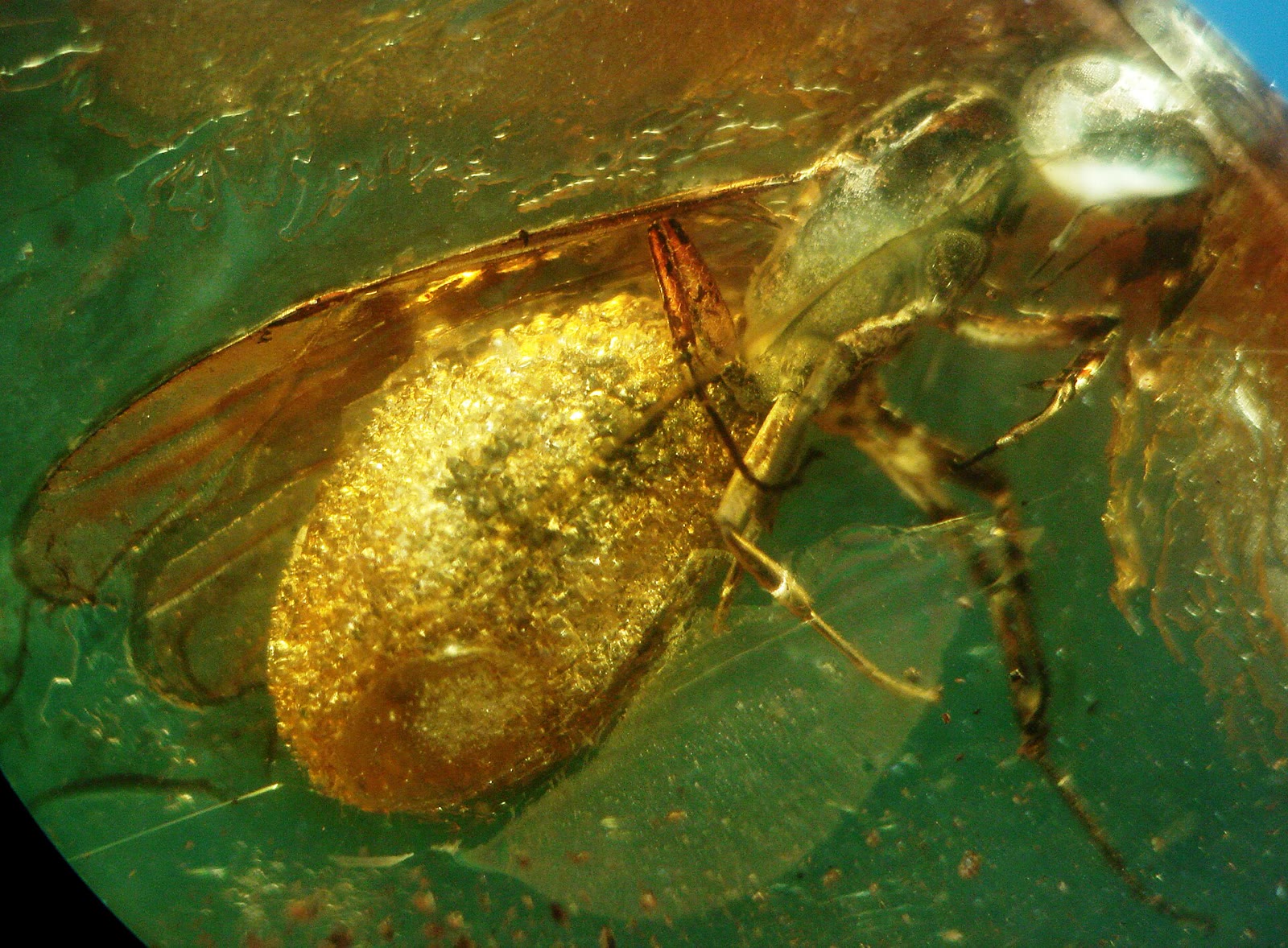
Image context: the cover image shows an ant inclusion in Baltic amber. It is a direct photographic example of the medium discussed here: a small body sealed in resin with enough three-dimensional fidelity to make amber fossils look unusually immediate.[7]
1) Amber begins with a tree, so the archive starts biased
Before amber is a fossil, it is a biological secretion. Resin flows from trees, traps organisms that happen to touch or fall into it, hardens, and only much later enters the geologic record.[1] That sequence gives amber its greatest strength and its first major bias at the same time.
The strength is obvious: resin can wrap tiny bodies quickly and preserve external detail at a scale most compression fossils rarely match.[1][3][5] The bias is just as important: everything begins near bark, branches, litter close to trunks, or the small forest-air space around resin-producing trees.
Solorzano Kraemer and colleagues tested this problem by comparing arthropods trapped in modern resins with the broader living arthropod communities around them.[2] Their result is exactly the kind of boundary readers should carry back into deep time. Resin captures some forest organisms very well, especially small arboreal forms, but it does not sample a forest proportionally.[2] Amber is therefore a high-resolution window with a narrow field of view.
That is why amber papers so often feel richer than the ecosystems they claim to describe. The medium magnifies the local and the tiny.
2) What amber does better than most rocks is preserve interfaces
The best amber discoveries are not impressive because they are small. They are impressive because they preserve contact surfaces and fragile anatomical relations that other fossil settings usually destroy.
The mid-Cretaceous tail described by Xing and colleagues in 2016 is the clearest example.[3] The specimen did not just show feathers near dinosaur material. It preserved articulated caudal vertebrae and associated plumage in one piece, anchoring the feathers to a non-avian dinosaur tail rather than leaving them as isolated feather impressions or free-floating fragments.[3]
That matters because amber can turn what is usually a reconstruction problem into a directly observed anatomical association. The scientific gain is not decorative softness. It is evidentiary linkage.
The same logic appears in Daza and colleagues' 2016 study of lizards in mid-Cretaceous amber.[5] Those fossils preserved tiny vertebrates with unusual fidelity, including scales, soft tissues, claws, and body outlines that help make tropical forest microfaunas legible in a way ordinary skeletal remains often do not.[5] Amber is especially powerful in this size range, where a whole body can disappear in most deposits yet survive here with texture still visible.
In that sense, amber is less like a standard bone record and more like a trap for anatomical relationships.
3) Amber can preserve behavior-adjacent evidence, but still only as a snapshot
Amber is at its strongest when it captures association, not just anatomy.
Penalver and colleagues' 2017 study on parasitised feathered dinosaurs is memorable for exactly that reason.[4] The assemblage included ticks preserved with feather material and dermestid beetle setae, allowing the authors to discuss parasitism and nest-associated ecological interaction rather than only isolated body parts.[4]
This is the kind of evidence amber does unusually well. It can preserve a contact event, a surface relationship, or an ecological adjacency that compression fossils often flatten away. A tooth and a feather found meters apart in sediment may suggest a world. A tick caught with feather material inside amber records a much tighter interpretive unit.[4]
Even here, the boundary matters. Amber does not give population averages by magic. It gives a frozen encounter. One trapped interaction can illuminate what kinds of relationships existed, but it does not tell us how common they were across a landscape or through time.
That is the article's central reading discipline: amber is strongest when treated as a microhistorian of forest life, not as a full statistical survey.
4) The big animals in amber are usually fragments of a much smaller story
Amber has helped drive public fascination because it occasionally preserves material from charismatic larger animals: dinosaur feathers, bird remains, lizards, and mammal hairs.[3][5] Those finds are real and scientifically valuable, but they can also produce a misleading emotional effect. Readers start to feel as if amber is a balanced archive of Mesozoic life.
It is not. The medium strongly favors small-bodied organisms and small parts of larger-bodied ones. Even when a dinosaur enters the record, it often does so through a tail tip, feathers, skin, or another limited interface with the resin-producing environment.[3] That is already an ecological clue. Amber records the forest edge of a body more often than the whole life history of the animal.
This is why amber should be read alongside other fossil records rather than above them. Bone beds, compression fossils, trackways, and sedimentary context still carry most of the weight for body size structure, habitat breadth, and whole-community reconstruction. Amber adds extraordinary detail, but only inside a selective capture system.[1][2][5]
5) In Myanmar amber, provenance is part of the evidence boundary
No serious amber essay in 2026 can stop at preservation quality alone. Much of the most spectacular mid-Cretaceous amber comes from northern Myanmar, and the scientific literature around it now sits inside a legal, political, and ethical dispute that cannot be treated as a footnote.[1][6]
Dunne and colleagues argue that research on Myanmar amber has to be read through law, conflict, and collection history as well as paleontological value.[6] That is not an external moral add-on. It directly shapes what material enters collections, how provenance can be checked, and what kinds of research practices remain defensible.[6]
So the boundary condition here is sharper than "good fossils, difficult context." Provenance affects the archive itself. If chain-of-custody is weak or extraction is entangled with violence, then the scientific reading of the specimen inherits those constraints.[6]
6) Amber is best read as a narrow beam, not a complete landscape
Amber deserves its reputation. It can preserve deep-time evidence with a degree of surface fidelity and ecological intimacy that few other media can match.[1][3][4][5] Feathers stay attached. Ticks stay with feather material. Tiny lizards keep body textures that would usually be lost. These are real gains.
The highest-value way to use that gain is disciplined. Amber tells us that some relationships, surfaces, and bodies existed in resin-producing forest settings. It tells us that tiny worlds on bark, branches, feathers, and fur can survive into the fossil record with astonishing clarity.[1][2][4][5]
What it does not do is erase its own filter. Amber preserves moments better than whole ecosystems, and reading it well means keeping that asymmetry visible from the first paragraph to the last.
Sources
- David Grimaldi, Michael S. Engel, and Paul C. Nascimbene (2002), American Museum Novitates: "Fossiliferous Cretaceous amber from Myanmar (Burma): its rediscovery, biotic diversity, and paleontological significance."
- Manuela M. Solorzano Kraemer et al. (2018), Proceedings of the National Academy of Sciences: "Arthropods in modern resins reveal if amber accurately recorded forest arthropod communities."
- Lida Xing et al. (2016), Current Biology: "A Feathered Dinosaur Tail with Primitive Plumage Trapped in Mid-Cretaceous Amber."
- Enrique Penalver et al. (2017), Nature Communications: "Parasitised feathered dinosaurs as revealed by Cretaceous amber assemblages."
- Juan D. Daza et al. (2016), Science Advances: "Mid-Cretaceous amber fossils illuminate the past diversity of tropical lizards."
- Emma M. Dunne et al. (2022), Communications Biology: "Law, ethics, and politics of Myanmar's amber fossils."
- Wikimedia Commons file page for the Baltic amber ant inclusion photograph used as the article image.