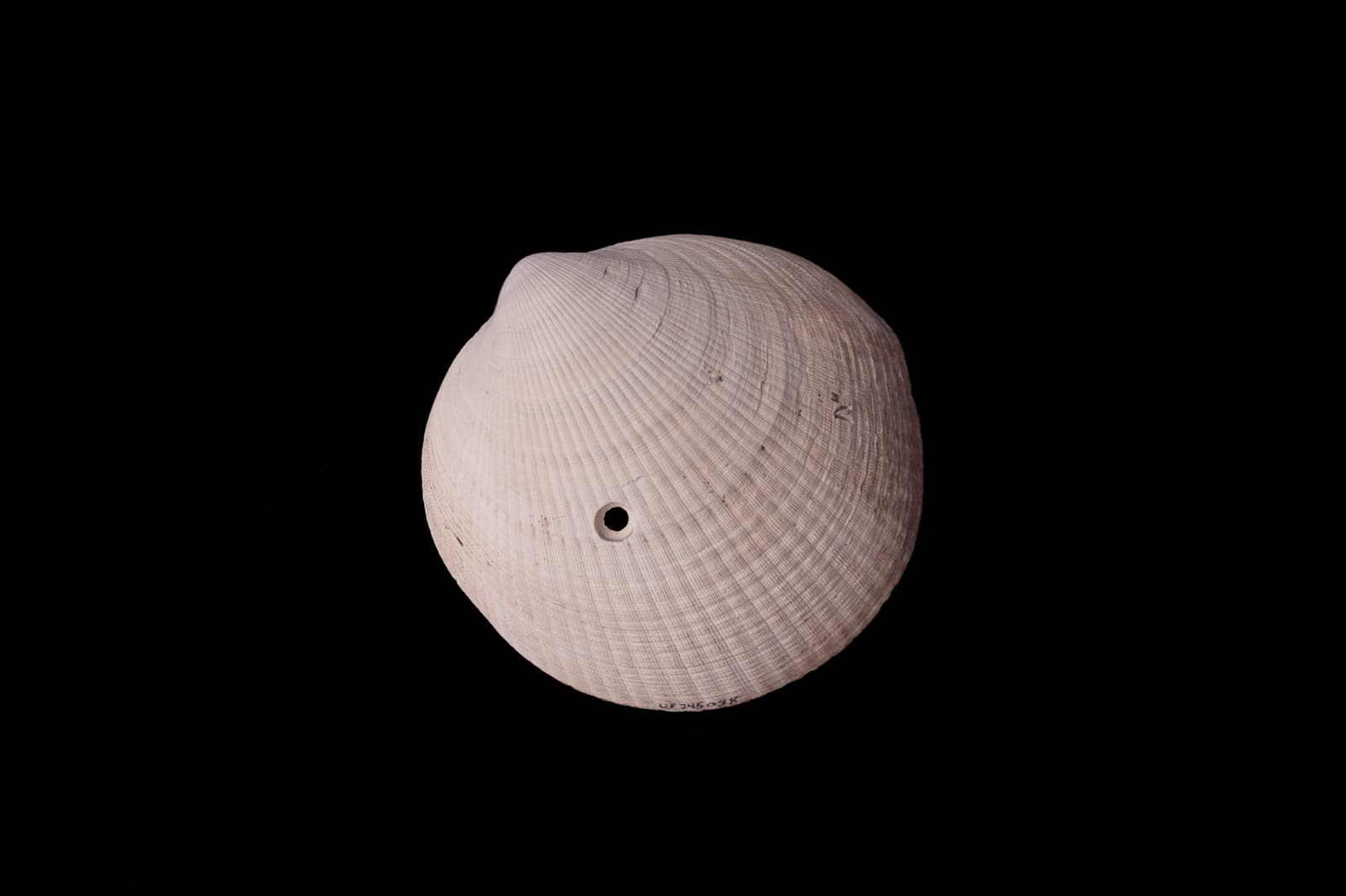
The shell has lost nearly everything that once made the scene legible. The soft animal is gone. So is the hunter. There is no seabed, no chase, no interval of waiting while a predator held its prey still. What remains is a round opening in carbonate.
That absence is exactly what gives a predatory drill hole its force. Most behavior vanishes without entering the fossil record at all. A hole can preserve one animal acting on another: an attack concentrated onto a few millimetres of shell. Across marine rocks, such traces have become one of paleontology's most abundant sources of direct evidence for predator–prey interaction.[1]
Yet “direct” does not mean self-interpreting. A complete hole may mark a consumed animal, an empty shell drilled by mistake, or damage misidentified as predation. An incomplete hole may record resistance, interruption, poor target choice, or simply a driller that stopped. Diameter can carry information about predator size; position can carry information about handling and anatomy. Counts can reveal change through time—but only after preservation, habitat, and the denominator are kept in view.[1][2]
A drill hole is therefore less like a photograph of a crime than a puncture in the case file. It preserves the act while removing the actor, the motive, and most of the sequence. Its scientific value comes from rebuilding those missing layers without pretending the hole contains them all.
Image context: the cover is a real specimen photograph of the bivalve Glycymeris americana, known as the American bittersweet. A drilling predator pierced the shell about 2.2 million years ago. The clean opening makes the trace easy to see, while the absent predator makes the interpretive problem equally visible.[7]
The hole is an event before it is a culprit
Living predatory snails show how a hard shell can be breached. Naticids, or moon snails, and muricids use a radula—a moving ribbon of tiny teeth—along with chemical secretions to weaken and rasp away carbonate. The operation leaves a circular or subcircular opening, often with a profile that widens toward the surface where drilling began. Octopuses and several smaller organisms can also perforate hard skeletons, however, and parasites, endolithic borers, abrasion, dissolution, and breakage can produce holes with different biological meanings.[1][7]
The first question is consequently not “Which predator was this?” but “Is this damage biological, and was feeding the likely purpose?” Researchers inspect the opening's outline, cross-section, wall texture, placement, relationship to shell growth, and repetition across an assemblage. Microscopic rasp marks or chemical alteration can strengthen a predatory interpretation. An irregular cavity that follows weakened shell fabric may instead reflect decay or weathering. A neat circle is suggestive; it is not a verdict.[1]
Even a biologically drilled opening may not name its maker. Naticid and muricid holes can overlap in shape, and the trace-maker's own shell may be absent. The formal trace-fossil name Oichnus describes a boring in a hard substrate, not a guaranteed species-level signature. That restraint is useful. It keeps an observable structure separate from the animal inferred to have produced it.
The fossil is strongest at its narrowest scale: something applied sustained force to this spot. Predator identity is a second claim, built from modern behavior, local fossil associations, microstructure, geometry, and alternative explanations.
A finished hole does not close the story
Paleontologists often treat a fully penetrating hole as a successful attack and an incomplete one as a failure. The distinction is productive because a completed opening generally gave a driller access to soft tissue, while an abandoned pit preserves effort without entry. But outcome and cause are not the same thing.
An incomplete hole can mean that thick shell exceeded the predator's drilling capacity. It can also mean the prey escaped, a competitor intervened, a storm disrupted the attempt, or the predator abandoned one site and began another. Two holes in one shell might record repeated failure, a restart, more than one attacker, or a second predator arriving after the first. The trace records work done to the shell; it does not automatically record why the work stopped.[1][4]
Two Neogene bivalves from the Netherlands sharpen that warning. Their holes began on the concave inner surface and progressed outward. These “reverse drill holes” were made after the valves were already empty, so they preserve unequivocal mistakes: gastropods responded to a dead shell as if food were inside. Diffuse chemical cues from dense living prey nearby may have confused them; hunger-driven haste is another hypothesis. Neither explanation is directly fossilized.[4]
The rarity matters as much as the mistake. Reverse holes made up less than one percent of drill holes in the two studied assemblages. They show that a completed-looking trace need not equal a meal, but they do not make every ordinary hole suspect. Instead, they measure one small failure rate inside a generally reliable sensory system.[4]
This is the productive tension of the evidence. Exceptions do not erase the proxy. They tell us how precisely to phrase it: a typical complete hole is evidence consistent with successful predation, not a universal receipt for consumption.
Position and diameter put behavior back onto the shell
A hole has coordinates. On a bivalve it may sit near the umbo, cross the valve wall, or hug the commissure where the two valves met. Repeated placement can imply how predators held prey, where shell was cheapest to penetrate, or where an opening offered efficient access to muscle and tissue.
Older studies often divided a shell into coarse sectors and counted hits within each. A spatial point-pattern method published in 2020 instead standardized shell shape and mapped each boring as a point. Separate case studies using fossil, beach-collected, and laboratory samples showed how the method can distinguish wall drilling from edge drilling and expose clustering that a simple “upper versus lower valve” tally would flatten. The fossil series illustrated a possible shift in favored locations; demonstrating behavioral change through time would require replicated sections and tighter control of age, geography, and environment.[3]
That pattern is behavioral evidence, but it still needs comparison. A cluster near the umbo may reflect anatomy, shell thickness, the predator's grip, or which parts of broken shells survived collection. Laboratory feeding trials and modern death assemblages provide baselines; fossil samples extend the pattern into time. Agreement among them makes site selectivity more persuasive than any isolated hole.[3]
Diameter carries a different signal. A 2017 study compiled 556 modern measurements across 14 families in five phyla and found that hole size was a robust predictor of driller body size. The researchers then examined data from 6,943 drilled fossil animals spanning roughly 500 million years. Drilled prey stayed broadly similar in size while holes occupied an increasing proportion of their shells, supporting a long-term rise in predator-to-prey size ratios.[5][7]
The opening does not identify a species, but it can preserve a scale relationship: the size of the tool relative to the target. That is a remarkable recovery from negative space. It also depends on a modern calibration and broad sampling, not on assuming that every ancient driller followed one geometry.
Counting holes means counting filters
One perforated shell is an encounter. A tray of shells can become a frequency: drilled specimens divided by all suitable prey specimens. Compare many trays across environments and ages, and the trace begins to describe ecological change.
The apparent simplicity hides several filters. A predator that sometimes swallows, pries, crushes, or attacks without drilling will leave holes for only part of its diet. A species that drills every meal produces a different relationship between hole frequency and mortality. Thin valves may break preferentially after being perforated, deleting drilled specimens from the sample. Currents can sort shells by size or strength. A single bed may mix generations of dead animals accumulated over years or millennia.[1][2]
The denominator is equally consequential. Museum drawers assembled for attractive or complete specimens do not represent the same population as bulk sediment collected and sieved without choosing individual shells. Pooling habitats can combine different predator communities. Pooling prey sizes can conceal a refuge in which juveniles are vulnerable but larger adults become too costly to drill.
Lindsey Leighton's analysis of predation proxies showed why even familiar measures resist one-line interpretations. Drilling frequency can indicate selection imposed by drilling predators, yet it does not automatically measure prey preference or total predation intensity. Repair-scar frequency is more slippery still: more healed damage could mean more attacks, better prey survival, or both. An increase can accompany either rising or falling mortality depending on how attack and escape changed together.[2]
The 2019 field review found a further historical skew. Published marine predation data were dominated by trace fossils—especially drill holes—from Cenozoic mollusks in Europe and North America. That archive is rich enough for major questions, but it is not a neutral census of all predators, prey, habitats, or intervals.[1]
Counting does not weaken the hole's evidential value. It changes the question from “Did an attack occur?” to “How representative are the attacks that survived?”
A deep-time pattern is not a single cause
Once drilling and repair frequencies are assembled across the Phanerozoic, they invite an arms-race story: predators became more effective, prey became thicker, spiny, mobile, or hidden, and each escalation drove the next. Some patterns fit that frame. The long rise in inferred driller size relative to prey is consistent with increasingly powerful predators, while defensive morphology and burrowing expanded in many marine groups.[5]
But a correlated history is not yet a causal mechanism. A 2007 analysis found that predation-trace frequency and marine diversity tracked one another over geologic time. Its authors offered three end-member explanations: ecological interactions may truly intensify as diversity grows; a more diverse biosphere may make more predatory behaviors likely to evolve and spread; or improved sampling may make both rare taxa and rare trace-producing behaviors easier to detect. The same curve could contain biology, discovery, or both.[6]
Drill holes cannot choose among those explanations alone. They need the body fossils of predators and prey, shell mechanics, environmental setting, independent diversity estimates, and sampling tests. Nor should a Phanerozoic trend be projected without inspection onto one coastline or one short interval. Scale changes the causal question.
The honest conclusion is more interesting than a universal arms race. A small mark can connect individual behavior to macroevolution, but every step changes the unit of inference: hole, shell, assemblage, habitat, interval, globe. Evidence can travel that distance only when its filters travel with it.
The missing predator is the point
The clean circle in a fossil shell feels unusually complete because it records contact. It is still a remainder. The predator's body, handling sequence, interruption risk, sensory cues, and surrounding community have been stripped away.
Paleontology recovers those layers by refusing to ask the hole for everything at once. Shape helps distinguish drilling from damage. Direction can expose a mistake. Completion constrains outcome. Position maps target choice. Diameter estimates scale. Frequencies describe populations only after collection and preservation are audited. Long curves become evolutionary arguments only when competing causes remain visible.[1][2][3][4]
A drill hole is powerful not because it restores an ancient attack whole, but because it preserves one act at unusually high resolution. The predator has been removed. The discipline lies in deciding how much of it can be put back.
Sources
- Adiël A. Klompmaker et al., “Predation in the marine fossil record: Studies, data, recognition, environmental factors, and behavior,” Earth-Science Reviews 194 (2019) — broad review of trace recognition, confounding processes, sampling, predator identity, prey defense, and geographic and taxonomic gaps in the evidence base.
- Lindsey R. Leighton, “Inferring predation intensity in the marine fossil record,” Paleobiology 28 (2002) — analysis of what drilling and repair frequencies can and cannot establish about predation intensity, preference, and size refuges.
- Alexis Rojas et al., “Spatial point pattern analysis of traces (SPPAT): An approach for visualizing and quantifying site-selectivity patterns of drilling predators,” Paleobiology 46 (2020) — open study mapping fossil, beach, and experimental drill-hole positions without reducing them to coarse shell sectors.
- Adiël A. Klompmaker and Gregory P. Dietl, “Reverse drill holes: remarkable mistakes made by gastropod predators attacking Neogene bivalve prey,” Journal of Paleontology 98 (2024) — open primary report of holes drilled from the inner surfaces of empty valves and the limits of interpreting failed attacks.
- Adiël A. Klompmaker et al., “Increase in predator-prey size ratios throughout the Phanerozoic history of marine ecosystems,” Science 356 (2017), indexed by the U.S. National Library of Medicine — modern calibration and fossil analysis linking drill-hole diameter to predator size.
- John Warren Huntley and Michał Kowalewski, “Strong coupling of predation intensity and diversity in the Phanerozoic fossil record,” Proceedings of the National Academy of Sciences 104 (2007) — open full text of the global compilation and its competing ecological, behavioral-diffusion, and sampling explanations.
- Natalie van Hoose, “Drill holes in fossil shells point to bigger predators picking on small prey,” Florida Museum of Natural History (2017) — institutional account of the size-ratio study and source page for Kristen Grace's photograph of the drilled Glycymeris fossil used as the cover image.