Mazon Creek is easy to enter through one mascot. For many readers that mascot is the Tully Monster, the soft-bodied Illinois fossil that never stops restarting classification arguments.[4][5] The stronger field reading starts earlier, with the fact that Mazon Creek is not famous because one strange animal turned up there. It is famous because a large Carboniferous deltaic system kept sealing plants and animals inside siderite concretions strongly enough that soft-bodied evidence survived where it normally would have been lost.[1][2][3]
That distinction matters because the site is older, broader, and more environmentally mixed than the mascot version suggests. The deposit sits in the Francis Creek Shale Member of the Carbondale Formation, a wedge of gray shale above the Colchester coal in what is now northeastern Illinois.[1][3] Smithsonian places it at roughly 309 million years old, in the Middle Pennsylvanian, when the region lay near the equator on Pangaea.[1] The Illinois State Museum describes the setting in landscape terms: swampy lowlands, shallow marine bays, and at least one major river system building large deltas through the coastal plain.[2]
That is why Mazon Creek still deserves a field-report frame in 2026. The site is not one swamp snapshot and not one marine basin either. It is a progradational deltaic archive whose fossils came out of creek banks, mine spoil piles, shaft mines, and strip mines across multiple counties.[2][3][4] Once that stays in view, the concretions stop looking like lucky stone eggs. They start looking like the storage format of a whole ecosystem transition.
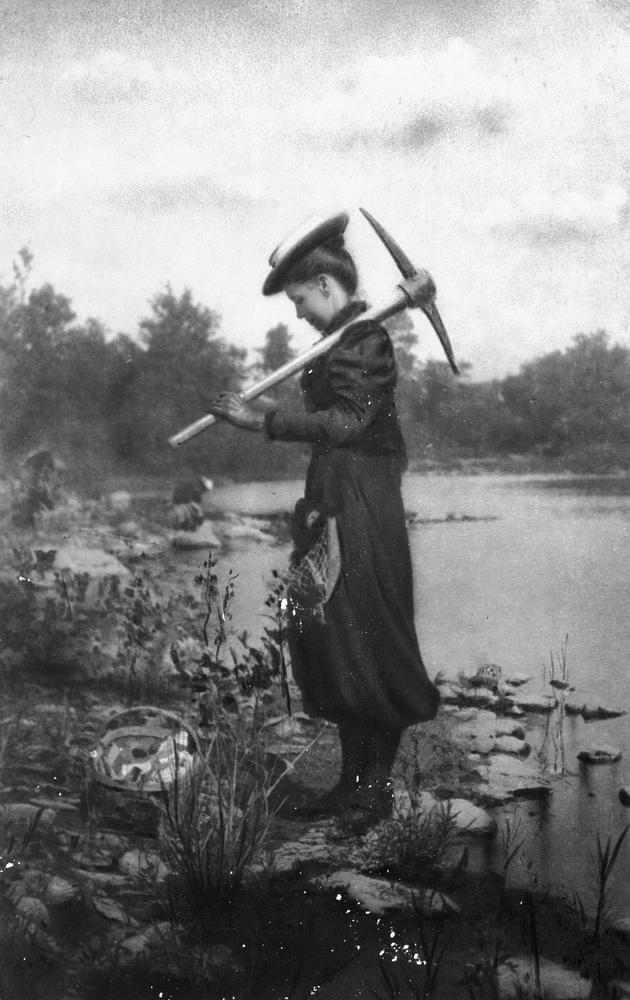
Image context: the cover uses the 1895 archival photograph of Zonia Baber collecting fossils at Mazon Creek.[6] It belongs here because this article is about how the archive was physically assembled. Mazon Creek did not become world-famous through one spectacular quarry wall. It became readable through repeated acts of collecting, splitting, and carrying nodules out of mud, spoil, and weathering exposures.
1) The deposit preserves two environmental lanes inside one shale wedge
One of the most useful corrections to the one-mascot view is that the Mazon Creek biota is divided into distinct assemblages.[2][3][4] The Illinois State Museum gives the classic broad split: the Essex fauna represents marine organisms from the shallow bays, while the Braidwood fauna consists of land and freshwater organisms washed into those bays.[2] Field Museum material refines the picture further. Its Mazon Creek flora overview describes the Francis Creek shale as a progradational deltaic sediment containing a terrestrial and freshwater Braidwood Biota alongside a more open-water, prodelta-estuary, storm-affected Essex Biota.[3]
The Field Museum's history page then sharpens that into three paleoenvironments identified through Gordon Baird's census work: a euryhaline estuarine Essex assemblage, a low-diversity freshwater association, and a terrestrial association of swamp, levee, and floodplain plants and animals.[4] The freshwater and terrestrial pieces together make up Braidwood.[4] That structure matters because it prevents the site from collapsing into a single Carboniferous mood. Mazon Creek is not just a coal-swamp plant deposit, and it is not just a marine soft-bodied fauna. It preserves a delta system where river influence, bay water, and nearby land all left different signatures inside the same regional archive.[2][3][4]
This is also why the site has unusual narrative force. A reader can move from jellyfish, worms, shrimp-like crustaceans, and fish on the Essex side to insects, spiders, millipedes, amphibians, freshwater horseshoe crabs, and seed ferns on the Braidwood side without leaving the same named deposit.[2] The field-report value sits exactly there. Mazon Creek shows how much environmental sorting can be compressed into one shale member if the preservational format is good enough.
2) The siderite concretion is the real preservational machine
The reason that compression worked is not mystery. It is early diagenesis under the right sedimentary conditions.[2][3] The Illinois State Museum's formation summary is unusually clear: plants and animals living in the bays, and others washed in from the rivers and swamps, were rapidly buried by mud. As bacteria decomposed the remains, carbon dioxide formed in the surrounding sediment and combined with iron in groundwater to make siderite, the ironstone that armored the fossils against further damage.[2]
That mechanism is the hinge of the whole site. In ordinary fossil deposits, hard parts dominate because soft tissues and unmineralized bodies are destroyed before lithification can lock them in.[2] Mazon Creek's concretions changed that timing.[1][2] Smithsonian's collection page stresses that the fossils are best known from siderite nodules that usually must be cracked open to expose the organism inside.[1] The Illinois State Museum adds the deeper implication: unique fossilization conditions meant that softer parts were often preserved, and many soft-bodied organisms that do not usually fossilize could still enter the record.[2]
Once you think in those terms, the concretion becomes more important than any individual celebrity taxon. The nodule is not just a container discovered after the fact. It is the preservational event made solid. The fossil and its ironstone shell are parts of the same argument about burial speed, microbial chemistry, and the moment when decay lost the race.[1][2][3]
3) Mazon Creek became a scientific archive because collectors kept rescuing nodules
The second half of the story is human, and the archival image makes that hard to miss.[6] Smithsonian notes that fossils have been excavated from the banks of Mazon Creek since the 1840s, with scientific papers following by about 1855.[1] The scale changed later, when mining opened far more material. Field Museum and IUGS both point to the era of strip mining as the great expansion phase: collecting localities multiplied, private and institutional collections surged, and Mazon Creek moved from notable locality to global reference archive.[4][5]
That collector history is not incidental. Smithsonian says tens of millions of fossiliferous concretions were rescued from weathering or reburial by collectors, and that large collections spread to museums across the United States and beyond.[1] Field Museum's own history page is even more concrete. Baird and his collaborators sampled 350 localities over roughly 200 square kilometers, hauled sacks of nodules back to Chicago, and used freeze-thaw buckets on the museum roof to split them more efficiently than hammer work would allow.[4] In total, they collected more than 285,000 nodules.[4]
That anecdote matters because it tells you what kind of field site Mazon Creek really is. The deposit does not yield its value in one dramatic face or one protected trench. It yields it through volume, patience, and repeated opening of small ironstone packages. Even the older phase visible in the Zonia Baber photograph belongs to that same logic.[6] The scene is modest: crouching, picking, carrying. The archive grows by accumulation.
This is also why Mazon Creek has remained legible after many classic collecting grounds were lost or overgrown.[4][5] The site's scientific afterlife depends on the fact that collectors and museums converted dispersed nodules into curated comparative memory. Without that transfer from field to drawer, many of the site's soft-bodied surprises would still be sealed shut or long weathered away.
4) Why the site still matters in 2026
IUGS now describes the Field Museum's Mazon Creek collection as the definitive resource for researchers, educators, and the public, with nearly 65,000 specimens and continuing publication activity.[5] That status is earned because the deposit remains strong in three directions at once. It is a paleoecology archive, because the Essex-Braidwood split preserves environmental structure.[3][4] It is a taphonomy archive, because concretions preserve the chemistry and timing of exceptional fossilization in unusually direct form.[1][2] And it is a systematics archive, because many organisms found there are rare, soft-bodied, or otherwise hard to capture in standard fossil records.[1][5]
The result is that Mazon Creek stays valuable even after the collector golden age has narrowed.[4] New technology can keep extracting information, but the deposit's deeper gift is older than any scanner. It is the combination of delta mud, rapid burial, siderite growth, and collector labor that turned one Pennsylvanian coastline into portable evidence.
So the right way to read Mazon Creek is archive first, mascot second. The Tully Monster can remain the doorway.[4][5] The concretions are the structure holding the building up.
Sources
- Smithsonian National Museum of Natural History, "Mazon Creek Fossil Flora."
- Illinois State Museum, "About the Mazon Creek Fossils and Deposits."
- Field Museum, "Mazon Creek Flora."
- Field Museum, "Fossil Invertebrates - History" - Mazon Creek collecting, assemblages, and curation history.
- IUGS GeoCollections, "Mazon Creek Fossil Collection."
- Wikimedia Commons, "File:Zonia Baber collecting fossils 1895.jpg" - archival photograph source page for the article image.