Macrauchenia patachonica is one of those extinct mammals that arrives in the imagination already bent out of shape. It is commonly introduced as a cross between a llama and an elephant, sometimes with a camel added to the sentence for good measure.[1] The comparison is understandable and scientifically lazy. A stronger species profile begins with the fact that Macrauchenia was the last and best-known member of the litopterns, a South American mammal lineage with its own history, its own three-toed limb design, and its own long-necked solution to herbivory.[1][4]
That matters because the familiar analogy hides the animal's actual coherence. The retracted nasal opening is real. The long neck is real. The three toes are real. The molecular result linking litopterns to Perissodactyla is also real.[1][2][3][4] What turns the profile back into science is keeping those features together instead of treating the skull opening as an excuse to draw a miniature elephant on camel legs. Macrauchenia was stranger than the shortcut and more orderly than it sounds.
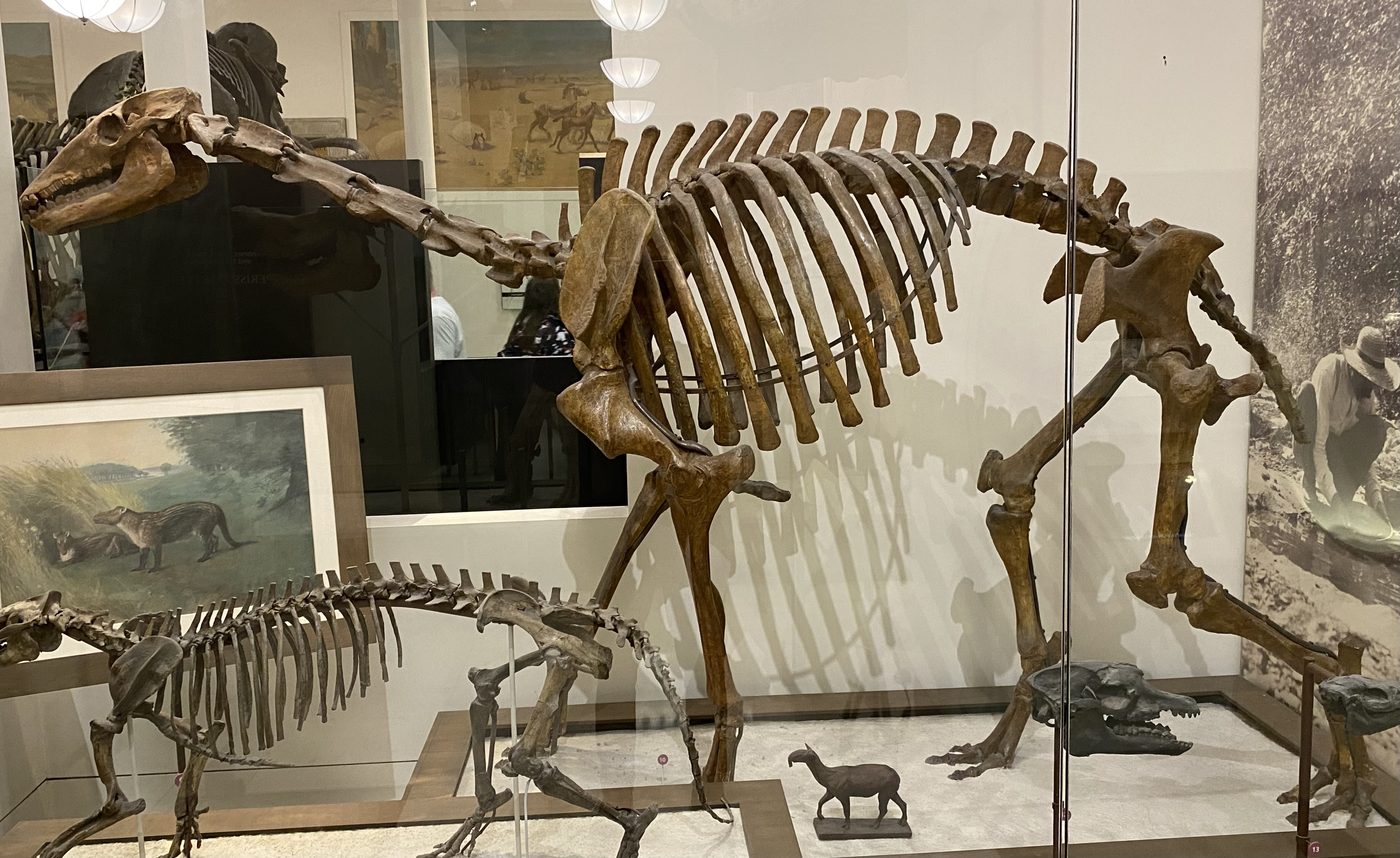
Image context: the cover uses a real Wikimedia Commons photograph of a mounted Macrauchenia skeleton at the American Museum of Natural History.[7] It belongs here because this profile turns on body coherence. One glance shows the long neck, the relatively narrow head, the depth of the torso, and the limb proportions that make the animal read as a distinct litoptern rather than as a collage assembled from living mammals.
1) The body plan is the first correction
The Natural History Museum's overview is a good place to start because it preserves the historical mistake and the anatomical fix in the same frame.[1] Richard Owen first described the species from Darwin's finds and called it a "giant llama" after noticing a camelid-like feature in the neck vertebrae.[1] The comparison did not hold. Macrauchenia had three toes, unlike the two-toed camels, and later discoveries made clear that it was the last surviving member of a much larger litoptern radiation rather than a camel cousin wandering through the South American Ice Age.[1]
The 2023 Swiss Journal of Palaeontology paper sharpens that correction. Püschel and Martinelli describe macraucheniids as litopterns with three-toed feet, elongated necks, and a trend toward retraction of the nasals, and they place M. patachonica as the last and best-known macraucheniine spanning much of Pleistocene South America.[4] Their paper also gives useful body-mass bounds, roughly 830 to 1100 kilograms, which makes the animal large enough that posture and feeding height were not ornamental questions.[4] The profile stops being whimsical at that point. You are dealing with a big open-country herbivore whose strange face belonged to a stable postcranial design.
This is also why the "llama-elephant" sentence is too cheap. It keeps only the visual shock. It loses the lineage, the feet, and the scale.
2) The neck carried a real functional program
The long neck is not just what gave the genus its name. It carried a functional burden. Blanco, Yorio, and Montenegro's 2023 neck-posture study treats Macrauchenia as unusual among endemic South American ungulates precisely because of its elongated cervical series.[5] Their biomechanical reconstruction concluded that a vertical posture best satisfies the requirement of nearly constant stress along the neck joints, which suggests an upright posture frequently used during feeding or standing.[5]
That result becomes more interesting because the paper does not stop there. The same authors argue that Macrauchenia probably used different neck positions for different tasks: a more upright posture for browsing or scanning, but an almost horizontal articulation during fast locomotion.[5] In other words, the neck was not a decorative giraffelike flourish attached to an otherwise ordinary ungulate trunk. It was part of a flexible mechanical system that changed how the animal met food and movement.[5]
That is the second major correction to the cartoon version. Macrauchenia is easier to understand once the neck is read as a working structure rather than as an odd silhouette. The animal could carry height when it needed reach, then streamline the neck when speed mattered. That is a more disciplined and more vivid profile than a generic "South American camel with a trunk."
3) The nose is a boundary, not a license
No feature pulls Macrauchenia back toward fantasy faster than the nasal opening high on the skull. The anatomical fact is secure. The Swiss paper states that the most distinctive common feature of macraucheniines is a retracted nasal aperture that suggests the presence of a proboscis.[4] The 2020 Quaternary Science Reviews paper is equally plain in its opening description, noting that Macrauchenia had nostrils on the top of the skull, posterior to the orbits.[6]
But that is exactly where a useful profile has to slow down. The fossil preserves the bony opening, not the full soft tissue. The strongest claim is that Macrauchenia carried an enlarged, retracted snout region of some kind, and that the old reconstructions were not inventing the feature from nothing.[4][6] The weaker claim, and the one popular art often slides into, is that we can restore a neat little elephant trunk with far more confidence than the bones actually permit.
That boundary improves the animal instead of shrinking it. A retracted nasal aperture already tells us the head was functionally unlike that of horses, camels, or tapirs in any simple one-to-one way.[4] The point is not to subtract strangeness. The point is to keep the strange part attached to evidence.
4) The lineage problem is no longer the mystery it used to be
For a long time, the biggest intellectual problem around Macrauchenia was not its face but its family tree. Welker and colleagues' 2015 Nature paper used ancient collagen to show that Macrauchenia and Toxodon form a group whose sister taxon is crown Perissodactyla rather than Afrotheria.[2] That mattered because South American native ungulates had long been one of mammalian evolution's most stubborn placement problems.[2]
Westbury and colleagues pushed the picture further in 2017 by recovering mitochondrial data from Macrauchenia patachonica and supporting litopterns as closely related to living odd-toed ungulates, with the split estimated around 66 million years ago.[3] The result does not make Macrauchenia a horse or a tapir in disguise. It does something better. It moves the animal out of the older taxonomic fog while preserving the fact that its body plan was still a South American experiment with no living twin.[2][3]
This is why the species profile gets cleaner once the lineage is in place. The neck, the feet, and the face stop looking like arbitrary borrowed parts. They become one branch's own solution to large-bodied herbivory on an isolated continent.
5) Ecology and extinction sharpen the final picture
The ecological signal is also tighter than older portraits suggested. The 2020 Quaternary Science Reviews study reconstructed dietary habits and ecological niches for late Quaternary macraucheniids and concluded that M. patachonica had grazing feeding habits.[6] The paper also argued that Macrauchenia could live in colder temperatures and arid subtropical to temperate ecosystems, distinguishing it from Xenorhinotherium even though both genera showed similar feeding habits.[6]
That finding helps the species profile end in the right place. Macrauchenia was not an abstract South American curiosity wandering through every habitat equally well.[6] It was a large grazer tied to a particular climatic envelope late in the Quaternary. The Natural History Museum page is correspondingly careful about extinction: climate change and its effects on vegetation were almost certainly part of the story, even if the exact causes cannot be compressed into one tidy sentence.[1]
That is enough to hold the whole animal together. Macrauchenia deserves attention because it shows what paleontology looks like when spectacle is trimmed back just enough for design to reappear. The long neck, the three-toed limbs, the retracted nasal opening, the litoptern history, and the cooler open-country ecology all belong to the same body. Once that body comes into focus, the old llama-elephant analogy feels less like a helpful doorway than like a habit worth leaving behind.
Sources
- Natural History Museum, "What was Macrauchenia?"
- Frido Welker, Matthew J. Collins, Jessica A. Thomas, and colleagues, "Ancient proteins resolve the evolutionary history of Darwin's South American ungulates." Nature 522 (2015).
- Michael Westbury, Frido Welker, Ross D. E. MacPhee, and colleagues, "A mitogenomic timetree for Darwin's enigmatic South American mammal Macrauchenia patachonica." Nature Communications 8 (2017).
- Hans P. Püschel and Agustín G. Martinelli, "More than 100 years of a mistake: on the anatomy of the atlas of the enigmatic Macrauchenia patachonica." Swiss Journal of Palaeontology 142 (2023).
- R. E. Blanco, Lara Yorio, and Felipe Montenegro, "Reconstruction of the cervical skeleton posture of the recently-extinct litoptern mammal Macrauchenia patachonica Owen, 1838." PalaeoVertebrata 46, no. 1 (2023).
- Karoliny de Oliveira, Thaísa Araújo, Alline Rotti, and colleagues, "Fantastic beasts and what they ate: Revealing feeding habits and ecological niche of late Quaternary Macraucheniidae from South America." Quaternary Science Reviews 231 (2020).
- Wikimedia Commons, "File:Macrauchenia skeleton at AMNH.jpg" - source page for the article image.