The modern hand carries too much narrative baggage backward into deep time. Once readers hear that Acanthostega had digits, the mind wants to finish the story automatically: fingers appear, feet firm up, the shoreline finally wins.[1][2] The cleaner lineage story begins one step lower. Elpistostege shows hand-like skeletal patterning assembling inside a fin; Acanthostega then shows true digits in a stem tetrapod whose limbs still worked more like broad aquatic paddles than dependable walking feet.[1][2][3][4]
That is why the Elpistostege-to-Acanthostega interval remains one of the most clarifying stretches in vertebrate history. Coates and Clack's 1990 paper made the famous point that the forelimb carried eight digits, and that the layout of those digits did not look like a compact terrestrial hand.[1] Jenny Clack's later synthesis pushed the implication harder: the wrist was not an ossified, supportive platform, the digits likely sat in a web, and the limb as a whole read as an aquatic structure.[2] Then the sequence below it sharpened. In 2020, Elpistostege showed how much of the vertebrate hand had already assembled inside an elpistostegalian fin before full tetrapod limbs appeared.[4] Put those pieces together and the message becomes difficult to evade. Digits, walking, and terrestriality are related events, but they are not the same event.[1][2][4]
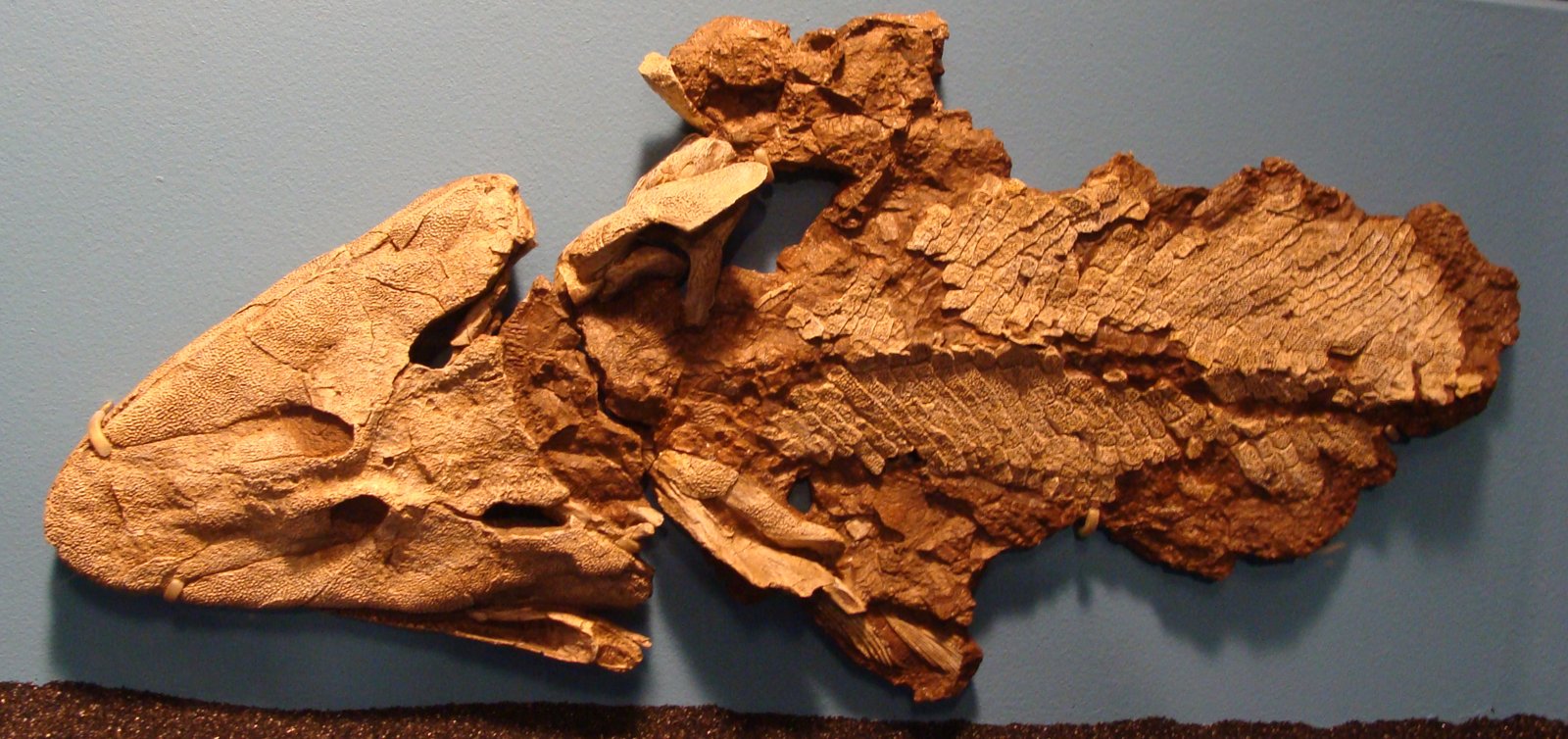
Image context: the cover now uses a real photograph of a Tiktaalik fossil slab from Wikimedia Commons.[5] That keeps the visual field inside the fish-to-tetrapod transition while avoiding the old explanatory artwork problem. The article still turns on Elpistostege and Acanthostega, but a real fossil surface is the right visual grammar for a lineage essay about anatomical sequence.
1) Digits did not debut here as a solved walking system
The cleanest thing Acanthostega still teaches is negative: digits do not automatically mean land gait.[1][2] The 1990 Nature paper described eight digits in the forelimb and treated the early polydactyl condition as evidence that the oldest digited limbs were operating under a different developmental and functional regime from later pentadactyl tetrapods.[1] Just as important, the paper argued that the limb morphology fit an aquatic setting rather than a terrestrial one.[1]
Clack's 2009 review made the anatomical consequences more readable.[2] The digits were arranged in a broad arc, probably held within a web of skin, while the wrist failed to produce the compact, flexible, load-bearing unit that readers tend to import from modern amphibians, reptiles, mammals, or birds.[2] The ankle tells a similar story. Its bones were ossified, but not in a way that yielded an obvious joint surface for a conventional step cycle on land.[2] In Clack's formulation, the limb was effectively a paddle.[2]
That distinction matters because it resets what the first digits are for. If the earliest well-understood digited limbs are broad, webbed, and mechanically weak at the wrist for full support, then the hand did not arrive as a ready-made terrestrial tool.[1][2] It arrived inside an animal still committed to water. The shoreline is in the story, but it is not yet the master of the story.
2) The lineage becomes clearer once Elpistostege sits below Acanthostega instead of behind it
One reason Acanthostega keeps getting misread is that it is often treated as the moment the hand suddenly appears.[2][4] The 2020 Nature paper on Elpistostege makes that reading harder to sustain. Richard Cloutier and colleagues showed that a fish still carrying a fin was already hiding a remarkably tetrapod-like distal skeleton inside it, to the point that the vertebrate hand reads less like a dramatic invention and more like a skeletal pattern being uncovered and reorganized across the fish-tetrapod transition.[4]
That result does not reduce Acanthostega's importance. It relocates it. Elpistostege shows that hand architecture was being assembled below the threshold of obvious tetrapod limbs.[4] Acanthostega shows that once that threshold is crossed, the first digited limb still does not have to be a good walking limb.[1][2] The sequence is therefore more interesting than a triumphal march from fin to foot. First the distal skeleton becomes hand-like inside a finned animal.[4] Then digits appear clearly in a tetrapod whose limbs still behave like aquatic surfaces.[1][2] Only later do terrestrial support and habitual walking become the dominant reading.
This is why lineage context matters more than a single famous skeleton. Acanthostega is not "the first walker with fingers." It is one of the clearest fossils for separating the origin of digits from the origin of confident locomotion on land.[1][2][4]
3) The 2016 growth study makes the aquatic delay harder, not easier, to ignore
The 2016 synchrotron study added a different kind of constraint.[3] Sanchez and colleagues showed that the best-known Acanthostega sample is a mass-death assemblage and that the known individuals are all juveniles, even though the largest had reached at least six years of age.[3] The finding does not turn Acanthostega into a mystery animal. It narrows the way we should talk about it.
Nature's editorial summary put the bigger point plainly: although Acanthostega had limbs with digits, everything known about it still suggested an obligately aquatic animal.[3] That matters because it blocks a familiar escape route. Readers sometimes grant that the limbs look aquatic, then quietly assume the adults must have solved the terrestrial problem offstage. The 2016 paper does not license that shortcut. It tells us that the famous digited tetrapod we know best is still anchored in water, and that the sample itself should make us cautious about projecting a full land lifestyle onto it.[3]
In other words, the delay between digits and walking is not a verbal flourish imposed by later commentators. It is built into the evidentiary record as we currently have it.[1][2][3]
4) Why this two-fossil sequence still matters
Acanthostega still matters, but it matters best when it is read alongside Elpistostege. Together they stop one of evolution's most overcompressed stories from becoming a cartoon. The old popular script made the fish-tetrapod transition look like a single dramatic landing. The better fossil sequence is slower and more modular.[2][4] Fin skeletons near the tetrapod boundary were already acquiring structures that anticipate the hand.[4] A digited limb then appears in Acanthostega, but the limb still reads as a webbed aquatic apparatus rather than a dependable terrestrial foot.[1][2] Only after that does the longer problem of walking, support, and routine life on land become dominant.
Clack's review ends near exactly that boundary. The origin of limbs with digits, the origin of walking and terrestriality, and the origin of tetrapods in the strict crown-group sense may be three different historical problems rather than one moment.[2] Acanthostega is the fossil that makes that sentence memorable. It does not give us the first clean step onto land. It gives us a body in which digits have arrived before the land answer has stabilized.
That is a better lesson than a heroic shoreline tableau. Evolution often builds the pieces before it settles the use. Acanthostega keeps that order visible.
Sources
- Michael I. Coates and Jennifer A. Clack, "Polydactyly in the earliest known tetrapod limbs," Nature 347 (1990).
- Jennifer A. Clack, "The Fish-Tetrapod Transition: New Fossils and Interpretations," Evolution: Education and Outreach 2 (2009).
- Sophie Sanchez, Paul Tafforeau, Jennifer A. Clack, and Per E. Ahlberg, "Life history of the stem tetrapod Acanthostega revealed by synchrotron microtomography," Nature 537 (2016).
- Richard Cloutier, Alice M. Clement, Michael S. Y. Lee, and colleagues, "Elpistostege and the origin of the vertebrate hand," Nature 579 (2020).
- Wikimedia Commons file page for the photographed Tiktaalik fossil slab used as the article image.