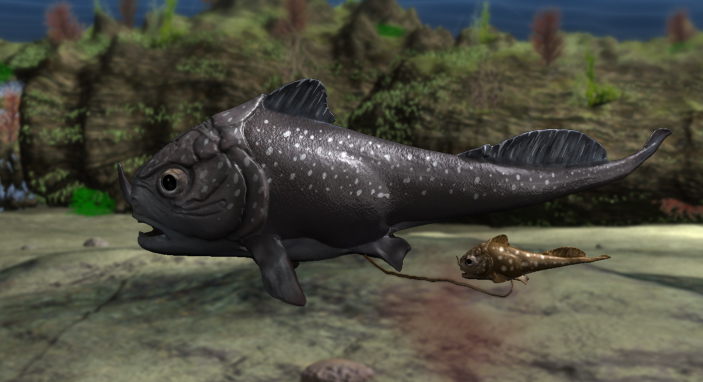
Materpiscis attenboroughi is easy to flatten into a single headline: the oldest known vertebrate to give live birth.[1] That line is true, but it is weaker than the fossil itself. What made the 2008 Gogo Formation specimen so disruptive was not a general idea about reproduction. It was the fact that one Late Devonian placoderm, about 380 million years old, preserved a mother, a single intra-uterine embryo, and a permineralized umbilical cord in the same three-dimensional fossil.[1][4] Paleontology rarely gets reproductive evidence with that much internal structure left intact. In this case, the specimen did not merely imply viviparity from association. It preserved the relationship.
That difference matters because reproductive claims in fossils are usually easiest to sensationalize and hardest to stabilize. Eggs can be laid near a skeleton after death. Small bones can be mistaken for gut contents, debris, or later intrusion. A broad evolutionary story can be attached too quickly to one dramatic specimen. Materpiscis became scientifically durable because the evidence chain was narrower and better locked than that. The embryo was preserved within the mother, and the mineralized cord gave the argument a physical hinge.[1] Once that hinge held, placoderm reproduction stopped looking like an abstract possibility and started looking like direct vertebrate history.
Image context: the lead image uses a real photograph of the Materpiscis fossil from Museum Victoria, preserved on Wikimedia Commons. It belongs here because this article is about specimen logic. The slab makes the central claim visible at once: reproductive evidence is being read from one body, not assembled from separate finds.[5]
The fossil preserves a reproductive scene, not just a surprising anatomy fact
John Long and colleagues described Materpiscis in Nature as a new ptyctodontid placoderm from the Gogo Formation of Western Australia.[1] The geological setting is already famous because Gogo fish are preserved in extraordinary three-dimensional detail, often retaining structures that flatter compressed fossils usually destroy.[4] That background matters. If the fossil came from a poorer preservational setting, the claim would be easier to challenge. At Gogo, soft-tissue-related structures and delicate internal relationships have a better chance of surviving long enough to be mineralized and recognized.[1][4]
The embryo therefore does more than add emotional drama to a fish fossil. It changes the kind of statement paleontologists are allowed to make. A fossil adult with eggs nearby can support a reproductive hypothesis. A fossil adult with an embryo inside the body cavity is stronger. A fossil adult with an embryo and a mineralized umbilical cord moves into another evidentiary class again.[1] The specimen preserves sequence and attachment, which are exactly the features that keep a reproductive interpretation from drifting into narrative convenience.
This is why Materpiscis is strongest when read as a scene. The fossil does not say only that live birth existed. It shows how one embryo occupied the mother's body and remained physically connected during gestation.[1] In other words, the force of the fossil comes from arrangement, not just from identity.
The umbilical cord is the hinge of the whole argument
The preserved cord is what prevents the specimen from collapsing into a weaker "pregnant fossil" anecdote.[1] Without that structure, skeptics would have more room to ask whether the young fish had been swallowed, whether the position was post-mortem coincidence, or whether the small skeleton represented some other relationship altogether. The cord sharply reduces those escape routes because it ties embryo and mother together in a way gut contents do not imitate well.[1]
That is also why the specimen deserves restraint in how it is described. The important claim is not that Devonian placoderms had mammalian-style pregnancy in every sense, or that Materpiscis somehow anticipated modern reproductive biology whole. The important claim is narrower and stronger: this placoderm provides direct evidence of viviparity and maternal-embryonic connection in an early jawed vertebrate.[1] Narrow claims survive better in paleontology because they stay attached to what the fossil really preserves.
The Gogo context strengthens this reading rather than replacing it. The Western Australian Museum's summary of the site notes that some Gogo fish preserve soft tissues and even, in one case, an umbilical cord.[4] That reminder is useful because it keeps the fossil inside a real preservational regime. Materpiscis is extraordinary, but it is not miraculous in a vacuum. It comes from a formation unusually capable of holding delicate biological information long enough for science to recover it.
Placoderm reproduction stopped looking primitively simple
Another reason Materpiscis keeps its value is that later work widened the reproductive frame instead of isolating it as a one-off curiosity. In 2009, Long and colleagues reported embryos in the arthrodire placoderm Incisoscutum ritchiei, also from Gogo, and argued that placoderms already showed internal fertilization in more than one lineage.[2] That mattered because Materpiscis could then be read as part of a reproductive pattern, not merely as an improbable accident attached to one small ptyctodont.
The frame widened again in 2015, when Long and coauthors described copulation structures in antiarch placoderms and argued that internal fertilization may have deeper roots in jawed-vertebrate history than older external-spawning-first narratives allowed.[3] That does not mean every placoderm reproduced the same way. It does mean the old intuition that very early jawed vertebrates must have had only simple, fully external reproductive systems became harder to defend once fossils began preserving embryos and claspers in multiple placoderm groups.[2][3]
This is where Materpiscis becomes more than a record holder. The fossil belongs to a shift in how vertebrate reproductive evolution is pictured. Instead of a straight ladder from primitive egg release to later internal complexity, the placoderm record starts to look branching, experimentally diverse, and older than the textbook caricature.
What the fossil can and cannot prove
The specimen is powerful, but its boundaries matter. Materpiscis does not prove that live birth was universal among placoderms.[1][2] It does not prove that internal fertilization was primitive for all jawed vertebrates beyond further debate.[3] It does not give a full account of gestation length, brood size across the clade, or how widespread placental-style nourishment was. One specimen, however beautiful, cannot do that much work.
What it can do is already substantial. It can show that by the Late Devonian, at least one placoderm lineage had evolved internal fertilization and live-bearing reproduction with a preserved maternal connection.[1] It can anchor broader placoderm reproductive discoveries in something visual and concrete.[2][3] And it can remind paleontology readers that the best fossils are not always the ones that look most cinematic at first glance. Sometimes the deepest shift comes from a body that preserved a relationship well enough to survive argument.
That is why Materpiscis remains one of the sharpest fossil finds in vertebrate paleontology. Its importance does not rest on a vague claim that "motherhood existed early." It rests on a bounded specimen in which embryo, cord, and maternal body stayed together long enough to turn a reproductive hypothesis into direct evidence.[1][2][3][4]
Sources
- John A. Long et al., "Live birth in the Devonian period," Nature 453 (2008).
- John A. Long et al., "Devonian arthrodire embryos and the origin of internal fertilization in vertebrates," Nature 457 (2009).
- John A. Long et al., "Copulation in antiarch placoderms and the origin of gnathostome internal fertilization," Nature 517 (2015).
- Western Australian Museum, "Gogo Fish."
- Wikimedia Commons file page for the photographed Materpiscis fossil used as the lead image.