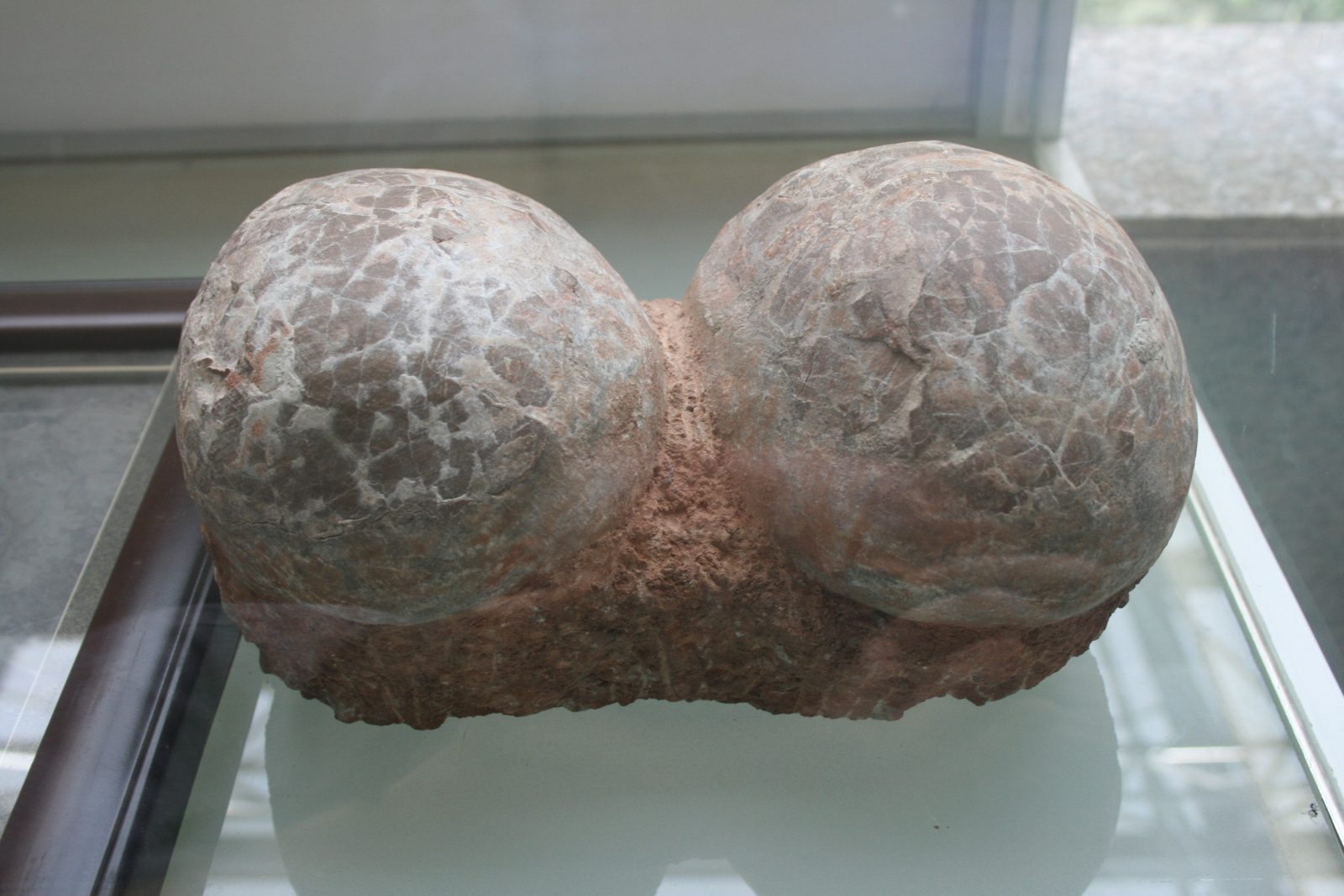
Fossil eggs are easiest to romanticize when they are least informative. A single rounded object in a display case invites the same thought every time: was there a baby dinosaur inside? Sometimes there was. More often, what survives and matters most is the shell itself. That shell is not decorative stone. It is a respiratory surface, a microbial boundary, a humidity regulator, and, when preserved in place with other eggs, part of a nesting system.[1][2][3]
That is why dinosaur eggs become stronger evidence when they are read less like miniature skeleton containers and more like environmental devices. Eggshell microstructure can say something about gas exchange and incubation setting. Clutch geometry can say something about laying sequence and parental posture. Sediment around the clutch can say whether the eggs were buried, partly exposed, or repeatedly reworked before fossilization.[1][2][4][5] Break those layers apart, and the egg becomes novelty. Keep them together, and it becomes paleobiology.
Image context: the cover uses a real photograph of fossil dinosaur eggs on display in the Kunming City Museum from Wikimedia Commons.[6] It is the right image for this piece because the article is not about one miraculous embryo reveal. It is about how multiple eggs, preserved together, force shell and arrangement to be read as one system.
1) Eggshell is the first archive, not the last residue
Shaena Montanari's 2018 review remains the cleanest place to start because it treats eggshells as information-rich material in their own right.[1] Eggs and eggshells, she argues, are useful substrates for reconstructing environment, ecology, and biology across deep time because their structure preserves more than shape alone.[1] Pore systems, mineral layers, organic residues, and diagenetic alteration all matter. In fossils, shell fragments are often what endure even when embryos do not.[1]
That changes the order of attention. A body fossil usually asks who the animal was first and what setting it lived in second. Eggshell often reverses that sequence. It asks what sort of nest environment this shell had to function in, what sort of gas exchange it supported, and whether the preserved microstructure is original or altered by burial chemistry.[1] The shell therefore behaves less like a prop and more like a record of incubation constraints.
This is also why fossil eggs cannot be read honestly from outline alone. Montanari emphasizes that morphological work on shell characteristics becomes powerful only when combined with context and diagenetic screening.[1] A beautiful egg shape in isolation may be memorable, but the scientific value usually sits in the wall of the shell, the pores that puncture it, and the sedimentary setting that explains why those pores took the form they did.[1][2]
2) Pores turn eggs into humidity arguments
The strongest modern bridge between eggshell structure and nest behavior is the 2015 PLOS One study by Tanaka, Zelenitsky, and Therrien.[2] Their key move was methodological discipline. Instead of leaning on older one-to-one comparisons between dinosaur eggs and living birds, they tested eggshell porosity against nest type across a broad extant archosaur dataset and then used that relationship to infer nest styles in extinct taxa.[2]
The basic logic is elegant. Covered nests keep eggs in wetter, more enclosed conditions, while open nests expose eggs to a different humidity regime.[2] Because gas exchange must still work, pore geometry becomes part of the adaptation. Tanaka and colleagues argue that eggshell porosity can therefore be used as a proxy for nest type when the comparison is handled statistically rather than impressionistically.[2]
Their results matter because they make dinosaur nesting look less uniform. Covered nests were likely primitive for dinosaurs, while open nests evolved later among more derived theropods.[2] Titanosaurs and Lourinhanosaurus plot closer to covered nesting conditions, whereas oviraptorosaurs and Troodon point toward more open nesting strategies.[2] Even there, the story is not simply "bird nest achieved." The paper notes that basal open nesters such as oviraptorosaurs and troodontids still seem to have partially buried their eggs in sediment, with fully exposed eggs becoming widespread only later among euornithine birds.[2]
That distinction is easy to miss in popular retellings. Dinosaur reproduction is often flattened into a single evolutionary arrow toward modern bird brooding. The porosity evidence says something narrower and more useful: exposure, burial, and brooding were mixed and transitional, and eggshell was one of the places where that transition got written down.[2]
3) Cuticle shows that shell function did not end with calcite
If pores tell us about exchange, cuticle tells us about protection. Yang and colleagues' 2018 PeerJ study on fossil eggshell cuticle pushed this point forward by reporting the first direct chemical evidence for preservation of the cuticle layer on dinosaur eggshells.[3] In living birds, that outer cuticle helps prevent dehydration and microbial invasion while also interacting with pigmentation and reflectance.[3] The paper matters because it shows that some dinosaur eggshells preserved more of their original functional envelope than paleontologists had long assumed.
That does two things at once. First, it expands what eggshell can preserve. Dinosaur shell is not just a mineral tube with holes; in some cases it retains traces of the outer barrier that managed real biological risk during incubation.[3] Second, it sharpens ecological inference. Yang and coauthors argue that cuticle structure can be traced back into maniraptoran dinosaurs and that this feature likely improved reproductive success in warm, mesic settings.[3]
In practical reading terms, cuticle evidence is a warning against treating shell thickness as the whole story. A fossil egg is not only a pressure vessel. It is also a surface built to negotiate moisture, microbes, and the outside world while the embryo is still alive.[1][3] Once that is clear, the shell starts looking less like a ceramic remnant and more like a preserved interface between body and nest environment.
4) Clutch geometry is where behavior stops being guesswork and starts being constrained
The history of Oviraptor is the classic lesson in why arrangement matters. The American Museum of Natural History recounts that the first famous eggs found at Mongolia's Flaming Cliffs in 1923 were initially thought to belong to Protoceratops because that dinosaur was common at the site.[4] Later discoveries of identical eggs, including one containing an oviraptor-like embryo, reversed the old story: Oviraptor was no longer an egg thief leaning over someone else's nest, but a parent associated with its own eggs.[4]
That reversal did not come from shell chemistry alone. It came from shell plus clutch association plus embryo evidence.[4] The same principle appears in the Western Australian Museum's summary of oviraptor nests: elongated eggs laid two at a time, arranged in a ring in a bowl-shaped nest, probably over a period of weeks, with shell properties suggesting they were unlikely to have been fully buried.[5] In that arrangement, the clutch itself starts constraining how the adult could have sat, incubated, or guarded it.[2][5]
This is the larger point. A single fossil egg may tell you that some dinosaur laid a mineralized shell. A clutch with repeated geometry tells you about sequence, posture, exposure, and timing.[2][4][5] Paleontology becomes stronger exactly where the eggs stop behaving like isolated collectibles and start behaving like a laid structure.
5) Site context decides whether an egg is a reproductive fossil or just an object
The same Western Australian Museum page makes the contrast with sauropods especially clear.[5] Sauropod nests are described there as elongated pits holding up to 28 eggs, with quite porous shells that would have allowed gas exchange while the eggs were covered by sand or plant material to reduce water loss.[5] Set against the ringed oviraptor nests, that is not a cosmetic difference. It is a different incubation logic written into shell properties and nest architecture.[2][5]
This is where sedimentary context becomes non-negotiable. Whether eggs were buried, partly exposed, broken by hatchlings, scattered by transport, or preserved within an organized nest determines what can be inferred from them.[1][2][4][5] The AMNH's Montana example of eggs, nests, hatchlings, juveniles, and adults found together works because the shells remain part of a larger site story rather than an isolated marvel.[4]
By 2026, the cleanest way to read dinosaur eggs is therefore a three-part discipline. Read the shell for pore system and outer structure. Read the clutch for spacing, pairing, breakage, and orientation. Read the sediment for humidity, burial, and disturbance.[1][2][3][4][5] When those three levels align, eggshell becomes some of the best evidence paleontology has for reproductive behavior in animals that rarely preserve the behavior itself.
That is the deeper correction to the museum-case fantasy. A fossil egg matters not because it promises a tiny dinosaur waiting inside like a sealed secret. It matters because shell, clutch, and context together preserve an incubation strategy. The egg is not only a relic of birth. It is a built device for breathing, protecting, and staging development in a specific environment, and paleontology is strongest when it keeps that whole device intact.[1][2][3][4][5]
Sources
- Shaena Montanari, "Cracking the egg: the use of modern and fossil eggs for ecological, environmental and biological interpretation," Royal Society Open Science 5 (2018).
- Kohei Tanaka, Darla K. Zelenitsky, and Francois Therrien, "Eggshell Porosity Provides Insight on Evolution of Nesting in Dinosaurs," PLOS One 10, no. 11 (2015).
- Tzu-Ruei Yang et al., "Fossil eggshell cuticle elucidates dinosaur nesting ecology," PeerJ 6 (2018).
- American Museum of Natural History, "Dinosaur Eggs."
- Western Australian Museum, "Eggs, Nest and Embryos."
- Wikimedia Commons, "File:Fossil Dinosaur Eggs (9964940574).jpg" (source page for the lead image).