Feathers are often narrated backward. Because modern birds use them for flight, the fossil story gets retold as if feathers first arrived as crude wings and then gradually improved. The stronger paleontological reading runs in the opposite direction. Feathers appear in the record as a family of structures whose jobs changed over time. Body covering comes first, then a widening menu of uses that likely included thermoregulation, display, brooding, maneuverability, and only later the fully integrated aerodynamic package associated with early birds.[1][2][5]
That matters because the word "feathered" can hide three different questions that should be kept separate. First: did the animal have filamentous or vaned integument at all? Second: what kind of feather architecture is preserved? Third: did the rest of the skeleton make those feathers into a workable flight system? If those questions are collapsed into one, every new fossil gets forced into a false either-or between "already a bird" and "not relevant yet." The lineage from Sinosauropteryx to Archaeopteryx shows why that shortcut fails.[2][5][7]
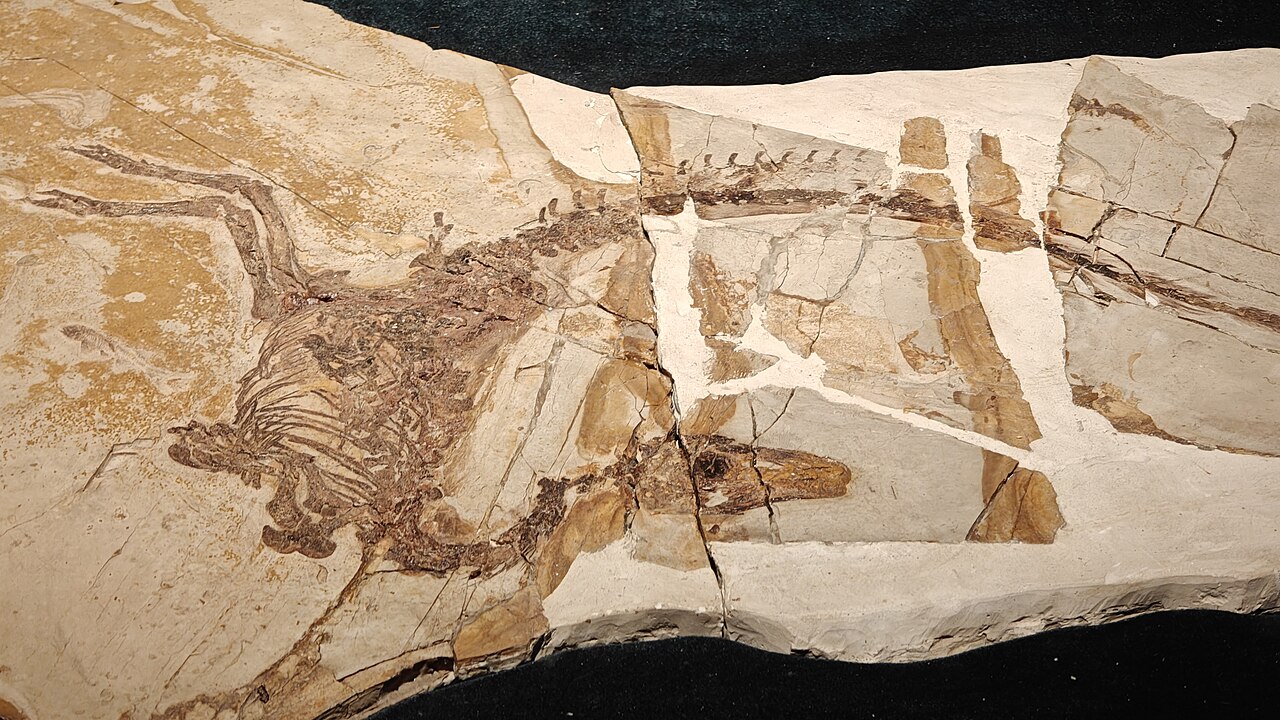
Image context: the cover uses a real photograph of the Sinosauropteryx holotype on temporary display at the Shanghai Natural History Museum, via Wikimedia Commons. It suits this article because the fossil is famous precisely for showing that the earliest widely recognized dinosaur plumage evidence is not a finished wing. It is a body covering wrapped around a small theropod skeleton.[8]
Sinosauropteryx: the first strong point is coverage, not flight
When Sinosauropteryx was described from Liaoning material in the 1990s, the shock was not that paleontologists had found a hidden bird. The shock was that a small non-avian theropod preserved a halo of simple filamentous structures along the head, neck, back, and tail.[2][3] That was enough to change the argument about what feathers were doing deep in dinosaur history.
The safest claim here is also the most important one. Sinosauropteryx does not give us evidence for a modern wing. It gives us evidence for an external covering that was already moving away from naked reptilian skin.[2][3] The Natural History Museum summary is useful because it preserves a key methodological episode: some researchers initially argued that the structures might be collagen fibres rather than feathers, while later work pushed the interpretation back toward true, if basic, feathers.[3] In other words, even the early debate was not really about powered flight. It was about whether the integument had crossed into feather territory at all.
That distinction resets the whole lineage. Once a dinosaur like Sinosauropteryx is accepted as carrying filamentous plumage, feathers stop being a feature that appears only at the threshold of birds. They become part of a broader theropod story. At that stage, the most defensible functions are the less glamorous ones: insulation, visual signaling, and other body-surface jobs that do not require a modern aerodynamic apparatus.[1][2][5] The evidence is direct for the presence of the covering, but more inferential for the precise behavior attached to it. That boundary is worth preserving.
Anchiornis: pennaceous feathers arrive before a clean flight package
The next conceptual jump is not from fuzz to birds. It is from simple covering to more organized feather architecture. Anchiornis is valuable because it makes that jump visible while still refusing to behave like a straightforward early bird.[4][5]
Hu and colleagues described Anchiornis huxleyi as a pre-Archaeopteryx paravian with long feathers on the metatarsus and extensive plumage on both forelimbs and hindlimbs.[4] That combination matters because it shows pennaceous feathers expanding across the body before the lineage has settled on the modern bird solution. The same paper also notes that the remiges in Anchiornis were relatively small, with thin rachises, symmetrical vanes, and blunt ends compared with the more flight-oriented feathers of Microraptor and basal avians.[4] The plumage is elaborate, but the aerodynamic case is still incomplete.
That is exactly the sort of fossil that breaks lazy storytelling. If feathers had evolved only as direct prototypes of modern flight feathers, Anchiornis would be an awkward detour. In the fossil record it looks more like a sign that feather complexity outran flight specialization. The review by Lefevre and colleagues makes this broader point clearly: basal paravians already show wide variation in filamentous and pennaceous structures, and many of those plumage arrangements were not yet obviously adapted for flight.[5]
So the important move in Anchiornis is not that it solves the origin of flight by itself. It does something more useful. It shows that the dinosaur-bird transition included a phase in which feathers were becoming more differentiated and more regionally organized before the shoulder girdle, forelimb proportions, vane asymmetry, and whole-body control system had converged on the avian standard.[4][5]
Microraptor: an airfoil appears before a modern bird does
If Anchiornis shows feather complexity outrunning flight specialization, Microraptor shows that some non-avian dinosaurs had already crossed into real aerodynamic performance without looking like modern birds.[5][6]
The 2013 Nature Communications study on Microraptor is especially useful here because it does not treat the animal as a symbolic "missing link." It asks a harder mechanical question: what could this animal actually do in air? The paper concludes that Microraptor could glide effectively and that it did not need a fully modern wing morphology to do so.[6] Just as important, the authors argue that this result is congruent with a fossil record in which symmetrical "flight" feathers first evolved for non-aerodynamic functions and were later adapted into lifting surfaces.[6]
That paper helps because it tightens the boundary between evidence and reconstruction. The fossil evidence tells us Microraptor had large pennaceous feathers on forelimbs, hindlimbs, and tail.[5][6] The aerodynamic modeling then asks what those structures could plausibly do when attached to a small paravian body. What emerges is not "bird flight completed," but something more interesting: a dinosaur-grade experiment in aerial control and gliding. Feathers have become airfoils here, but the whole organism is still carrying a very non-avian skeleton and a tetrapteryx-style body plan.[5][6]
This is why the middle of the lineage matters so much. If one jumps from Sinosauropteryx straight to Archaeopteryx, the transition can look abrupt. Microraptor slows the film down. It shows that aerodynamic use and avian identity are not the same event. A lineage can discover workable lifting surfaces before it arrives at the modern bird answer.
Archaeopteryx: the hinge is integration, not the invention of feathers
By the time we reach Archaeopteryx, feathers are no longer the novelty. Integration is.[5][7] The Natural History Museum's summary gets the balance right: Archaeopteryx had broad feathered wings and a small body, but it also retained teeth and a long, bony tail, and there is still debate over whether it was fully capable of powered flight or functioned more as a glider.[7]
That is why Archaeopteryx should not be read as the first appearance of feathers in the strong sense. It is better read as one of the first fossils where feathers, forelimb architecture, and the broader avian body plan begin to lock together in a way later birds will elaborate.[5][7] The wings matter, but so do the unresolved edges. Archaeopteryx still sits across categories because the dinosaurian inheritance has not yet been stripped away. The long tail is still there. The teeth are still there. The animal is telling us that flight-related plumage and dinosaurian anatomy coexisted inside the same body.[7]
Seen in that light, the famous fossil becomes less of a magical starting pistol and more of a hinge. Feathers had a long prehistory before Archaeopteryx. What changes here is that feathers are being recruited into a more coherent avian system.
A better way to read feather evolution
The strongest takeaway from this lineage is procedural. When a fossil dinosaur is described as feathered, readers should ask three things in order.
First, what is actually preserved: simple filaments, branched structures, or fully pennaceous feathers?[1][2][5] Second, where on the body are those structures distributed?[3][4][5] Third, does the rest of the anatomy support insulation, display, brooding, maneuvering, gliding, or sustained flapping flight?[5][6][7]
That sequence matters because feather evolution was not a one-purpose march toward birds. It was a prolonged diversification of integumentary structures, later coupled to repeated aerial experiments near the origin of birds.[5] Some plumage clearly was not built for flight. Some was good enough for gliding. Some sat inside bodies that looked half-familiar only because we are imposing neat categories on a messy transition.[4][5][6][7]
So the most accurate sentence is also the least cinematic. Feathers became useful before they became wings, and they became wings before they became a cleanly modern bird wing. Paleontology does not give us one dramatic leap. It gives us a sequence of changing jobs, changing body plans, and narrowing mechanical possibilities. That is a better story because it is the one the fossils actually support.
Sources
- Richard O. Prum and Alan H. Brush, "The Origin and Evolution of Feathers" (Yale Prum Lab publication page with PDF of the classic review).
- Encyclopaedia Britannica, "feathered dinosaur" overview and feather-evolution summary.
- Natural History Museum, "Sinosauropteryx" specimen overview, including the debate over whether its filamentous covering was collagen or true feathers.
- Hu et al., "A pre-Archaeopteryx troodontid theropod from China with long feathers on the metatarsus," Nature (2009) PDF.
- Ulysse Lefevre, Andrea Cau, and Pascal Godefroit, "Feather Evolution in Pennaraptora" (2020) PDF review.
- Gareth Dyke, Roeland de Kat, Colin Palmer, Jacques van der Kindere, Darren Naish, and Bharathram Ganapathisubramani, "Aerodynamic performance of the feathered dinosaur Microraptor and the evolution of feathered flight," Nature Communications (2013).
- Natural History Museum, "Archaeopteryx" overview and discussion of why it remains both bird-like and dinosaurian.
- Wikimedia Commons file page for the photographed Sinosauropteryx holotype image used as the lead visual.