

Mesozoic seas were crowded with reptiles, but they were not crowded with one repeated design. That is the first thing these three videos make clear. Ichthyosaurs, plesiosaurs, and mosasaurs all lived as large marine predators, yet each lineage reached the water through a different anatomical bargain.[4][5][6][7]
That matters because the public category of the "sea monster" hides the real paleontological interest. If you flatten these animals into one mood board of teeth, flippers, and open ocean, you lose the engineering differences that made each group work. Ichthyosaurs pushed hardest toward drag reduction and sustained swimming efficiency.[4][5] Plesiosaurs turned four limbs into a locomotor system more like underwater flight than tail-first cruising.[4][6] Mosasaurs, arriving later, took a squamate body and drove it toward a powerful tail-propelled offshore predator without erasing its lizard ancestry.[4][7]
That is why a video collection is the right mode here. A single clip can make one animal memorable. Three clips, placed in sequence, make a stronger paleontological point: "marine reptile" names an environment, not a single body plan. Watch them together and the sea stops looking like a place that imposed one solution. It starts looking like a place that rewarded multiple solutions under different mechanical constraints.[4]
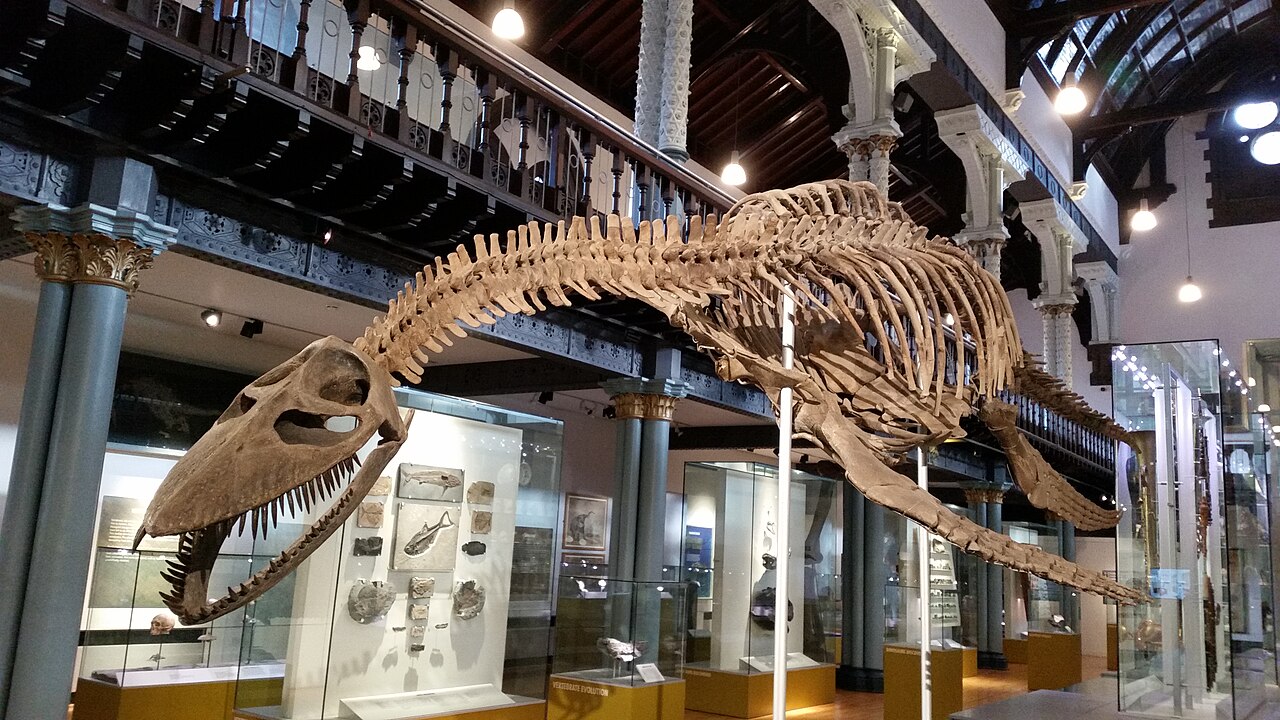
Image context: the cover uses a real Hunterian Museum photograph of a plesiosaur skeleton from Wikimedia Commons. It fits this piece because the long neck, compact trunk, and four broad flippers immediately contradict the lazy idea that all successful marine reptiles simply turned into dolphin copies.[8]
Video 1: ichthyosaurs show what happens when a reptile body is pushed toward open-water efficiency
Oxford University Museum of Natural History's ichthyosaur video is a good opening choice because it starts by stripping away the most common category error: ichthyosaurs were marine reptiles, not dinosaurs.[1] That sounds basic, but it matters because the distinction resets the reader's eye. Once you stop treating ichthyosaurs as just "dinosaurs in water," their body starts to read as a special-purpose swimming instrument assembled inside a reptile lineage.
The key thing to watch for in the Oxford clip is not spectacle but profile: long snout, compact body, fin-like limbs, and a tail system built to move a fast pelagic hunter through open water.[1][5] Gutarra and colleagues quantify why that outline matters. Across ichthyosaur evolution, body-plan change was linked to hydrodynamic drag and the energetic cost of swimming, with later forms converging on lower-drag shapes suited to efficient movement in marine settings.[5] In other words, the fish-like look is not merely superficial resemblance. It is a mechanically meaningful result.
This is where marine-reptile convergence becomes interesting instead of vague. Ichthyosaurs converged strongly with tuna- and dolphin-like streamlining, but that does not mean they became interchangeable with either fish or mammals.[4][5] Their eyes, skull proportions, and limb history still speak from a reptile lineage. The Oxford video is useful because it keeps that dual fact in view. Ichthyosaurs are unmistakably marine specialists, yet the route they took into specialization still preserves the evolutionary memory of where they started.[1][4][5]
Video 2: plesiosaurs refused the fish template and built a four-flipper machine instead
If ichthyosaurs are the body plan most people expect, the Oxford video on Eve the plesiosaur is the corrective.[2] Everything about a plesiosaur looks slightly unreasonable if you carry a single template for marine success into the gallery: the neck is too long, the torso too barrel-like, the limbs too evenly enlarged. Yet that visual strangeness is exactly the point. Plesiosaurs were not failed ichthyosaurs. They were a different answer to the same environment.
Seen next to the ichthyosaur clip, Eve's body clarifies what plesiosaur locomotion was asking of the skeleton. Muscutt and colleagues argue that plesiosaurs used all four flippers in a swimming method that enabled both efficient and effective locomotion, supporting the long-standing idea that these animals moved through the water by a kind of underwater flight rather than by simply wagging a tail behind a stiff body.[6] The long neck therefore has to be read together with the propulsion system. It is not an isolated novelty. It belongs to a whole architecture in which maneuvering, prey approach, and body balance had to be solved differently.
That is why plesiosaurs are so valuable in a collection like this. They prevent the ocean from being read as a one-way funnel toward streamlining.[2][4][6] Marine life rewarded streamlining, yes, but it also left room for an animal whose locomotor logic centered on four enlarged limbs and whose feeding envelope could be organized around a neck that separated the head from the main propulsive body. A museum mount makes that argument almost embarrassingly obvious. The animal looks unlike the fast cruiser that came before it in the article because it was solving a different set of tradeoffs.[2][6]
Video 3: mosasaurs show a late lizard lineage finding power in the tail, not in imitation
The American Museum of Natural History's mosasaur video closes the set well because mosasaurs arrived later and from another starting point again.[3] They were squamates, closer to lizards and snakes than to the earlier marine reptile lineages.[4][7] That ancestry matters because it blocks the lazy reading that Mesozoic seas simply recycled one dominant reptile body across time.
AMNH frames Mosasaurus as a late apex predator, and the paleontological value of that framing lies in the details of how squamate anatomy was reorganized for marine life.[3][7] Lindgren and colleagues, working from an exceptional fossil, argued that mosasaurs had already developed a shark-like tail fluke and a more streamlined body outline than older, more serpentine reconstructions suggested.[7] That is convergence again, but of a different kind from the ichthyosaur case. Mosasaurs did not become carbon copies of earlier marine reptiles. They retained the deeper signature of a lizard body while shifting propulsion toward the tail and improving open-water performance.[3][7]
Placed after the plesiosaur section, the mosasaur video helps the article recover a useful paleontological distinction between similarity and sameness. Similarity tells you that water exerts real physical pressure on body design. Sameness would imply that all lineages eventually collapse into one solution. Mosasaurs say otherwise. They converged enough to become formidable marine predators, but the route remained visibly their own: late, squamate, tail-dominant, and anatomically distinct from both the four-flipper plesiosaur plan and the more fully fish-shaped ichthyosaur profile.[3][4][7]
What the three videos reveal together
Watched in sequence, these clips do more than introduce three famous groups. They break the bad habit of treating marine reptiles as a single parade of interchangeable ocean monsters. The stronger reading is comparative. Ichthyosaurs show how far reptile bodies could be pushed toward drag reduction and efficient cruising.[1][5] Plesiosaurs show that marine success could also be built around four-limb propulsion and a radically different distribution of body length.[2][6] Mosasaurs show that a late lizard lineage could enter the same waters and still arrive at a recognizably separate package of streamlining and power.[3][7]
That comparative view is the real payoff of a paleontology video collection. It keeps the prose honest. "Back to the sea" sounds like one journey when told at poster scale. In the fossil record it was several journeys, each with its own mechanical compromises, anatomical leftovers, and ecological opportunities.[4] The ocean imposed pressure, but it did not dictate one finished answer. That is why these animals remain so instructive. They are not merely sea monsters from different centuries of museum culture. They are evidence that evolution can meet similar physical demands while still producing visibly different bodies.
Sources
- Oxford University Museum of Natural History, "Ichthyosaurs - not dinosaurs, but marine reptiles," YouTube video.
- Oxford University Museum of Natural History, "Spotlight Specimen: Eve the plesiosaur," YouTube video.
- American Museum of Natural History, "Mosasaurus: Lizard King of the Ancient Ocean," YouTube video.
- Ryosuke Motani, "The Evolution of Marine Reptiles," Evolution: Education and Outreach (2009).
- Susana Gutarra, Benjamin C. Moon, Imran A. Rahman, Colin Palmer, Stephan Lautenschlager, Alison J. Brimacombe, and Michael J. Benton, "Effects of body plan evolution on the hydrodynamic drag and energy requirements of swimming in ichthyosaurs," Proceedings of the Royal Society B (2019).
- Luke E. Muscutt, Gareth Dyke, Gabriel D. Weymouth, Darren Naish, Colin Palmer, and Bharathram Ganapathisubramani, "The four-flipper swimming method of plesiosaurs enabled efficient and effective locomotion," Proceedings of the Royal Society B (2017).
- Johan Lindgren, Michael W. Caldwell, Takuya Konishi, and Luis M. Chiappe, "Convergent Evolution in Aquatic Tetrapods: Insights from an Exceptional Fossil Mosasaur," PLOS ONE (2010).
- Wikimedia Commons file page for the Hunterian Museum plesiosaur photograph used as the lead image.